Enterprise AI Market Size, Share, Trends & Growth Opportunities Forecast to 2026 - 2035
Enterprise AI Market Size, Share & Trends Report, 2026–2035
LAST UPDATED: OCTOBER 2026
The global enterprise AI market size was valued at USD 105.83 billion in 2025 and is projected to reach USD 660.75 billion by 2035, growing at a CAGR of 20.1% from 2026 to 2035. The market is estimated at USD 127.10 billion in 2026, with North America holding the largest share and Asia Pacific registering the fastest growth.
Enterprise AI refers to the artificial intelligence software, platforms, models and services that organizations use to automate work, analyze data, predict outcomes and support decisions across their operations. It covers machine learning and deep learning, natural language processing, computer vision, speech recognition, generative AI and, increasingly, autonomous AI agents, all delivered with the security, governance and system integration that businesses need.
Enterprise AI has moved from experimentation to everyday use. Close to nine in ten organizations now use AI in at least one business function, and generative AI copilots and agents are spreading from IT and customer service into finance, HR, marketing, supply chain and software development. The focus for 2026 is scaling these tools across the business and proving a measurable return on investment.
Enterprise AI Market Key Takeaways
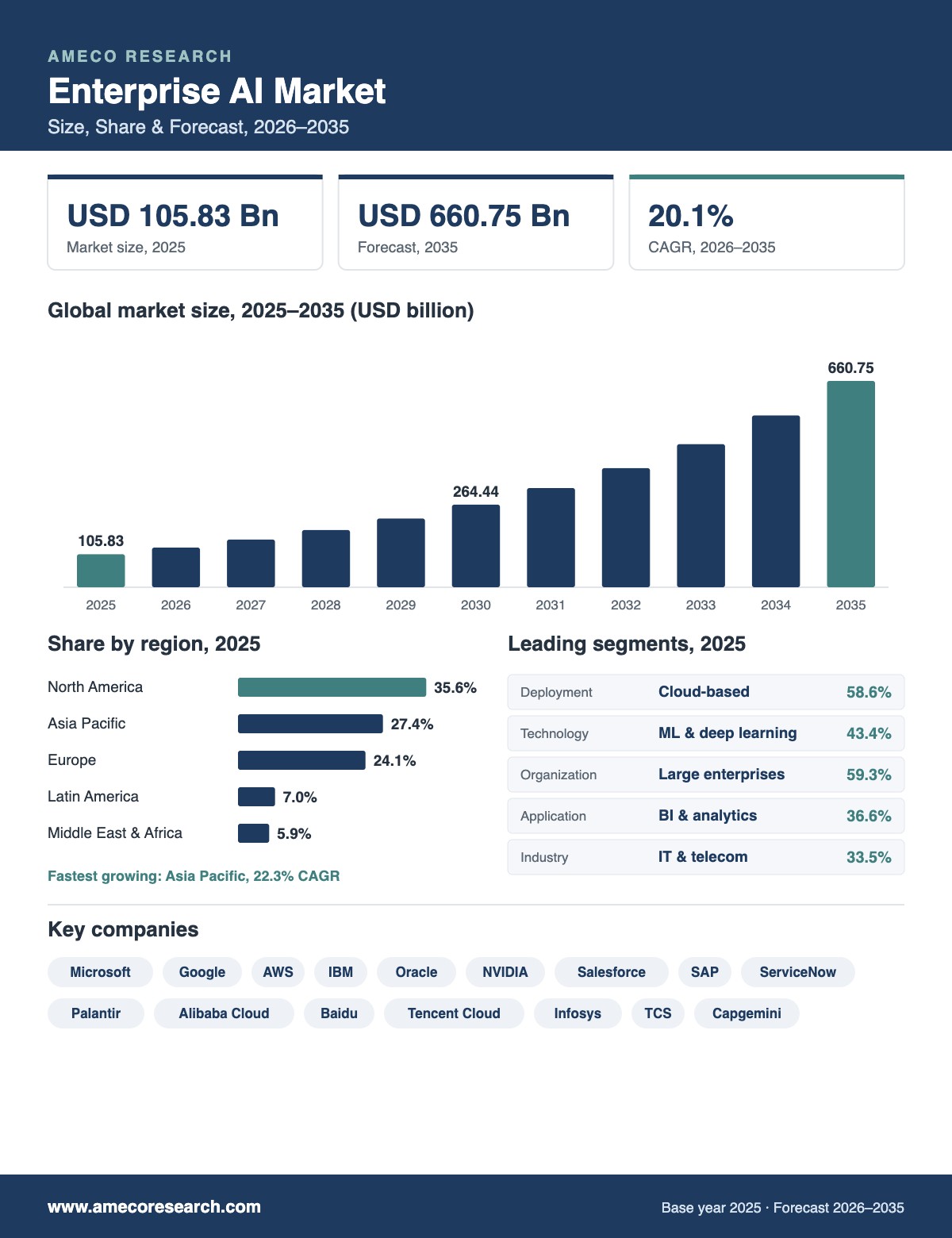 Infographic: Enterprise AI Market Size, Share, Trends & Growth Opportunities Forecast to 2026 - 2035 | Ameco Research
Enterprise AI Market Report Scope
| Report Attribute | Details |
| Enterprise AI Market Size in 2025 | USD 105.83 Billion |
| Enterprise AI Market Size in 2026 | USD 127.10 Billion |
| Enterprise AI Market Forecast by 2035 | USD 660.75 Billion |
| Enterprise AI Market CAGR (2026–2035) | 20.1% |
| Historical Data | 2021–2024 |
| Base Year | 2025 |
| Forecast Period | 2026–2035 |
| Largest Region | North America (35.6% share in 2025) |
| Fastest-Growing Region | Asia Pacific (22.3% CAGR) |
| Segments Covered | Deployment Mode, Technology, Organization Size, Application, Industry Vertical and Region |
| Regional Scope | North America, Europe, Asia Pacific, Latin America, and Middle East & Africa |
| Key Companies Profiled | Microsoft, Google (Alphabet), Amazon Web Services, IBM, Oracle, NVIDIA, Salesforce, SAP, ServiceNow, Palantir Technologies, Alibaba Cloud, Baidu, Tencent Cloud, Infosys, Tata Consultancy Services and Capgemini |
| Report Coverage | Market size and forecast, trends, drivers, restraints, opportunities, segment and regional analysis, competitive landscape, recent developments |
How Big Is the Enterprise AI Market in 2026?
Ameco Research estimates the enterprise AI market at USD 127.10 billion in 2026, up about 20% from USD 105.83 billion in 2025. The market is expected to reach about USD 264.44 billion by 2030 and USD 660.75 billion by 2035, as generative AI, copilots and AI agents become standard features of enterprise software and companies expand AI from single use cases to company-wide platforms.
| Year | Enterprise AI Market Size (USD Billion) |
| 2025 | 105.83 |
| 2026 | 127.10 |
| 2028 | 183.33 |
| 2030 | 264.44 |
| 2032 | 381.43 |
| 2035 | 660.75 |
Latest Enterprise AI Market Trends 2026
AI agents move into production
Enterprises are deploying AI agents that complete multi-step tasks rather than just answer questions. In 2026, about 40% of organizations with more than USD 1 billion in revenue reported scaling AI agents, up from 27% a year earlier, and platforms such as Alibaba’s Wukong now coordinate multiple agents for document, spreadsheet and workflow tasks.
From pilots to enterprise-wide scale
Around 44% of AI-using organizations are now scaling AI across the enterprise, up from 38%, and 56% use it in three or more business functions. Cloud-based platforms have cut typical AI pilot timelines from 4–6 months to about 6–8 weeks.
Investment surge, ROI pressure
Global corporate AI investment more than doubled in 2025 and generative AI investment more than tripled. Yet only about 37% of organizations report a positive profit impact from AI, so buyers are prioritizing use cases with clear, measurable returns.
Copilots across every business function
Generative AI copilots are spreading from IT and customer support into HR, finance, marketing, legal and procurement, helping employees draft content, summarize information and analyze data. About 80% of users report that AI improves their productivity.
Build-versus-buy shifts
AI coding agents and low-code tools are making it easier to build software in-house. Around a third of organizations have skipped at least one software purchase to build their own AI-powered solution instead.
Governance and sovereign AI
New rules such as the EU AI Act and growing data-residency requirements are pushing enterprises toward AI governance platforms, private and hybrid deployments, and regional sovereign AI clouds, especially in finance, healthcare and government.
Enterprise AI Market Dynamics
Growth drivers
- Explosion of enterprise data: companies generate huge volumes of structured and unstructured data that AI can turn into insights, predictions and automated decisions.
- Generative AI and agents: large language models, copilots and agents extend AI to knowledge work in every department.
- Cloud AI platforms: hyperscalers offer ready-to-use models, AI infrastructure and development tools that lower the cost and time of adoption.
- Productivity and cost pressure: AI automation can cut operating costs sharply, for example reducing network operating expenses in telecom by up to 40% and fraud losses in banking by 30–35%.
- Digital transformation programs: AI has become central to modernization strategies in banking, healthcare, retail, manufacturing and government.
Restraints and challenges
- Data privacy and regulation: rules such as GDPR, the EU AI Act and sector regulations raise compliance costs and slow deployments in sensitive industries.
- Data quality and silos: fragmented, poor-quality data limits model accuracy and makes AI harder to scale.
- Unclear ROI: many organizations struggle to move beyond pilots and prove financial value from AI.
- Talent shortages: demand for AI engineers, data scientists and AI governance specialists far exceeds supply.
- Rising compute and operating costs: inference, GPU capacity and model usage fees can make large-scale AI expensive to run.
Opportunities
- Agentic AI platforms that automate end-to-end workflows in customer service, IT operations, finance and supply chain.
- Industry-specific AI for drug discovery, clinical documentation, fraud detection, predictive maintenance and retail personalization.
- SME adoption through affordable, cloud-based AI tools built into everyday business software.
- AI governance, security and observability tools to manage risk as AI use grows.
- Sovereign and on-premises AI for governments and regulated industries that need full control over data.
Enterprise AI Market Segment Analysis
By deployment mode: Why does cloud lead the enterprise AI market?
Cloud-based deployment accounted for 58.6% of revenue in 2025 because cloud platforms provide instant access to AI models, GPUs and development tools without large upfront investment. On-premises deployment held 41.4%, favored by banks, healthcare providers and governments that need tight control over sensitive data.
| Deployment Mode | Share (2025) | Key Highlights |
| Cloud-Based | 58.6% | Fast deployment, scalable compute and access to foundation models |
| On-Premises | 41.4% | Data control and compliance for regulated industries |
By technology
Machine learning and deep learning held the largest share at 43.4% in 2025, powering prediction, forecasting and analytics. Natural language processing, including large language models, accounted for 22.5% and is growing fastest with generative AI adoption, followed by computer vision at 17.6%.
| Technology | Share (2025) | Key Highlights |
| Machine Learning & Deep Learning | 43.4% | Prediction, forecasting, recommendation and analytics |
| Natural Language Processing | 22.5% | LLMs, chatbots, copilots and document processing |
| Computer Vision | 17.6% | Quality inspection, security and retail analytics |
| Speech Recognition & Others | 16.5% | Voice assistants, call analytics and transcription |
By organization size
Large enterprises accounted for 59.3% of revenue in 2025, as they have the data, budgets and technical teams to deploy AI at scale. Small and medium enterprises held 40.7% and are adopting AI quickly through cloud subscriptions and AI features built into business software.
| Organization Size | Share (2025) | Key Highlights |
| Large Enterprises | 59.3% | Enterprise-wide AI platforms and custom models |
| Small & Medium Enterprises | 40.7% | Affordable cloud AI tools and embedded copilots |
By application: What are the top enterprise AI use cases?
Business intelligence and analytics led with 36.6% of revenue in 2025, as companies use AI to forecast demand, analyze performance and support decisions. Security and risk management followed at 18.3%, customer support and experience at 14.4%, marketing at 11.7%, process automation at 11.2% and HR and recruitment at 7.8%.
| Application | Share (2025) | Key Highlights |
| Business Intelligence & Analytics | 36.6% | Forecasting, reporting and decision intelligence |
| Security & Risk Management | 18.3% | Fraud detection, threat detection and compliance |
| Customer Support & Experience | 14.4% | AI chatbots, agents and contact center automation |
| Marketing & Advertising Management | 11.7% | Personalization, content generation and campaign optimization |
| Process Automation | 11.2% | Document processing, finance and IT operations workflows |
| Human Resource & Recruitment | 7.8% | Candidate screening, onboarding and employee support |
By industry vertical
IT and telecommunications accounted for 33.5% of demand in 2025, followed by BFSI at 21.4%, where AI is used for fraud detection, credit scoring and customer service. Healthcare and life sciences held 16.3%, supported by AI in diagnostics, clinical documentation and drug discovery.
| Industry Vertical | Share (2025) | Key Highlights |
| IT & Telecommunications | 33.5% | Network automation, IT operations and software development |
| BFSI | 21.4% | Fraud detection, risk analytics and customer service |
| Healthcare & Life Sciences | 16.3% | Diagnostics, clinical documentation and drug discovery |
| Retail & E-commerce | 12.7% | Personalization, demand forecasting and pricing |
| Automotive & Transportation | 8.2% | Predictive maintenance, logistics and autonomous systems |
| Media & Advertising | 5.1% | Content creation, recommendation and ad targeting |
| Others | 2.8% | Government, education, energy and manufacturing |
Enterprise AI Market Regional Analysis
| Region | Share (2025) | Outlook |
| North America | 35.6% | Largest market; U.S. AI platform providers and early enterprise adoption |
| Asia Pacific | 27.4% | Fastest-growing at a 22.3% CAGR; China, India, Japan, South Korea |
| Europe | 24.1% | EU AI Act, sovereign AI and strong industrial AI demand |
| Latin America | 7.0% | Growing adoption in Brazil and Mexico |
| Middle East & Africa | 5.9% | National AI strategies in the UAE and Saudi Arabia |
Why does North America dominate the enterprise AI market?
North America accounted for about 35.6% of global revenue in 2025. The United States is home to the largest AI platform providers, including Microsoft, Google, Amazon Web Services, IBM, Oracle, NVIDIA, Salesforce and ServiceNow, and its banks, healthcare systems, retailers and telecom operators are among the earliest large-scale adopters of generative AI and AI agents.
What makes Asia Pacific the fastest-growing region?
Asia Pacific held about 27.4% of the market in 2025 and is forecast to grow at a 22.3% CAGR through 2035. China is investing heavily in AI, with Alibaba committing more than USD 50 billion to cloud and AI development and national plans targeting a very large domestic AI industry by 2030. India’s IT services giants, Japan’s and South Korea’s industrial groups, and Southeast Asia’s digital economies are also accelerating enterprise AI adoption.
How is Europe developing?
Europe represented about 24.1% of revenue in 2025. The EU AI Act is shaping how companies build and deploy AI, increasing demand for governance, transparency and risk management tools. Germany, the U.K. and France lead adoption, particularly in manufacturing, automotive, finance and public services, while sovereign AI and data-residency requirements are encouraging regional cloud and on-premises deployments.
Enterprise AI Market Segmentation
Enterprise AI Market Leading Companies
The enterprise AI market is led by cloud and AI platform providers, enterprise software vendors that embed AI into their applications, AI chip makers, and IT services firms that help companies design, integrate and run AI at scale. Competition centers on model quality, AI agents and copilots, data integration, security and governance, industry-specific solutions and total cost of ownership.
Microsoft · Google (Alphabet) · Amazon Web Services · IBM · Oracle · NVIDIA · Salesforce · SAP · ServiceNow · Palantir Technologies · Alibaba Cloud · Baidu · Tencent Cloud · Infosys · Tata Consultancy Services · Capgemini
Recent developments
- April 2026: Thoma Bravo and Google Cloud announced a strategic partnership giving Thoma Bravo’s portfolio software companies access to Google Cloud’s AI platform, including Gemini models and Gemini Enterprise.
- March 2026: Alibaba launched Wukong, an enterprise AI agent platform that coordinates multiple AI agents to complete tasks such as editing documents and updating spreadsheets.
- 2026: The Stanford AI Index reported that global corporate AI investment more than doubled in 2025, with generative AI investment more than tripling and 88% of organizations using AI in at least one function.
Enterprise AI Market: Frequently Asked Questions
How big is the enterprise AI market?
The global enterprise AI market was valued at USD 105.83 billion in 2025 and is estimated at USD 127.10 billion in 2026. Ameco Research projects it to reach USD 660.75 billion by 2035, growing at a CAGR of 20.1% from 2026 to 2035.
What is the growth rate of the enterprise AI market?
The enterprise AI market is expected to grow at a CAGR of 20.1% between 2026 and 2035, more than six times its 2025 size, as companies move from AI pilots to enterprise-wide deployment of generative AI, copilots and AI agents.
What is enterprise AI?
Enterprise AI is the use of artificial intelligence software, platforms and services inside large and mid-sized organizations to automate processes, analyze data, support decisions and improve customer and employee experiences. It includes machine learning, natural language processing, computer vision, generative AI and AI agents, delivered with the security, governance and integration that businesses require.
What is the difference between enterprise AI and consumer AI?
Consumer AI tools are built for individuals, while enterprise AI is designed to work with company data and systems at scale. Enterprise AI adds data privacy controls, access management, compliance, auditability and integration with business applications such as ERP, CRM and HR software.
How many companies use AI in 2026?
AI is now mainstream in business. Industry surveys in 2026 show that close to nine in ten organizations use AI in at least one business function, and around 44% are scaling AI across the enterprise. However, only about a third report a measurable positive impact on profits, showing that many companies are still moving from experimentation to value.
What are AI agents in the enterprise?
Enterprise AI agents are AI systems that can plan and carry out multi-step tasks, such as handling customer requests, updating documents and spreadsheets, writing code or processing invoices, with limited human input. About 40% of large organizations with more than USD 1 billion in revenue reported scaling AI agents in 2026.
Which region leads the enterprise AI market?
North America leads with about 35.6% of global revenue in 2025, driven by U.S. technology companies and early adoption across finance, healthcare and retail. Asia Pacific is the fastest-growing region at about a 22.3% CAGR, led by China, India, Japan and South Korea.
Who are the key players in the enterprise AI market?
Leading companies include Microsoft, Google (Alphabet), Amazon Web Services, IBM, Oracle, NVIDIA, Salesforce, SAP, ServiceNow, Palantir Technologies, Alibaba Cloud, Baidu, Tencent Cloud, Infosys, Tata Consultancy Services and Capgemini.
Related ICT and Media Market Reports
- Data Center Cooling Market Size, Share, Trends & Growth Opportunities Forecast to 2026 - 2035
- AI Data Center Market Size, Share, Trends & Growth Opportunities Forecast to 2026 - 2035
- Physical AI Market Size and Growth Opportunities and Forecast till 2026 - 2035
- Corporate eLearning Market Size, Share, Trends & Growth Opportunities Forecast to 2026 - 2035
- Over the Top (OTT) Services Market Growth Opportunities and Forecast till 2032