Humanoid Robot Market Size, Share, Trends & Growth Opportunities Forecast to 2026 - 2035
Humanoid Robot Market Size, Share & Trends Report, 2026–2035
LAST UPDATED: NOVEMBER 2026
The global humanoid robot market size was valued at USD 2.01 billion in 2025 and is projected to reach USD 20.11 billion by 2035, growing at a CAGR of 25.9% from 2026 to 2035. The market is estimated at USD 2.53 billion in 2026, with North America holding the largest share and Asia Pacific registering the fastest growth.
A humanoid robot is a robot with a human-like form, typically a head, torso and two arms on either two legs or a wheeled base. Because factories, warehouses, hospitals and homes are built for people, a human-shaped robot can use the same doors, stairs, shelves and tools without changes to the workplace. Today’s humanoids combine electric actuators, dexterous hands, cameras and force sensors, high-density batteries and AI models that let them perceive their surroundings, plan and act.
The humanoid robot market is moving from research labs and demonstrations into early commercial deployment. Automakers, logistics firms and electronics makers are piloting humanoids for repetitive, physically demanding work, while advances in robot foundation models, often called physical AI, are making the robots faster to train and more adaptable to new tasks.
Humanoid Robot Market Key Takeaways
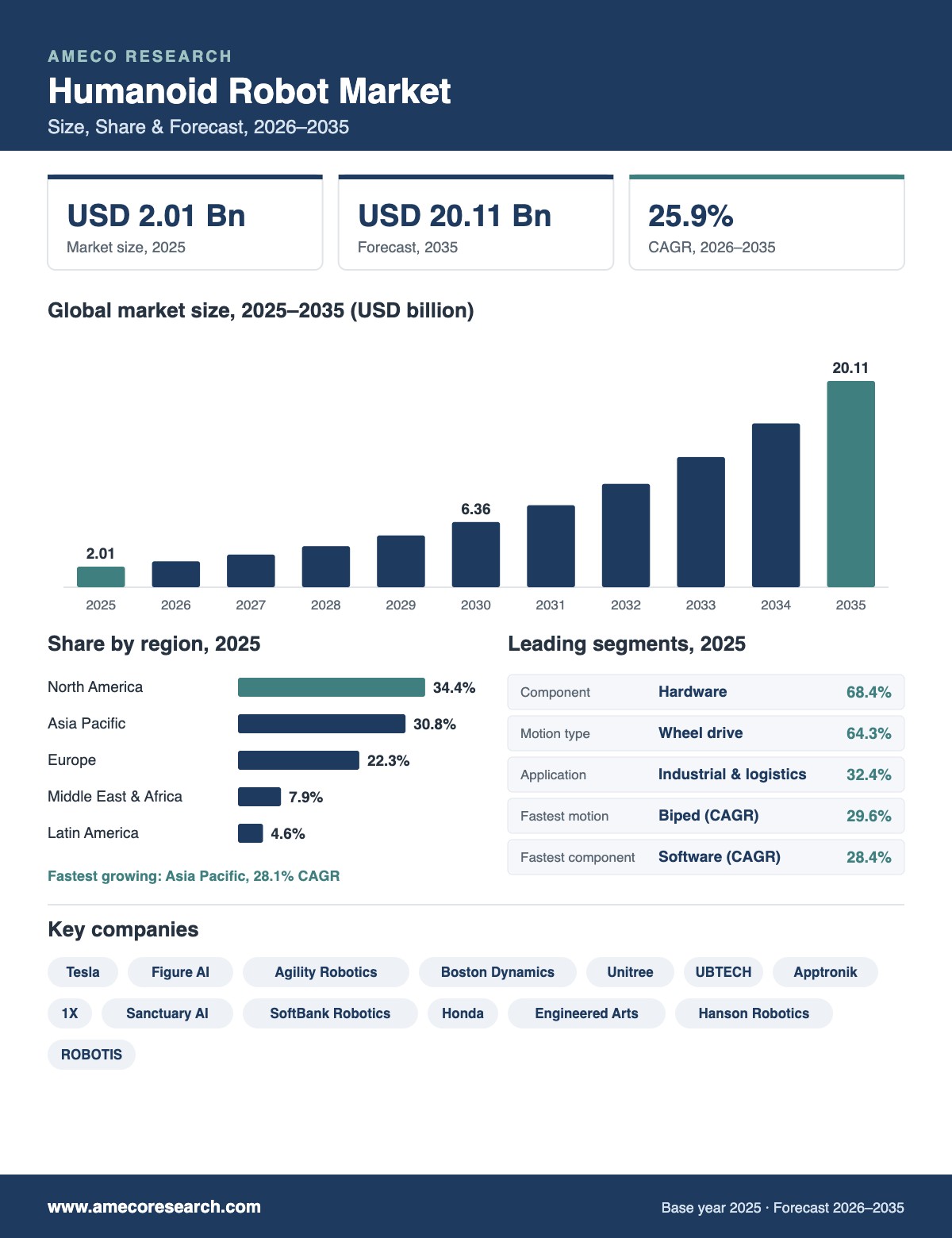 Infographic: Humanoid Robot Market Size, Share, Trends & Growth Opportunities Forecast to 2026 - 2035 | Ameco Research
Humanoid Robot Market Report Scope
| Report Attribute | Details |
| Humanoid Robot Market Size in 2025 | USD 2.01 Billion |
| Humanoid Robot Market Size in 2026 | USD 2.53 Billion |
| Humanoid Robot Market Forecast by 2035 | USD 20.11 Billion |
| Humanoid Robot Market CAGR (2026–2035) | 25.9% |
| Historical Data | 2021–2024 |
| Base Year | 2025 |
| Forecast Period | 2026–2035 |
| Largest Region | North America (34.4% share in 2025) |
| Fastest-Growing Region | Asia Pacific (28.1% CAGR) |
| Segments Covered | Component, Motion Type, Application and Region |
| Regional Scope | North America, Europe, Asia Pacific, Latin America, and Middle East & Africa |
| Key Companies Profiled | Tesla, Figure AI, Agility Robotics, Boston Dynamics (Hyundai Motor Group), Unitree Robotics, UBTECH Robotics, Apptronik, 1X Technologies, Sanctuary AI, SoftBank Robotics, Honda, Engineered Arts, Hanson Robotics, ROBOTIS and Kawada Robotics |
| Report Coverage | Market size and forecast, unit shipments and production capacity, pricing, trends, drivers, restraints, opportunities, segment and regional analysis, competitive landscape, recent developments |
How Big Is the Humanoid Robot Market in 2026?
Ameco Research estimates the humanoid robot market at USD 2.53 billion in 2026, up about 26% from USD 2.01 billion in 2025, as the first commercial production lines from Boston Dynamics, Unitree, Agility Robotics and others ramp up. The market is expected to reach about USD 6.36 billion by 2030 and USD 20.11 billion by 2035 as unit costs fall and deployments spread from pilots to fleets.
| Year | Humanoid Robot Market Size (USD Billion) |
| 2025 | 2.01 |
| 2026 | 2.53 |
| 2027 | 3.19 |
| 2028 | 4.01 |
| 2030 | 6.36 |
| 2032 | 10.08 |
| 2035 | 20.11 |
Latest Humanoid Robot Market Trends 2026
Mass production begins
Boston Dynamics began commercial production of its new all-electric Atlas at CES in January 2026, with all 2026 units already committed and deployment planned across Hyundai Motor Group plants. Hyundai’s U.S. investment plan includes a robotics factory able to build 30,000 robots a year. In China, Unitree shipped about 5,500 humanoid units in 2025 and targets 10,000 to 20,000 in 2026.
Car factories lead real-world pilots
Figure AI’s Figure 02 completed an 11-month pilot at BMW’s Spartanburg plant, logging more than 1,250 operating hours and loading over 90,000 sheet-metal parts, and BMW plans to extend humanoid use to its Leipzig plant. Agility Robotics’ Digit has logged more than 65,000 operating hours across customers including GXO, Schaeffler, Toyota and Mercado Libre.
Physical AI and robot foundation models
Humanoids are increasingly powered by large vision-language-action models that let them learn tasks from demonstrations and video. Google DeepMind is integrating Gemini Robotics models into Atlas, NVIDIA offers its Isaac GR00T platform to humanoid makers, and Figure, Tesla and others train their own models.
Record investment
Figure AI raised more than USD 1 billion in its Series C round in September 2025 at a USD 39 billion post-money valuation. Unitree raised funds at a USD 1.3 billion valuation in 2025 from ByteDance, Alibaba and Tencent and has been approved for a STAR Market listing in Shanghai.
Falling prices widen the market
Chinese makers are pushing prices down sharply, with Unitree’s G1 starting at around USD 16,000. Cheaper actuators, sensors and batteries, and robot-as-a-service leasing, are making humanoids accessible to research labs, schools and smaller businesses.
Gap between targets and reality
Several makers have missed early targets. Tesla aimed for about 5,000 Optimus robots in 2025 but output was reported at only a few hundred, and its planned Fremont production line had not started by mid-2026. This shows how hard it is to scale reliable, safe humanoids.
Humanoid Robot Market Dynamics
Growth drivers
- Labor shortages: aging populations and hard-to-fill manual jobs in manufacturing, logistics and care are pushing employers toward automation. ManpowerGroup found that about 75% of employers reported difficulty filling roles in 2024.
- AI breakthroughs: robot foundation models, better perception and simulation-based training make humanoids far more capable and quicker to deploy.
- Lower hardware costs: mass-produced actuators, sensors and batteries, largely from China’s supply chain, are cutting unit prices.
- Human-built environments: humanoids can work in existing facilities without costly redesigns, unlike traditional fixed automation.
- Government support: China, Japan, South Korea and the U.S. are funding robotics and physical AI as strategic industries.
Restraints and challenges
- High upfront cost: industrial humanoids remain expensive, and return on investment is still unproven for many tasks.
- Reliability and speed: humanoids are often slower than people or fixed automation and need more uptime and robustness.
- Safety and standards: safety rules for mobile, two-legged robots working near people are still being developed.
- Battery life and dexterity: limited runtime and hand dexterity restrict the tasks humanoids can handle.
- Workforce concerns: fears about job losses, union opposition and public perception can slow adoption.
Opportunities
- Automotive and electronics manufacturing, where pilots are already proving value.
- Warehouse and logistics automation for tote moving, picking and trailer unloading.
- Healthcare and elder care, including patient support, mobility help and medication reminders.
- Home robots for household chores as prices fall.
- Robot-as-a-service models that lower upfront costs for smaller businesses.
Humanoid Robot Market Segment Analysis
By component: Hardware or software?
Hardware, including actuators, motors, reducers, dexterous hands, sensors, batteries and control units, accounted for 68.4% of revenue in 2025. Software, including AI models, perception, motion planning and fleet management, held 31.6% and is growing faster at about a 28.4% CAGR, as value shifts toward the intelligence that lets robots learn new tasks.
| Component | Share (2025) | Key Highlights |
| Hardware | 68.4% | Largest; actuators, hands, sensors, batteries and computing |
| Software | 31.6% | Faster-growing at 28.4% CAGR; AI models, perception and fleet software |
By motion type: Wheeled or biped?
Wheel-drive humanoids, which pair a human-like upper body with a wheeled base, held 64.3% of revenue in 2025, as they are more stable, efficient and easier to certify for service and retail settings. Biped humanoids accounted for 35.7% and are growing faster, at about a 29.6% CAGR, as legged robots such as Atlas, Figure, Digit and Optimus move into factories and warehouses.
| Motion Type | Share (2025) | Key Highlights |
| Wheel Drive | 64.3% | Largest; stable and efficient for service, retail and hospitality |
| Biped | 35.7% | Faster-growing at 29.6% CAGR; factory and warehouse humanoids |
By application: Where are humanoid robots used most?
Industrial and logistics applications led with 32.4% of revenue in 2025 and are also the fastest-growing, at about a 28.9% CAGR, driven by automotive plants and warehouses. Healthcare and personal assistance held 22.8%, followed by hospitality at 12.7% and education and entertainment at 12.2%.
| Application | Share (2025) | Key Highlights |
| Industrial & Logistics | 32.4% | Largest and fastest-growing at 28.9% CAGR; car plants and warehouses |
| Healthcare & Personal Assistance | 22.8% | Patient support, elder care and rehabilitation |
| Hospitality | 12.7% | Reception, guidance and customer service |
| Education & Entertainment | 12.2% | Teaching, research platforms and events |
| Research & Space Exploration | 9.1% | University labs and space agency programs |
| Others | 10.8% | Retail, security and household use |
Humanoid Robot Market Regional Analysis
| Region | Share (2025) | Outlook |
| North America | 34.4% | Largest; about USD 0.69 billion in 2025; Tesla, Figure, Agility, Boston Dynamics |
| Asia Pacific | 30.8% | Fastest-growing at 28.1% CAGR; China, Japan, South Korea |
| Europe | 22.3% | Automotive pilots and healthcare robotics |
| Middle East & Africa | 7.9% | Hospitality, healthcare and smart city programs |
| Latin America | 4.6% | Logistics, hospitality and research use |
Why does North America dominate the humanoid robot market?
North America accounted for about 34.4% of global revenue in 2025, or about USD 0.69 billion. The U.S. is home to many of the most advanced humanoid developers, including Tesla, Figure AI, Agility Robotics, Boston Dynamics and Apptronik, as well as the AI chip and model companies that power them. Deep venture funding and early pilots at automakers and logistics firms support the region’s lead.
What makes Asia Pacific the fastest-growing region?
Asia Pacific held about 30.8% of the market in 2025 and is forecast to grow at a 28.1% CAGR. China has dozens of humanoid makers, including Unitree and UBTECH, strong government support and a low-cost supply chain for actuators, sensors and batteries. Japan, home to pioneers such as Honda and Kawada Robotics, and South Korea, through Hyundai and ROBOTIS, are investing heavily to address aging workforces.
How is Europe developing?
Europe represented about 22.3% of revenue in 2025. German carmakers BMW and Mercedes-Benz are among the leading pilot customers, while the U.K.’s Engineered Arts and other European developers focus on social and service humanoids. Strict safety and machinery rules are shaping how humanoids are certified for use near people.
Humanoid Robot Market Segmentation
Humanoid Robot Market Leading Companies
The humanoid robot market brings together well-funded start-ups, carmakers, Chinese volume producers and long-established robotics firms. Competition centers on AI capability and learning speed, dexterity and reliability, unit cost and production scale, safety, and proven deployments with major customers.
Tesla · Figure AI · Agility Robotics · Boston Dynamics (Hyundai Motor Group) · Unitree Robotics · UBTECH Robotics · Apptronik · 1X Technologies · Sanctuary AI · SoftBank Robotics · Honda · Engineered Arts · Hanson Robotics · ROBOTIS · Kawada Robotics
Recent developments
- 2026: BMW announced plans to extend humanoid robot deployment to its Leipzig plant from summer 2026, after Figure AI’s pilot at Plant Spartanburg.
- April 2026: Tesla said Optimus production at its Fremont factory was slated to begin in late July or August 2026; by mid-2026 production had not yet started.
- January 2026: Boston Dynamics began commercial production of its new electric Atlas at CES 2026 and announced a partnership with Google DeepMind to integrate Gemini Robotics models.
- November 2025: Figure AI reported that Figure 02 completed an 11-month pilot at BMW’s Spartanburg plant, loading more than 90,000 parts across over 1,250 operating hours.
- September 2025: Figure AI raised more than USD 1 billion in Series C funding at a USD 39 billion post-money valuation.
- June 2025: Unitree Robotics raised funds at a USD 1.3 billion valuation from investors including ByteDance, Alibaba and Tencent.
Humanoid Robot Market: Frequently Asked Questions
How big is the humanoid robot market?
The global humanoid robot market was valued at USD 2.01 billion in 2025 and is estimated at USD 2.53 billion in 2026. Ameco Research projects it to reach USD 20.11 billion by 2035, growing at a CAGR of 25.9% from 2026 to 2035.
What is a humanoid robot?
A humanoid robot is a robot built with a human-like body, usually with a head, torso, two arms and either two legs or a wheeled base. This shape lets it work in spaces and with tools designed for people. Modern humanoids combine motors and actuators, cameras and other sensors, batteries and AI software that lets them see, plan and carry out tasks such as moving totes, loading parts or assisting people.
What is the growth rate of the humanoid robot market?
The market is expected to grow at a CAGR of 25.9% from 2026 to 2035, driven by labor shortages, rapid advances in AI foundation models for robots, falling hardware costs, large investments from automakers and tech companies, and government support in China, the U.S., Japan and South Korea.
How much does a humanoid robot cost?
Prices vary widely by capability. Entry-level research and education humanoids such as Unitree’s G1 start at around USD 16,000, while full-size industrial humanoids from companies such as Agility Robotics, Figure AI, Apptronik and Boston Dynamics are typically sold or leased to businesses at much higher prices, often through robot-as-a-service contracts.
Which companies make humanoid robots?
Leading humanoid robot makers include Tesla, Figure AI, Agility Robotics, Boston Dynamics (Hyundai Motor Group), Unitree Robotics, UBTECH Robotics, Apptronik, 1X Technologies, Sanctuary AI, SoftBank Robotics, Honda, Engineered Arts, Hanson Robotics, ROBOTIS and Kawada Robotics.
Where are humanoid robots used today?
Industrial and logistics work is the largest application, with about 32.4% of revenue in 2025, including tote handling in warehouses and parts loading in car plants such as BMW’s Spartanburg factory. Humanoids are also used in healthcare and personal assistance, hospitality, education and entertainment, and research and space exploration.
Which region leads the humanoid robot market?
North America leads with about 34.4% of revenue in 2025, or about USD 0.69 billion, home to Tesla, Figure AI, Agility Robotics, Boston Dynamics and Apptronik. Asia Pacific is the fastest-growing region at about a 28.1% CAGR, led by China’s large-scale production, Japan and South Korea.
Are humanoid robots in mass production?
Production is starting to scale. Unitree shipped about 5,500 humanoid units in 2025 and targets 10,000 to 20,000 in 2026. Boston Dynamics began commercial production of its new electric Atlas in January 2026, with all 2026 units already committed, and Hyundai plans a U.S. robotics factory able to build 30,000 robots a year. Agility Robotics’ RoboFab in Oregon is designed for up to 10,000 Digit robots a year.
Related Electronics & Semiconductor Market Reports
- Android TV Market Growth Opportunities and Forecast till 2032
- Flexible Electronics Market Size and Growth Opportunities and Forecast till 2026 - 2035
- Circuit Breaker Market Growth Opportunities and Forecast till 2032
- Flexible Display Market Growth Opportunities and Forecast till 2032
- Printed Electronics Market Growth Opportunities and Forecast till 2032