Liquid Nitrogen Cryopreservation Market Size and Growth Opportunities and Forecast till 2026 - 2035
Liquid Nitrogen Cryopreservation Market Size, Share & Trends Report, 2026–2035
LAST UPDATED: OCTOBER 2026
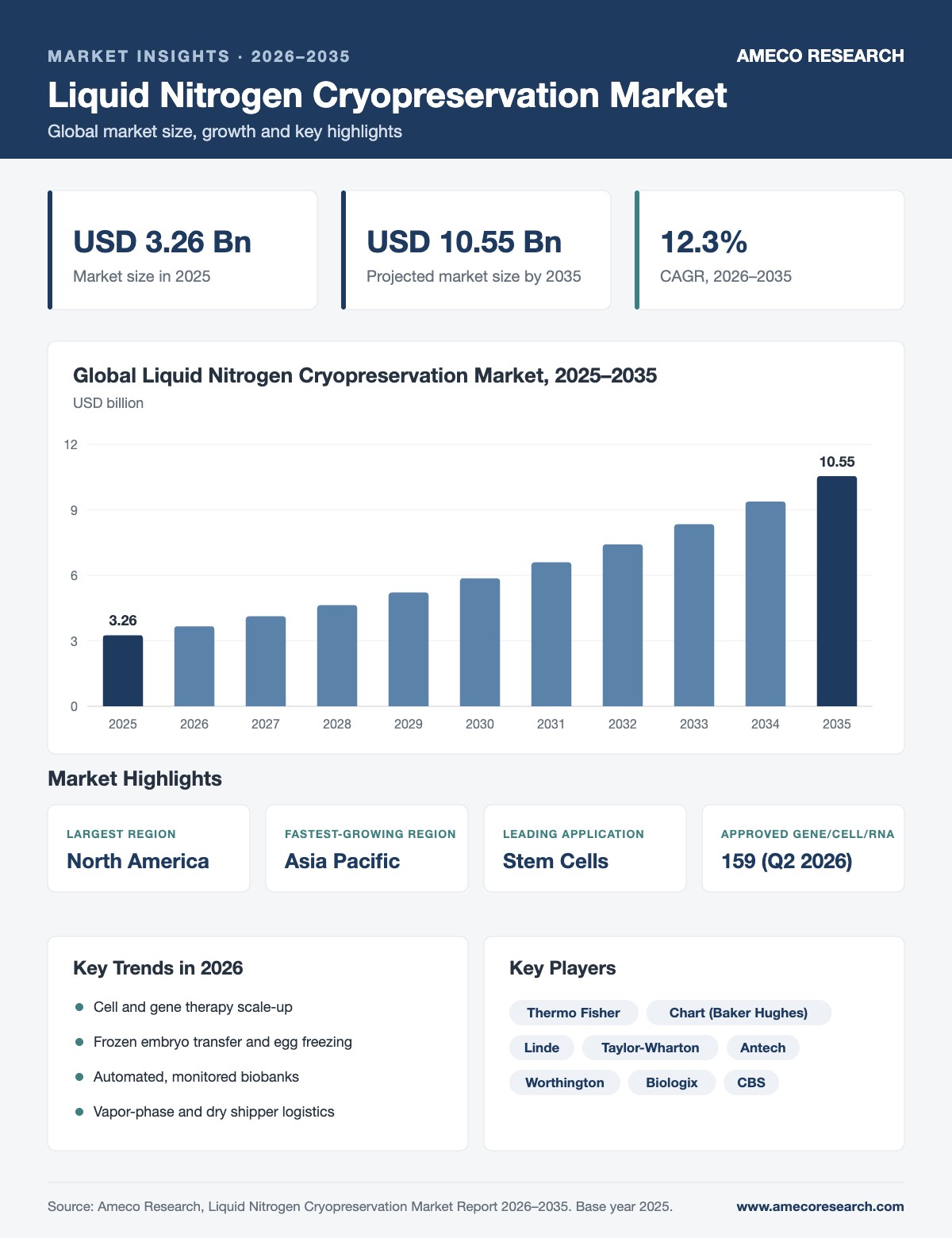
The global Liquid Nitrogen Cryopreservation Market size was valued at USD 3.26 billion in 2025 and is projected to reach USD 10.55 billion by 2035, growing at a CAGR of 12.3% from 2026 to 2035. Growth is driven by the rapid expansion of cell and gene therapies, wider use of frozen embryo transfer and egg freezing in fertility care, growing biobanks and stem cell banks, and investment in automated, monitored cold-chain storage.
Liquid nitrogen cryopreservation is the long-term storage of cells, tissues, embryos, gametes and other biological samples at ultra-low temperatures, typically in liquid nitrogen at -196°C or in its vapor phase below -150°C. At these temperatures biological activity effectively stops, so samples can be stored for years and revived when needed. A typical workflow uses cryoprotective agents, controlled-rate freezers, cryovials or straws, liquid nitrogen freezers or dewars, dry shippers and temperature-monitoring systems.
Liquid Nitrogen Cryopreservation Market Key Takeaways
Liquid Nitrogen Cryopreservation Market Report Scope
| Report Attribute | Details |
| Liquid Nitrogen Cryopreservation Market Size in 2025 | USD 3.26 Billion |
| Liquid Nitrogen Cryopreservation Market Forecast by 2035 | USD 10.55 Billion |
| Liquid Nitrogen Cryopreservation Market CAGR (2026–2035) | 12.3% |
| Analysis Period | 2023–2035 |
| Base Year | 2025 |
| Forecast Period | 2026–2035 |
| Segments Covered | By Application, By End-Use, and By Region |
| Regional Scope | North America, Europe, Asia Pacific, Latin America, and Middle East & Africa |
| Key Companies Profiled | Abeyance Cryo Solutions, Antech Group Inc., Biologix Group Ltd., Custom Biogenic Systems, Chart Industries (Baker Hughes), Linde, Taylor-Wharton, Thermo Fisher Scientific Inc., and Worthington Enterprises |
| Report Coverage | Market Trends, Drivers, Restraints, Opportunities, Competitive Analysis, Player Profiling, Regulation Analysis |
Latest Liquid Nitrogen Cryopreservation Market Trends (2026)
Cell and gene therapies scale up
Cell and gene therapies depend on cryopreservation at every step, from starting material and cell banks to finished doses shipped to hospitals. According to the ASGCT and Citeline, 159 gene, cell and RNA therapies were approved worldwide as of Q2 2026, with about 4,500 more in development. Each new approved therapy adds demand for liquid nitrogen freezers, controlled-rate freezers and cryogenic shippers.
Frozen embryo transfer and egg freezing become routine
Fertility care is a major user of liquid nitrogen storage. ESHRE data presented in July 2026 show that frozen embryo transfers made up about 35% of more than 1.15 million assisted reproduction cycles in Europe in 2023. Elective egg freezing and "freeze-all" IVF strategies are adding to long-term storage needs.
Automated and monitored biobanks
Biobanks, stem cell banks and pharma companies are moving to automated liquid nitrogen storage with barcode tracking, remote alarms and continuous temperature logging. These systems reduce handling errors, protect irreplaceable samples and support regulatory compliance.
Vapor-phase storage and safer handling
Vapor-phase liquid nitrogen storage is gaining share over liquid-phase storage because it lowers the risk of cross-contamination between samples. Oxygen-depletion monitors, auto-fill systems and better operator training are becoming standard to improve safety.
Cold-chain logistics for cell therapies
Dry shippers that hold liquid nitrogen in an absorbent material, along with GPS and temperature tracking, are critical for moving patient cells between hospitals and manufacturing sites. Demand is rising as more autologous therapies such as CAR-T reach patients worldwide.
Industry consolidation
Major cryogenic equipment makers are being folded into larger groups. Baker Hughes completed its acquisition of Chart Industries in July 2026, making Chart, which owns well-known cryobiology brands, its third operating segment.
Liquid Nitrogen Cryopreservation Market Dynamics
Growth drivers
- Rapid growth of cell and gene therapy development and commercialization
- Rising use of IVF, frozen embryo transfer and egg freezing
- Expansion of biobanks, cord blood banks and stem cell banks
- Growing pharmaceutical and biotech research using cell lines and biological samples
- Liquid nitrogen's ability to hold ultra-low temperatures without electricity
Restraints and challenges
- High cost of cryogenic freezers, automation and ongoing liquid nitrogen supply
- Safety risks such as asphyxiation, cold burns and sample contamination
- Strict regulations and quality requirements for clinical samples
- Shortage of trained staff for cryogenic handling
Opportunities
Key opportunities include automated biobanking systems, digital sample tracking, cryogenic logistics for cell therapies, fertility preservation services, and new biobanks and cell therapy centers in Asia Pacific, the Middle East and Latin America.
Liquid Nitrogen Cryopreservation Market Segment Analysis
By application
The market is segmented into stem cells; sperm, semen and testicular tissues; embryos and oocytes; and others. Stem cells hold the largest share thanks to their use in research, cord blood banking and cell therapy manufacturing. Embryos and oocytes are a fast-growing segment as frozen embryo transfer and elective egg freezing become more common.
By end-use
End users include stem cell banks, stem cell research laboratories, biotechnology and pharmaceutical organizations, research and academic institutes, and contract research organizations. Biotechnology and pharmaceutical companies are a major and fast-growing segment, driven by cell and gene therapy pipelines, while stem cell banks remain large users of long-term storage.
Liquid Nitrogen Cryopreservation Market Regional Analysis
North America is the largest market, led by the United States, which has the largest cell and gene therapy industry, many biobanks and fertility clinics, and strong research funding.
Europe is a major market thanks to widespread IVF, frozen embryo transfer and well-established biobank networks. Asia Pacific is expected to grow the fastest, driven by biotech investment in China, Japan, South Korea and India, expanding stem cell banking and rising IVF demand.
Latin America and the Middle East & Africa are smaller but growing markets, supported by new fertility clinics, cord blood banks and healthcare investment.
Liquid Nitrogen Cryopreservation Market Segmentation
Liquid Nitrogen Cryopreservation Market Leading Companies
The liquid nitrogen cryopreservation market includes cryogenic equipment makers, industrial gas suppliers and life-science tool companies. They compete on storage capacity, holding time, safety, monitoring and automation features, and service networks. Key players profiled in this report include Abeyance Cryo Solutions, Antech Group Inc., Biologix Group Ltd., Custom Biogenic Systems, Chart Industries (Baker Hughes), Linde, Taylor-Wharton, Thermo Fisher Scientific Inc., and Worthington Enterprises.
Thermo Fisher ScientificChart Industries (Baker Hughes)LindeTaylor-WhartonAntech GroupBiologixCustom Biogenic SystemsAbeyance Cryo SolutionsWorthington Enterprises
Recent developments
Liquid Nitrogen Cryopreservation Market: Frequently Asked Questions
How big is the liquid nitrogen cryopreservation market?
The global liquid nitrogen cryopreservation market was valued at USD 3.26 billion in 2025 and is expected to reach USD 10.55 billion by 2035.
What is the growth rate of the liquid nitrogen cryopreservation market?
The liquid nitrogen cryopreservation market is projected to grow at a CAGR of 12.3% from 2026 to 2035.
What is driving growth in the liquid nitrogen cryopreservation market?
Key drivers are the growth of cell and gene therapies, rising use of IVF and egg freezing, expanding biobanks and stem cell banks, and growing biotech research.
At what temperature are samples stored in liquid nitrogen?
Liquid nitrogen keeps samples at about -196°C in the liquid phase, while vapor-phase storage typically holds them below -150°C, which is cold enough to stop biological activity.
Which region leads the liquid nitrogen cryopreservation market?
North America is the largest market, while Asia Pacific is expected to grow the fastest.
What are the latest trends in liquid nitrogen cryopreservation?
The main 2026 trends are cell and gene therapy scale-up, frozen embryo transfer and egg freezing, automated and monitored biobanks, vapor-phase storage and cryogenic logistics.
Who are the key players in the liquid nitrogen cryopreservation market?
Leading companies include Thermo Fisher Scientific, Chart Industries (Baker Hughes), Linde, Taylor-Wharton, Antech Group, Biologix, Custom Biogenic Systems, Abeyance Cryo Solutions and Worthington Enterprises.
Related Chemical & Material Market Reports
- Didecyldimethylammonium Chloride Market Size and Growth Opportunities and Forecast till 2026 - 2035
- Polyisoprene Market Size and Growth Opportunities and Forecast till 2026 - 2035
- Styrene Market Size and Growth Opportunities and Forecast till 2026 - 2035
- Benzene Market Size and Growth Opportunities and Forecast till 2026 - 2035
- Acetone Market Size and Growth Opportunities and Forecast till 2026 - 2035