Non-Ferrous Metal Castings Market Size and Growth Opportunities and Forecast till 2026 - 2035
Non-Ferrous Metal Castings Market Size, Share & Trends Report, 2026–2035
LAST UPDATED: OCTOBER 2026
The global Non-Ferrous Metal Castings Market size was valued at USD 29.3 billion in 2025 and is projected to reach USD 52.6 billion by 2035, growing at a CAGR of 5.9% from 2026 to 2035. Growth is driven by vehicle lightweighting and electric vehicles, large single-piece gigacastings, rising use of aluminum and copper castings in power and electrical equipment, and growing demand from aerospace, construction and industrial machinery.
Non-ferrous metal castings are parts made by pouring or injecting molten metals that contain little or no iron, such as aluminum, copper, zinc and magnesium, into molds. Common processes include high-pressure die casting, gravity and low-pressure die casting, sand casting and investment casting. These castings are lighter, more corrosion resistant and better conductors than iron and steel castings, so they are widely used in automotive structures and powertrains, electrical equipment, aerospace parts, construction hardware and industrial machinery. The market is also referred to as aluminum casting, die casting or light-metal casting.
Non-Ferrous Metal Castings Market Key Takeaways
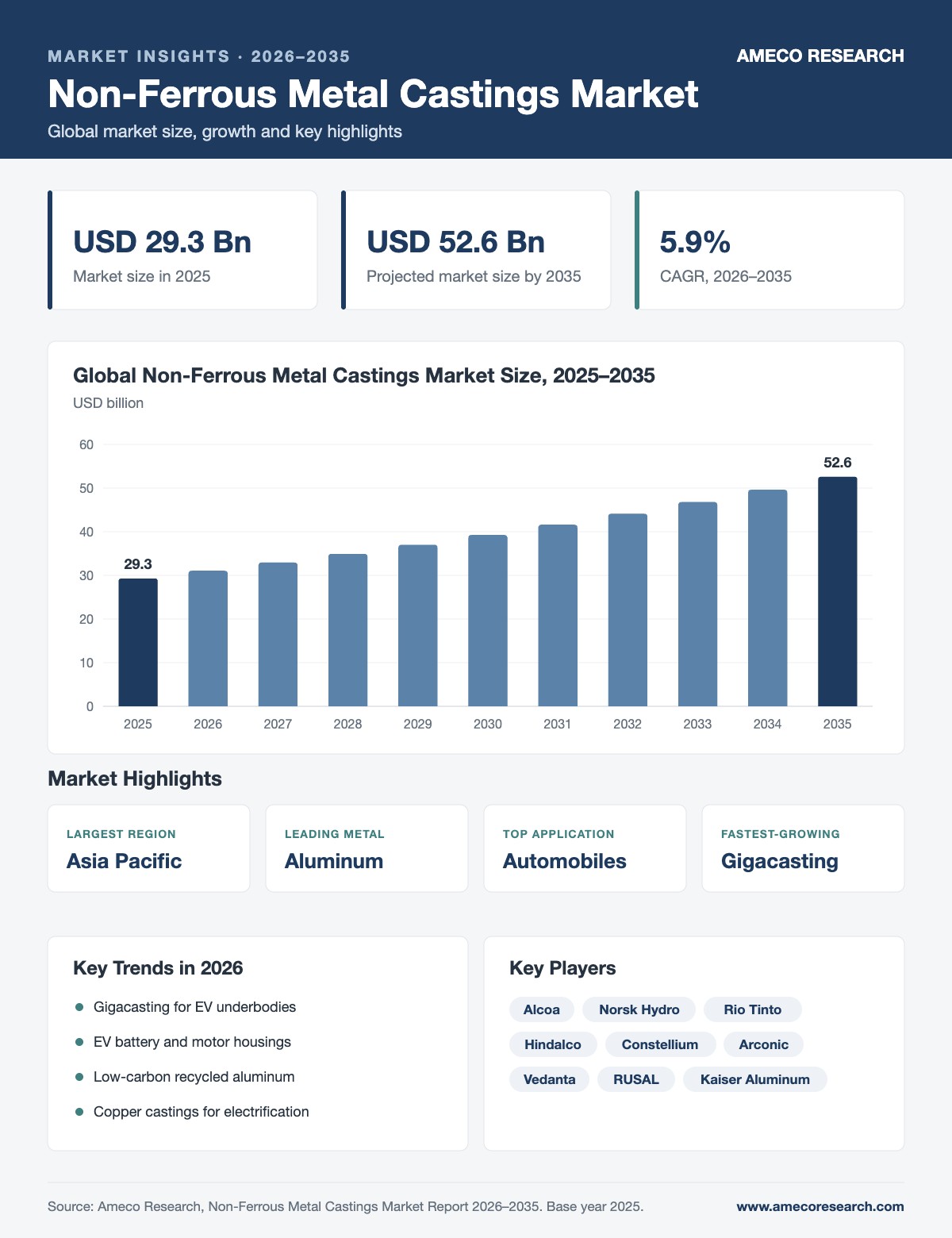 Infographic: Non-Ferrous Metal Castings Market Size and Growth Opportunities and Forecast till 2026 - 2035 | Ameco Research
Non-Ferrous Metal Castings Market Report Scope
| Report Attribute | Details |
| Non-Ferrous Metal Castings Market Size in 2025 | USD 29.3 Billion |
| Non-Ferrous Metal Castings Market Forecast by 2035 | USD 52.6 Billion |
| Non-Ferrous Metal Castings Market CAGR (2026–2035) | 5.9% |
| Analysis Period | 2023–2035 |
| Base Year | 2025 |
| Forecast Period | 2026–2035 |
| Segments Covered | by Metal Type, by Application, and By Region |
| Regional Scope | North America, Europe, Asia Pacific, Latin America, and Middle East & Africa |
| Key Companies Profiled | Alcoa Corporation, BHP Group Limited, Rio Tinto Group, Vedanta Resources Limited, Norsk Hydro ASA, Hindalco Industries Limited, Century Aluminum Company, China Hongqiao Group Limited, United Company RUSAL Plc, Arconic Inc., Constellium SE, and Kaiser Aluminum Corporation |
| Report Coverage | Market Trends, Drivers, Restraints, Opportunities, Competitive Analysis, Player Profiling, Regulation Analysis |
Non-Ferrous Metal Castings Market Size Forecast, 2023–2035
The table below shows the year-by-year size of the global non-ferrous metal castings market. Revenue is expected to grow about 1.8 times between 2025 and 2035, reaching roughly USD 39.3 billion by 2030.
| Year | Market Size (USD Billion) |
| 2023 (historical) | 26.1 |
| 2024 (historical) | 27.6 |
| 2025 (base year) | 29.3 |
| 2026 (forecast) | 31.1 |
| 2027 (forecast) | 32.9 |
| 2028 (forecast) | 34.9 |
| 2029 (forecast) | 37.0 |
| 2030 (forecast) | 39.3 |
| 2031 (forecast) | 41.6 |
| 2032 (forecast) | 44.1 |
| 2033 (forecast) | 46.8 |
| 2034 (forecast) | 49.6 |
| 2035 (forecast) | 52.6 |
Latest Non-Ferrous Metal Castings Market Trends (2026)
Gigacasting spreads beyond Tesla
Large single-piece aluminum castings are replacing dozens of stamped and welded parts. Tesla's rear underbody casting cut about 70 parts to one, and automakers such as Volvo with its EX60 are now using castings that replace 60 to 100 components. Giga-press lines from IDRA, now owned by China's LK Group, and Bühler are in high demand.
EV battery and motor housings
Electric vehicles use more aluminum castings for battery trays, motor housings, inverter cases and thermal management parts. This is shifting foundry demand from engine blocks toward lightweight structural and e-drive components.
Low-carbon and recycled aluminum
Automakers and electrical OEMs are asking for castings made with recycled scrap and low-carbon primary aluminum to cut product emissions. Producers are expanding secondary alloy capacity and certifying carbon footprints.
Heat-treatment-free alloys
New high-strength die-casting alloys that need no heat treatment reduce distortion and cost for large structural castings, making gigacasting more practical for mass production.
Copper castings for electrification
Grid upgrades, data centers and EV charging infrastructure are lifting demand for copper and copper-alloy castings used in connectors, motors, pumps and valves.
Automation and digital foundries
Foundries are adopting simulation, X-ray inspection, robotics and real-time process monitoring to cut scrap, improve quality and offset labor shortages.
Non-Ferrous Metal Castings Market Dynamics
Growth drivers
- Vehicle lightweighting to improve fuel economy and EV range
- Rapid growth of electric vehicles and their battery and motor parts
- Adoption of large single-piece structural castings
- Investment in power grids, data centers and electrical equipment
- Demand from aerospace, construction and industrial machinery
Restraints and challenges
- Volatile prices of aluminum, copper and other non-ferrous metals
- High capital cost of large die-casting cells and giga-presses
- Energy-intensive melting and rising energy prices
- Quality and repairability concerns with very large castings
Opportunities
Key opportunities include gigacasting for EV platforms, battery enclosures and e-motor housings, recycled and low-carbon alloys, copper castings for electrification, aerospace and defense parts, and new foundry capacity in India, Southeast Asia and Mexico.
Non-Ferrous Metal Castings Market Segment Analysis
By metal type
The market is segmented into aluminum, copper, zinc, magnesium and others. Aluminum castings dominate the market because they combine light weight, strength and easy casting. Magnesium is gaining interest for ultra-light parts, while copper and zinc castings serve electrical, plumbing and hardware uses.
By application
Applications include automobiles, electrical and construction, industrial machinery and others. Automobiles are the largest application, led by powertrain, chassis, body and EV battery parts. Electrical and construction uses are growing with grid and building investment.
Non-Ferrous Metal Castings Market Regional Analysis
Asia Pacific holds the largest share of the non-ferrous metal castings market, led by China, Japan, India and South Korea, which host the largest automotive and industrial foundry bases.
North America is one of the largest markets, supported by automotive, aerospace and defense demand and new investment in EV and gigacasting capacity. Europe is strong in premium automotive, aerospace and recycled aluminum castings.
Latin America, led by Mexico and Brazil, and the Middle East & Africa are growing markets as automotive production and infrastructure investment expand.
Non-Ferrous Metal Castings Market Segmentation
Non-Ferrous Metal Castings Market Leading Companies
The non-ferrous metal castings market includes primary aluminum and copper producers, alloy and rolled-product makers, and die-casting foundries serving automotive, electrical and industrial customers. Companies compete on alloy development, low-carbon metal supply, casting size and quality, and long-term contracts with automakers. Key players profiled in this report include Alcoa Corporation, BHP Group Limited, Rio Tinto Group, Vedanta Resources Limited, Norsk Hydro ASA, Hindalco Industries Limited, Century Aluminum Company, China Hongqiao Group Limited, United Company RUSAL Plc, Arconic Inc., Constellium SE, and Kaiser Aluminum Corporation.
Alcoa CorporationBHP Group LimitedRio Tinto GroupVedanta Resources LimitedNorsk Hydro ASAHindalco Industries LimitedCentury Aluminum CompanyChina Hongqiao Group LimitedUnited Company RUSAL PlcArconic Inc.Constellium SEKaiser Aluminum Corporation
Recent developments
Key Questions Answered in This Report
- What is the size of the non-ferrous metal castings market in 2025, and how large will it be by 2030 and 2035?
- What are the main growth drivers, restraints and opportunities through 2035?
- Which by metal type and by application segments will grow the fastest?
- Which regions and countries offer the largest and fastest-growing opportunities?
- How are gigacasting, EV components and low-carbon aluminum shaping demand in 2026?
- Who are the leading companies, and what strategies are they using to compete?
Research Methodology
This report combines primary and secondary research. Primary research includes interviews with foundries, die casters, metal and alloy producers, automotive and electrical OEMs, and equipment suppliers. Secondary research covers company annual reports, investor presentations, government and trade association data, patent filings and industry publications. Market size is estimated using both bottom-up (company revenue and production data) and top-down (end-use demand) methods, and results are cross-checked through data triangulation before forecasts are built for 2026–2035.
Related Reports
- Metal Additives Market Report
- Metal Hoses Market Report
- Metal Wire Mesh Belt Market Report
- 3D Printing Metal Market Report
- Homogenous Precious Metal Catalyst Market - Size, Industry Trends, Competitive Landscape, and Opport... Report
Non-Ferrous Metal Castings Market: Frequently Asked Questions
How big is the non-ferrous metal castings market?
The global non-ferrous metal castings market was valued at USD 29.3 billion in 2025 and is expected to reach USD 52.6 billion by 2035.
What is the growth rate of the non-ferrous metal castings market?
The non-ferrous metal castings market is projected to grow at a CAGR of 5.9% from 2026 to 2035.
What will the non-ferrous metal castings market be worth in 2030?
The non-ferrous metal castings market is projected to reach about USD 39.3 billion in 2030, growing at a CAGR of 5.9%.
What is driving growth in the non-ferrous metal castings market?
Key drivers are vehicle lightweighting, electric vehicle growth, large single-piece gigacastings, and rising demand from electrical, aerospace and industrial equipment.
What is non-ferrous metal castings?
Non-ferrous metal castings are parts made by casting metals that contain little or no iron, such as aluminum, copper, zinc and magnesium, into molds to form lightweight, corrosion-resistant components.
Which region leads the non-ferrous metal castings market?
Asia Pacific holds the largest share of the market, while North America is one of the largest and most innovative markets for automotive and aerospace castings.
Which segment holds the largest share of the non-ferrous metal castings market?
Aluminum dominates by metal type, and automobiles are the largest application.
What are the latest trends in the non-ferrous metal castings market?
The main 2026 trends are gigacasting spreads beyond Tesla, eV battery and motor housings, low-carbon and recycled aluminum, heat-treatment-free alloys, copper castings for electrification and automation and digital foundries.
What are the main challenges in the non-ferrous metal castings market?
The main challenges are volatile metal prices, high capital costs for large die-casting cells, energy-intensive melting and quality concerns with very large castings.
What is gigacasting?
Gigacasting is the production of very large single-piece aluminum castings, such as vehicle underbodies, using die-casting machines with clamping forces of 6,000 to 9,000 tonnes or more. It cuts part counts, welding and assembly costs.
Who are the key players in the non-ferrous metal castings market?
Leading companies include Alcoa Corporation, BHP Group Limited, Rio Tinto Group, Vedanta Resources Limited, Norsk Hydro ASA, Hindalco Industries Limited, Century Aluminum Company, China Hongqiao Group Limited, United Company RUSAL Plc, Arconic Inc., Constellium SE, and Kaiser Aluminum Corporation.