Press Release
Humanoid Robot Market to Reach USD 20.11 Billion by 2035, Growing at 25.9% CAGR | Ameco Research
Date : Nov 12, 2026
Pune, India, November 12, 2026 — The global humanoid robot market is projected to rise from USD 2.01 billion in 2025 to USD 20.11 billion by 2035, registering a CAGR of 25.9% from 2026 to 2035, according to the latest Humanoid Robot Market report by Ameco Research. The study shows humanoids crossing from research labs and trade-show demonstrations into paid factory and warehouse deployments, as AI foundation models give robots the ability to learn tasks rather than follow fixed scripts.
Humanoid robots are machines built with a human-like form — typically a torso, arms, hands, and either legs or a wheeled base — so they can work in spaces, and with tools, designed for people. That design choice is the core of the investment case: manufacturers and logistics operators can add humanoids to existing lines without rebuilding facilities. The report finds that 2025 and 2026 marked the start of volume production, with several developers moving from prototypes to hundreds and then thousands of units.
Humanoid Robot Market Size and Forecast
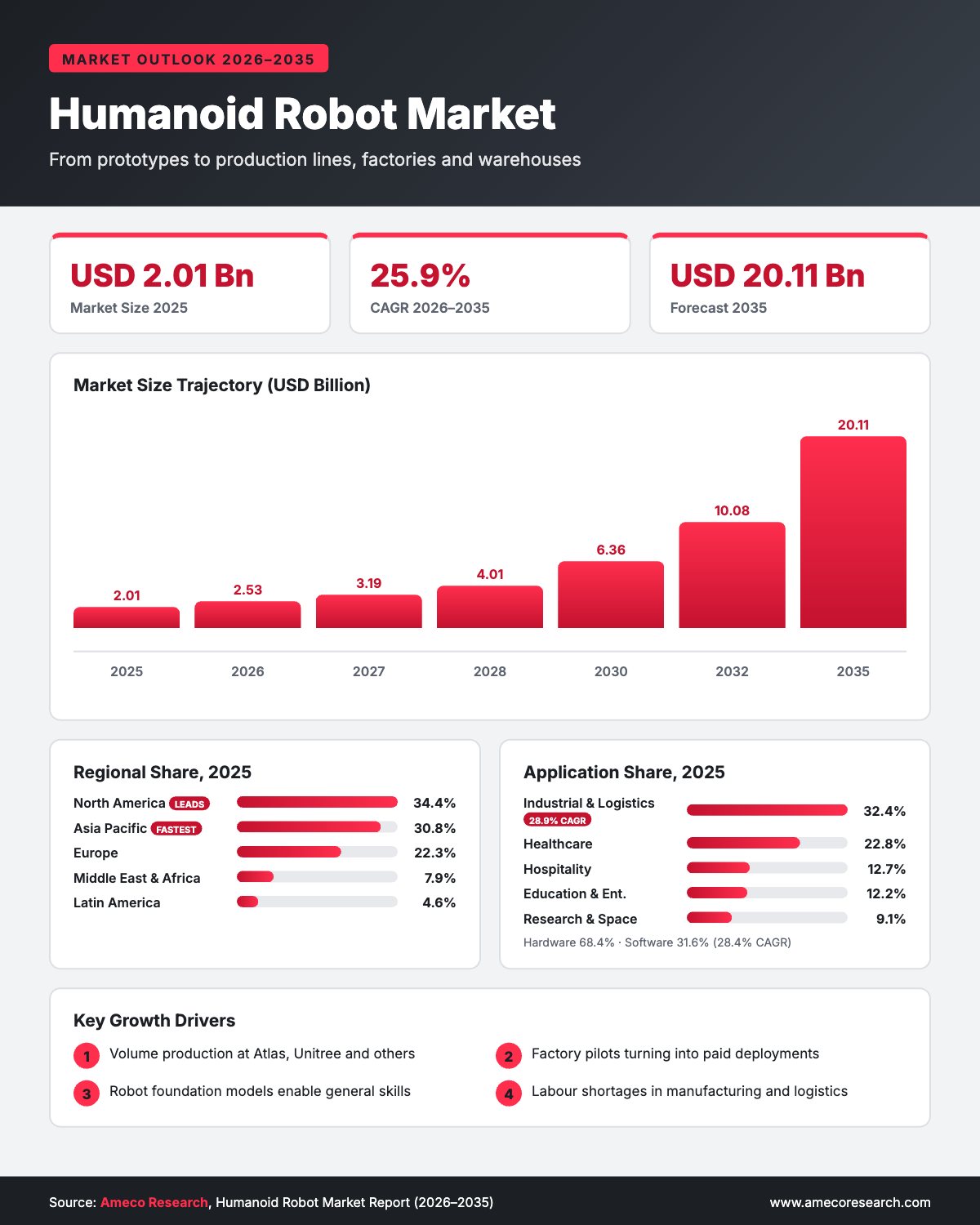
Ameco Research estimates the market at USD 2.01 billion in 2025, rising to USD 2.53 billion in 2026 and USD 6.36 billion by 2030. As unit costs fall and AI-driven dexterity improves, the market is expected to exceed USD 10 billion in 2032 and reach USD 20.11 billion by 2035.
| Year | Market Size (USD Billion) |
|---|---|
| 2025 | 2.01 |
| 2026 | 2.53 |
| 2027 | 3.19 |
| 2028 | 4.01 |
| 2030 | 6.36 |
| 2032 | 10.08 |
| 2035 | 20.11 |
Key Takeaways
- Market size: USD 2.01 billion in 2025, forecast to reach USD 20.11 billion by 2035.
- Growth rate: 25.9% CAGR from 2026 to 2035.
- Leading region: North America, with a 34.4% share (about USD 0.69 billion) in 2025.
- Fastest-growing region: Asia Pacific, at a 28.1% CAGR.
- Largest component: Hardware, at 68.4% of revenue; software is growing faster at 28.4% CAGR.
- Fastest-growing motion type: Biped humanoids, at a 29.6% CAGR.
What Is Driving the Humanoid Robot Market?
Production lines are opening
Boston Dynamics began production of its electric Atlas humanoid, unveiled at CES in January 2026, and parent company Hyundai has outlined plans for a robot factory with capacity of around 30,000 units a year. In China, Unitree shipped about 5,500 humanoids in 2025 and is targeting 10,000 to 20,000 units in 2026, with its G1 model starting at roughly USD 16,000. Rising volumes are pushing down component costs for actuators, reducers, sensors, and batteries.
Factory and warehouse pilots are turning into deployments
Figure AI’s Figure 02 completed a pilot at BMW’s Spartanburg plant, logging more than 1,250 operating hours and handling over 90,000 parts, with a deployment at BMW Leipzig planned from summer 2026. Agility Robotics’ Digit has accumulated more than 65,000 working hours across customers such as GXO, Schaeffler, Toyota, and Mercado Libre. These results give buyers real productivity data rather than demo footage.
Robot foundation models bring general-purpose skills
AI is the main reason humanoids are viable now. Google DeepMind’s Gemini Robotics models are being integrated into Atlas, and NVIDIA’s Isaac GR00T platform gives developers pre-trained models, simulation tools, and synthetic data for humanoid training. Robots can increasingly learn new tasks from demonstration, which reduces programming costs for each new application.
Labour shortages create demand
The report highlights ManpowerGroup survey data showing that 75% of employers reported difficulty filling roles. Ageing workforces in Japan, South Korea, Germany, and China, combined with hard-to-staff shifts in logistics and manufacturing, make flexible automation increasingly attractive.
Capital is flowing into the sector
Figure AI raised more than USD 1 billion at a valuation of about USD 39 billion, while Unitree, valued at around USD 1.3 billion, received approval for a listing on Shanghai’s STAR Market. Strong funding allows developers to scale manufacturing and invest in safety certification.
Key Market Trends
- Robots-as-a-service: Leasing and per-hour pricing models lower upfront costs for first-time buyers.
- Dexterous hands: Investment is shifting toward multi-fingered hands with tactile sensing, the hardest part of human-level manipulation.
- Sim-to-real training: Large-scale simulation and synthetic data shorten the time needed to teach new skills.
- Chinese supply chain scale: Domestic actuator, motor, and reducer suppliers are cutting bill-of-materials costs.
- Safety standards: Work on standards for dynamically stable mobile robots is preparing the ground for humanoids to work alongside people without cages.
Challenges
Commercial timelines remain uncertain. Tesla’s Optimus programme, for example, has missed earlier production targets, showing how hard it is to build reliable humanoids at scale. Battery life, hand dexterity, and fall safety still limit continuous operation, and the cost per unit must keep falling before humanoids compete with conventional automation or human labour on many tasks. Buyers also need clear safety certification and proof of uptime before committing to fleet purchases. The report expects these barriers to ease gradually through the late 2020s as production experience accumulates.
Segment Analysis
By component, hardware accounted for 68.4% of the market in 2025, reflecting the high cost of actuators, sensors, and power systems. Software, at 31.6%, is the faster-growing segment at a 28.4% CAGR, as AI models, fleet management, and skill libraries become a larger share of value. By motion type, wheel-drive humanoids held 64.3% because they are simpler and more stable for service and logistics roles, but biped humanoids (35.7%) are expanding faster at a 29.6% CAGR as balance control improves.
| Application | Share, 2025 | Note |
|---|---|---|
| Industrial & logistics | 32.4% | Largest and fastest growing, 28.9% CAGR |
| Healthcare | 22.8% | Elder care, rehabilitation, hospital logistics |
| Hospitality | 12.7% | Reception and guest services |
| Education & entertainment | 12.2% | STEM teaching, theme parks |
| Research & space | 9.1% | Universities, space agencies |
| Others | 10.8% | — |
Where Humanoid Robots Are Working Today
Most current deployments focus on repetitive, physically demanding tasks that are hard to staff but do not yet require fine human dexterity. In automotive plants, humanoids move sheet-metal parts, load fixtures, and carry totes between stations. In warehouses, they unload containers, move empty totes to conveyors, and fill gaps on night shifts. These jobs suit humanoids because they happen in environments built for people, where fixed automation would need costly redesign.
Healthcare is the second-largest application. Hospitals and care homes are testing humanoids for patient-room deliveries, rehabilitation support, and companionship for elderly residents, particularly in Japan and South Korea. Hospitality operators use wheeled humanoids for reception and guidance, while universities and space agencies buy research platforms to develop new control and AI methods.
The report expects the task list to widen steadily. As robot foundation models improve and hands gain tactile sensing, humanoids should move from simple pick-and-place work to assembly, machine tending, and inspection tasks over the forecast period, which is a key reason software is the fastest-growing component.
Regional Outlook
| Region | Share, 2025 | Highlights |
|---|---|---|
| North America | 34.4% | About USD 0.69 billion; strong venture funding and auto-plant pilots |
| Asia Pacific | 30.8% | Fastest growing at 28.1% CAGR; China’s volume production |
| Europe | 22.3% | Automotive and logistics deployments in Germany |
| Middle East & Africa | 7.9% | Hospitality and smart-city programmes |
| Latin America | 4.6% | E-commerce logistics pilots |
North America leads on funding and early factory deployments, while Asia Pacific is growing fastest on the strength of China’s manufacturing ecosystem, government support for embodied AI, and Japan’s and South Korea’s long robotics heritage.
Competitive Landscape
The market includes automotive and technology giants, venture-backed start-ups, and established robotics firms. Key companies profiled include Tesla, Figure AI, Agility Robotics, Boston Dynamics (Hyundai), Unitree Robotics, UBTECH Robotics, Apptronik, 1X Technologies, Sanctuary AI, SoftBank Robotics, Honda, Engineered Arts, Hanson Robotics, ROBOTIS, and Kawada Robotics. Competition centres on manipulation capability, AI model partnerships, unit cost, and the ability to prove uptime in customer facilities. Readers who want company benchmarking or supplier analysis can make an inquiry with Ameco Research.
Opportunities Ahead
- Actuator, reducer, and tactile sensor supply for high-volume humanoid production.
- Robot foundation models, simulation platforms, and skill marketplaces.
- Robots-as-a-service financing for mid-sized manufacturers and 3PLs.
- Assistive humanoids for elder care in ageing societies.
For related coverage, see Ameco Research’s Physical AI Market, Healthcare Robots Market, Surgical Robots Market, and Agentic AI Market reports.
Report Scope
| Attribute | Details |
|---|---|
| Market size (2025) | USD 2.01 billion |
| Market size (2035) | USD 20.11 billion |
| CAGR (2026–2035) | 25.9% |
| Segments covered | Component, motion type, application, region |
| Regions covered | North America, Europe, Asia Pacific, Latin America, Middle East & Africa |
Who Should Read This Report
- Manufacturing, automotive, and logistics leaders evaluating flexible automation.
- Robotics developers and component suppliers planning capacity.
- Investors tracking embodied AI and robotics opportunities.
- Healthcare and hospitality operators exploring service robots.
The full report provides segment-level forecasts, regional and country data, and detailed company profiles. To access the complete analysis, buy the report today.
Frequently Asked Questions
How big is the humanoid robot market?
The global humanoid robot market was valued at USD 2.01 billion in 2025 and is expected to reach USD 20.11 billion by 2035, according to Ameco Research.
What is the growth rate of the humanoid robot market?
The market is projected to grow at a CAGR of 25.9% between 2026 and 2035.
Which application uses humanoid robots the most?
Industrial and logistics applications lead with a 32.4% share and are also the fastest-growing application at a 28.9% CAGR.
Which region is growing fastest?
Asia Pacific is the fastest-growing region at a 28.1% CAGR, while North America held the largest share at 34.4% in 2025.
Who are the major humanoid robot companies?
Leading players include Tesla, Figure AI, Agility Robotics, Boston Dynamics, Unitree Robotics, UBTECH Robotics, Apptronik, 1X Technologies, and Sanctuary AI.
Conclusion
The humanoid robot industry is entering its first real production cycle. With a 25.9% CAGR and a forecast value of USD 20.11 billion by 2035, growth will depend on how quickly developers cut costs, prove reliability, and turn AI-driven dexterity into dependable work in factories, warehouses, and care settings.
Explore the complete Humanoid Robot Market report for detailed forecasts and competitive analysis.
About Ameco Research
Ameco Research is a market research and consulting firm that provides syndicated reports, custom research, and strategic advisory services across technology, healthcare, energy, automotive, chemicals, and consumer markets. Its analysts combine primary interviews with secondary research to help clients identify growth opportunities and make confident decisions.
Contact Us
Ameco Research
201, Vaidehi-Saaket, Baner - Pashan Link Rd, Pashan, Pune 411021
Phone: +91 898 322 5533
Email: [email protected]
Website: www.amecoresearch.com