Agentic AI Market Size, Share, Trends & Growth Opportunities Forecast to 2026 - 2035
Agentic AI Market Size, Share & Trends Report, 2026–2035
LAST UPDATED: NOVEMBER 2026
The global agentic AI market size was valued at USD 6.92 billion in 2025 and is projected to reach USD 240.60 billion by 2035, growing at a CAGR of 42.6% from 2026 to 2035. The market is estimated at USD 9.87 billion in 2026, with North America holding the largest share and Asia Pacific registering the fastest growth.
Agentic AI refers to AI systems that can pursue goals with limited human supervision. Built on large language models and other foundation models, AI agents break a goal into steps, use tools such as APIs, databases, browsers and enterprise applications, take actions, check results and adjust their plans. Multi-agent systems go further, with specialized agents that hand off work to one another to complete complex workflows.
Where earlier AI tools answered questions or generated content, agentic AI completes work: resolving customer tickets, triaging security alerts, processing invoices, writing and testing code, and planning supply chains. The market covers agent platforms and frameworks, prebuilt and custom agents, and the services needed to design, integrate, govern and run them across industries.
Agentic AI Market Key Takeaways
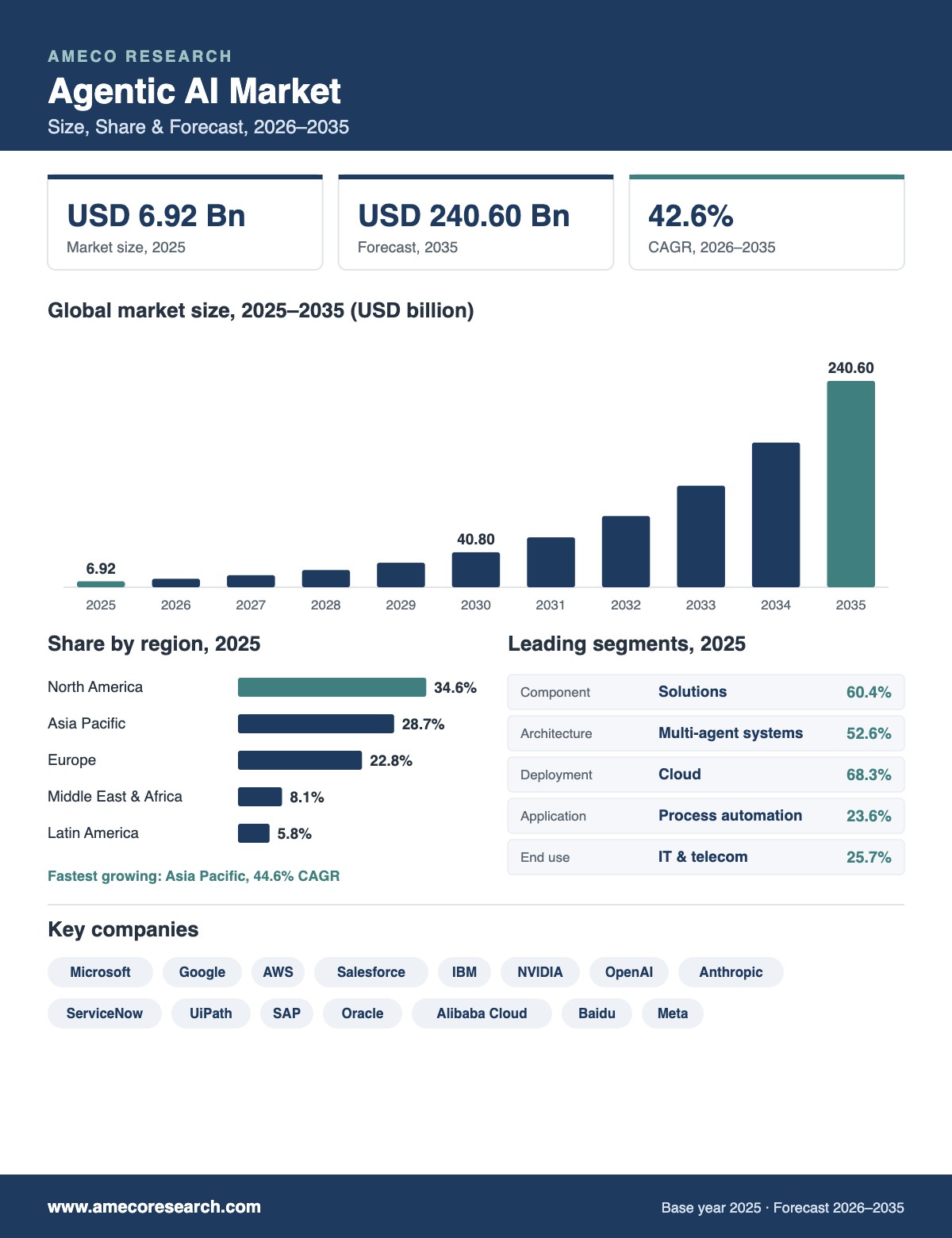 Infographic: Agentic AI Market Size, Share, Trends & Growth Opportunities Forecast to 2026 - 2035 | Ameco Research
Agentic AI Market Report Scope
| Report Attribute | Details |
| Agentic AI Market Size in 2025 | USD 6.92 Billion |
| Agentic AI Market Size in 2026 | USD 9.87 Billion |
| Agentic AI Market Forecast by 2035 | USD 240.60 Billion |
| Agentic AI Market CAGR (2026–2035) | 42.6% |
| Historical Data | 2022–2024 |
| Base Year | 2025 |
| Forecast Period | 2026–2035 |
| Largest Region | North America (34.6% share in 2025) |
| Fastest-Growing Region | Asia Pacific (44.6% CAGR) |
| Segments Covered | Component, Agent Architecture, Deployment, Enterprise Size, Application, End Use and Region |
| Regional Scope | North America, Europe, Asia Pacific, Latin America, and Middle East & Africa |
| Key Companies Profiled | Microsoft, Google (Alphabet), Amazon Web Services, Salesforce, IBM, NVIDIA, OpenAI, Anthropic, ServiceNow, UiPath, SAP, Oracle, Alibaba Cloud, Baidu and Meta |
| Report Coverage | Market size and forecast, adoption analysis, trends, drivers, restraints, opportunities, standards and regulation, segment and regional analysis, competitive landscape, recent developments |
How Big Is the Agentic AI Market in 2026?
Ameco Research estimates the agentic AI market at USD 9.87 billion in 2026, up about 43% from USD 6.92 billion in 2025, as enterprises move AI agents from pilots into production in customer service, IT, software development and back-office operations. The market is expected to reach about USD 40.80 billion by 2030 and USD 240.60 billion by 2035.
| Year | Agentic AI Market Size (USD Billion) |
| 2025 | 6.92 |
| 2026 | 9.87 |
| 2027 | 14.07 |
| 2028 | 20.07 |
| 2030 | 40.80 |
| 2032 | 82.97 |
| 2035 | 240.60 |
Latest Agentic AI Market Trends 2026
Agents move from pilots to scale
McKinsey’s State of AI 2026 survey, published in August 2026, found that 40% of respondents at large organizations report scaling AI agents in at least one business function, compared with 22% at smaller organizations. Gartner forecasts that 40% of enterprise applications will include task-specific AI agents by the end of 2026, up from less than 5% in 2025.
Big tech launches full agent platforms
Major vendors now offer complete stacks for building, deploying and managing agents, including Microsoft Copilot Studio and Agent 365, Google Gemini Enterprise, Amazon Bedrock AgentCore, OpenAI AgentKit and Salesforce Agentforce. Agents are also being built directly into business applications from SAP, Oracle, ServiceNow and Workday.
Open standards for interoperability
In December 2025, the Linux Foundation launched the Agentic AI Foundation, with founding contributions including Anthropic’s Model Context Protocol (MCP), OpenAI’s AGENTS.md and Block’s goose. MCP and agent-to-agent (A2A) protocols are becoming the common way to connect agents to tools, data and each other.
Multi-agent systems take the lead
Multi-agent architectures, in which an orchestrator coordinates specialized agents, accounted for about 52.6% of revenue in 2025. They are used for complex workflows such as claims processing, software delivery and supply chain planning, where one agent alone is not enough.
Governance and security become buying criteria
As agents gain access to systems and data, enterprises are investing in identity, permissions, monitoring, evaluation and audit trails for agents. Gartner has warned that more than 40% of agentic AI projects could be canceled by the end of 2027 because of cost, unclear value or weak risk controls.
Agentic coding and IT operations surge
AI coding agents that plan, write, test and fix code, and IT agents that resolve incidents automatically, are among the fastest-adopted use cases, giving the IT and telecom segment the largest share of demand.
Agentic AI Market Dynamics
Growth drivers
- Demand for end-to-end automation: companies want AI that completes whole workflows, not just tasks, to cut costs and handle labor shortages.
- More capable reasoning models: advances in large language models, reasoning and tool use make agents reliable enough for real business work.
- Platform availability: cloud and software leaders are bundling agent builders, orchestration and monitoring into products enterprises already use.
- Interoperability standards: MCP and A2A protocols lower the cost of connecting agents to enterprise systems.
- Clear early returns: customer service, IT support and software development show measurable productivity gains.
Restraints and challenges
- Reliability and errors: agents can make mistakes or take unintended actions, especially in long, multi-step tasks.
- Data security and privacy: agents need broad access to systems and data, raising risks of leaks, prompt injection and misuse.
- Regulatory uncertainty: rules such as the EU AI Act and sector rules in finance and healthcare raise compliance questions about autonomous decisions.
- Cost and unclear ROI: compute, integration and change management costs can outweigh value in poorly chosen use cases.
- Legacy integration: older systems and fragmented data slow deployment.
Opportunities
- Industry-specific agents for banking, insurance, healthcare, manufacturing, retail and the public sector.
- Agent governance and security tools for identity, permissions, observability and evaluation.
- Agent marketplaces where enterprises can buy and deploy prebuilt agents.
- Small and mid-sized businesses adopting low-code agent builders delivered as SaaS.
- Physical and embodied AI that extends agents to robotics, factories and logistics.
Agentic AI Market Segment Analysis
By component: Solutions or services?
Solutions, including agent platforms, frameworks and prebuilt agents, accounted for 60.4% of revenue in 2025. Services held 39.6% and are growing faster, at about a 44.1% CAGR, as enterprises need help with use case design, integration, data preparation, governance and ongoing management.
| Component | Share (2025) | Key Highlights |
| Solutions | 60.4% | Agent platforms, frameworks, prebuilt and embedded agents |
| Services | 39.6% | Faster-growing at 44.1% CAGR; consulting, integration and managed services |
By agent architecture: Why do multi-agent systems lead?
Multi-agent systems held 52.6% of revenue in 2025 and are growing at about a 44.9% CAGR, as complex enterprise workflows need several specialized agents working together under an orchestrator. Single-agent systems accounted for 47.4%, used widely for focused tasks such as customer support and coding assistance.
| Agent Architecture | Share (2025) | Key Highlights |
| Multi-Agent Systems | 52.6% | Larger and faster-growing at 44.9% CAGR; orchestrated workflows |
| Single-Agent Systems | 47.4% | Focused tasks such as support, coding and research |
By deployment
Cloud deployment accounted for 68.3% of revenue in 2025, as most agents run on hyperscaler model and agent platforms. On-premises and private deployments held 31.7%, favored by banks, governments and healthcare providers with strict data requirements.
| Deployment | Share (2025) | Key Highlights |
| Cloud | 68.3% | Largest; hyperscaler agent platforms and SaaS |
| On-Premises / Private | 31.7% | Regulated industries and data sovereignty needs |
By enterprise size
Large enterprises accounted for 64.8% of revenue in 2025. Small and medium-sized enterprises held 35.2% and are growing faster, at about a 45.3% CAGR, as low-code agent builders and agents embedded in SaaS tools make adoption easier and cheaper.
| Enterprise Size | Share (2025) | Key Highlights |
| Large Enterprises | 64.8% | Multi-function deployments and custom agents |
| SMEs | 35.2% | Faster-growing at 45.3% CAGR; low-code and SaaS agents |
By application: Where are AI agents used most?
Autonomous process automation led with 23.6% of revenue in 2025, followed by predictive analytics and decision support at 19.3% and intelligent virtual assistants at 18.4%. Intelligent virtual assistants, including customer service and employee agents, are the fastest-growing application at about a 45.8% CAGR.
| Application | Share (2025) | Key Highlights |
| Autonomous Process Automation | 23.6% | Largest; end-to-end back-office and IT workflows |
| Predictive Analytics & Decision Support | 19.3% | Forecasting, planning and recommendations |
| Intelligent Virtual Assistants | 18.4% | Fastest-growing at 45.8% CAGR; customer and employee agents |
| RPA Integration | 14.7% | AI agents added to robotic process automation |
| Smart Manufacturing & IIoT | 13.2% | Production, maintenance and quality agents |
| Others | 10.8% | Cybersecurity, research and creative workflows |
By end use
IT and telecom accounted for the largest share at 25.7% in 2025, driven by coding agents, IT operations and network automation. BFSI held 19.2% and healthcare 15.3%. Healthcare is the fastest-growing industry at about a 46.2% CAGR, as agents take on clinical documentation, prior authorization, scheduling and drug research.
| End Use | Share (2025) | Key Highlights |
| IT & Telecom | 25.7% | Largest; coding agents, IT operations and networks |
| BFSI | 19.2% | Fraud, compliance, claims and customer service |
| Healthcare | 15.3% | Fastest-growing at 46.2% CAGR; documentation and research |
| Manufacturing | 10.2% | Planning, maintenance and quality control |
| Retail & E-commerce | 9.4% | Shopping assistants, merchandising and service |
| Government | 7.1% | Citizen services and case processing |
| Automotive | 5.1% | Engineering, supply chain and in-vehicle agents |
| Others | 8.0% | Energy, logistics, education and media |
Agentic AI Market Regional Analysis
| Region | Share (2025) | Outlook |
| North America | 34.6% | Largest; about USD 2.39 billion in 2025; home to leading AI platform vendors |
| Asia Pacific | 28.7% | Fastest-growing at 44.6% CAGR; China, India, Japan, South Korea, Singapore |
| Europe | 22.8% | EU AI Act shapes governed, compliant agent deployments |
| Middle East & Africa | 8.1% | National AI programs in Saudi Arabia and the UAE |
| Latin America | 5.8% | Banking and retail adoption in Brazil and Mexico |
Why does North America dominate the agentic AI market?
North America accounted for about 34.6% of global revenue in 2025, or about USD 2.39 billion. The U.S. is home to the leading model and platform companies, including Microsoft, Google, Amazon Web Services, OpenAI, Anthropic, Salesforce, ServiceNow and NVIDIA, as well as the largest pool of enterprise buyers and AI venture funding.
What makes Asia Pacific the fastest-growing region?
Asia Pacific held about 28.7% of the market in 2025 and is forecast to grow at a 44.6% CAGR through 2035. China’s Alibaba, Baidu and other model makers are building agent platforms, India’s IT services firms are deploying agents for global clients, and Japan, South Korea and Singapore are investing heavily in AI to offset labor shortages and boost productivity.
How is Europe developing?
Europe represented about 22.8% of revenue in 2025. Germany, the U.K., France and the Nordics lead adoption in manufacturing, banking and public services, while the phased rollout of the EU AI Act is pushing companies toward agents with strong transparency, human oversight and risk controls.
Agentic AI Market Segmentation
Agentic AI Market Leading Companies
The agentic AI market includes foundation model developers, cloud hyperscalers, enterprise software vendors, automation specialists and a fast-growing group of agent start-ups. Competition centers on model quality and reasoning, integration with enterprise data and applications, orchestration and multi-agent tooling, security and governance, and pricing models that are shifting from per-seat to per-task or outcome-based fees.
Microsoft · Google (Alphabet) · Amazon Web Services · Salesforce · IBM · NVIDIA · OpenAI · Anthropic · ServiceNow · UiPath · SAP · Oracle · Alibaba Cloud · Baidu · Meta
Recent developments
- August 2026: McKinsey’s State of AI 2026 survey of 1,719 respondents reported that 40% of large organizations are scaling AI agents in at least one function.
- December 2025: The Linux Foundation launched the Agentic AI Foundation with Anthropic’s Model Context Protocol, OpenAI’s AGENTS.md and Block’s goose as founding projects.
- December 2025: Fujitsu announced technology that lets AI agents from different vendors collaborate securely across supply chains.
- November 2025: Microsoft introduced Agent 365 to help organizations manage, secure and govern AI agents at scale.
- October 2025: OpenAI launched AgentKit, Google introduced Gemini Enterprise and AWS made Amazon Bedrock AgentCore generally available, expanding enterprise agent platforms.
- August 2025: Gartner predicted that 40% of enterprise applications will feature task-specific AI agents by the end of 2026, up from less than 5% in 2025.
Agentic AI Market: Frequently Asked Questions
How big is the agentic AI market?
The global agentic AI market was valued at USD 6.92 billion in 2025 and is estimated at USD 9.87 billion in 2026. Ameco Research projects it to reach USD 240.60 billion by 2035, growing at a CAGR of 42.6% from 2026 to 2035.
What is agentic AI?
Agentic AI refers to AI systems, usually built on large language models, that can pursue a goal with limited human input. An AI agent plans the steps needed, uses tools and software such as APIs, databases and browsers, takes actions, checks results and adjusts. Unlike a chatbot that only answers questions, an agent can complete multi-step tasks such as resolving a support ticket, reconciling invoices or writing and testing code.
What is the difference between generative AI and agentic AI?
Generative AI creates content, such as text, images or code, in response to a prompt. Agentic AI uses generative models as its reasoning engine but adds planning, memory, tool use and the ability to act, so it can carry out tasks and workflows from start to finish rather than just producing an answer.
What is the growth rate of the agentic AI market?
The market is expected to grow at a CAGR of 42.6% from 2026 to 2035, driven by enterprise automation, more capable reasoning models, agent platforms from major cloud and software vendors, and open standards such as the Model Context Protocol (MCP) that make it easier to connect agents to business systems.
How many companies are using AI agents?
Adoption is growing fast but is still uneven. McKinsey’s State of AI 2026 survey, published in August 2026, found that 40% of respondents at large organizations (revenue above USD 1 billion) report scaling AI agents in at least one function, compared with 22% at smaller organizations. Gartner forecasts that 40% of enterprise applications will feature task-specific AI agents by the end of 2026, up from less than 5% in 2025.
What are the main applications of agentic AI?
Autonomous process automation is the largest application, with about 23.6% of revenue in 2025, followed by predictive analytics and decision support, intelligent virtual assistants, RPA integration, and smart manufacturing and industrial IoT. Common uses include customer service, IT operations, software development, finance and procurement workflows, cybersecurity and supply chain planning.
Which region leads the agentic AI market?
North America leads with about 34.6% of revenue in 2025, or about USD 2.39 billion, home to Microsoft, Google, AWS, OpenAI, Anthropic, Salesforce and NVIDIA. Asia Pacific is the fastest-growing region at about a 44.6% CAGR, led by China, India, Japan, South Korea and Singapore.
Who are the key players in the agentic AI market?
Leading companies include Microsoft, Google (Alphabet), Amazon Web Services, Salesforce, IBM, NVIDIA, OpenAI, Anthropic, ServiceNow, UiPath, SAP, Oracle, Alibaba Cloud, Baidu and Meta.
Related ICT and Media Market Reports
- Enterprise AI Market Size, Share, Trends & Growth Opportunities Forecast to 2026 - 2035
- Data Center Cooling Market Size, Share, Trends & Growth Opportunities Forecast to 2026 - 2035
- AI Data Center Market Size, Share, Trends & Growth Opportunities Forecast to 2026 - 2035
- Physical AI Market Size, Share & Growth Forecast 2026–2035
- Corporate eLearning Market Size, Share, Trends & Growth Opportunities Forecast to 2026 - 2035