Press Release
Single-stage Onboard Charger Market to Reach USD 4,002.8 Million by 2035, Growing at a 24.6% CAGR on SiC and Bidirectional EV Charging
Date : Nov 04, 2026
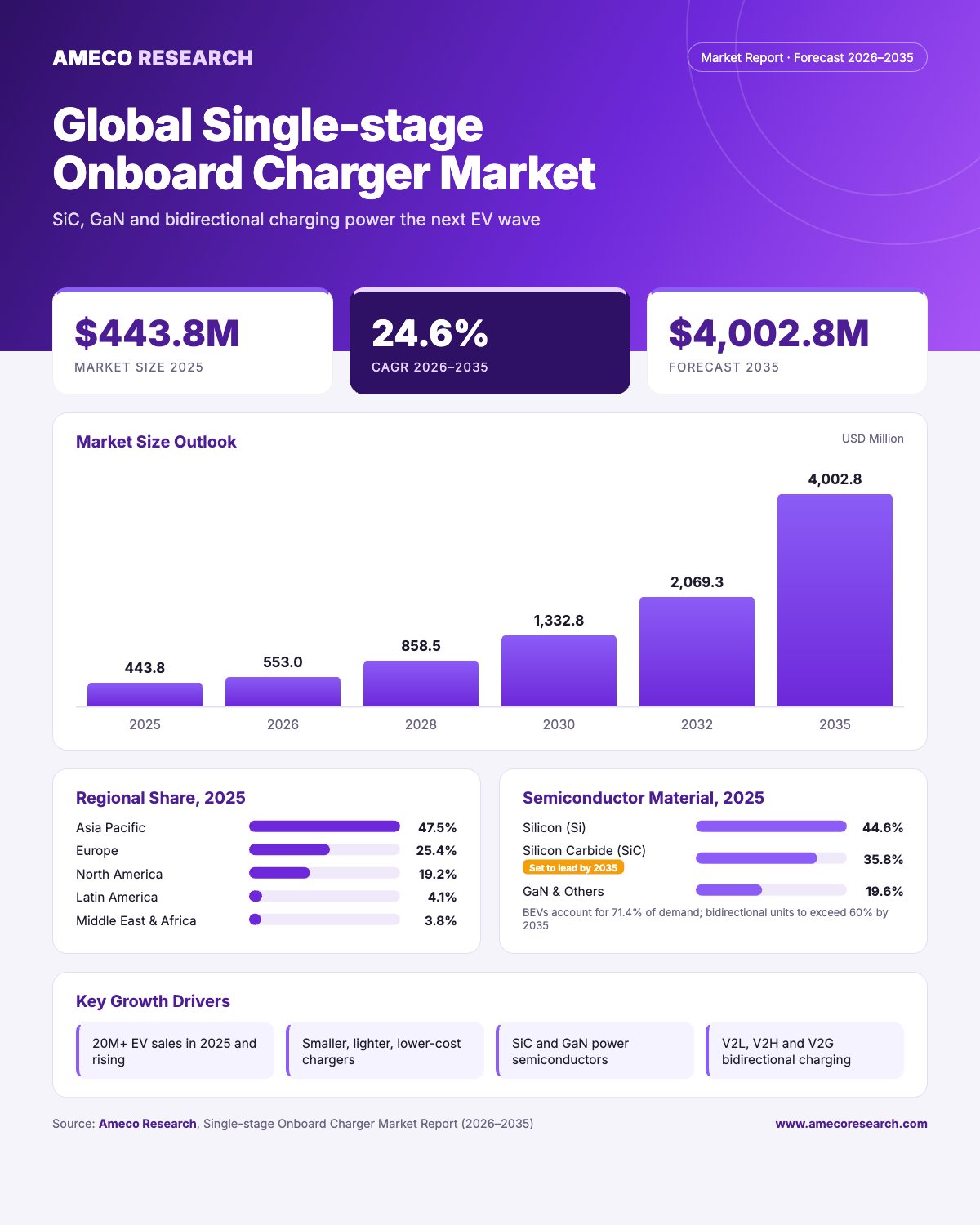
Pune, India, November 4, 2026 — The global Single-stage Onboard Charger Market was valued at USD 443.8 million in 2025 and is projected to reach USD 4,002.8 million by 2035, growing at a CAGR of 24.6% from 2026 to 2035, according to the new Single-stage Onboard Charger Market report by Ameco Research. The market is estimated at USD 553.0 million in 2026. Rising EV sales, the push for smaller and cheaper power electronics, and maturing silicon carbide (SiC) and gallium nitride (GaN) devices are moving single-stage designs from early programs into high-volume vehicle platforms.
The onboard charger (OBC) converts AC grid power into DC power for an electric vehicle's traction battery. Ameco Research's 180-page study analyzes integration types, power flow, charging power bands, semiconductor materials, propulsion and vehicle types, and regional demand, along with the suppliers shaping this fast-growing niche of the EV power electronics market.
What Is a Single-stage Onboard Charger?
A conventional OBC uses two stages: a power factor correction (PFC) rectifier followed by an isolated DC-DC converter. A single-stage OBC combines both functions in one integrated conversion stage, removing the large DC-link capacitor and cutting the number of magnetic and semiconductor components. The result is a smaller, lighter, and lower-cost charger with fewer conversion losses, which matters as automakers push for higher power density, 800 V platforms, and bidirectional charging.
Single-stage Onboard Charger Market Size, 2025–2035
Ameco Research expects the market to roughly triple by 2030 and grow about nine-fold over the full forecast period:
| Year | Market Size (USD Million) |
|---|---|
| 2025 (Base Year) | 443.8 |
| 2026 | 553.0 |
| 2028 | 858.5 |
| 2030 | 1,332.8 |
| 2032 | 2,069.3 |
| 2035 | 4,002.8 |
Key Takeaways
- Market size 2025: USD 443.8 million, rising to USD 4,002.8 million by 2035
- Growth rate: 24.6% CAGR from 2026 to 2035
- Leading region: Asia Pacific, with about 47.5% share, followed by Europe at 25.4%
- Integration type: Standalone units hold 67.4%; integrated units grow at a 26.5% CAGR
- Power flow: Unidirectional leads with 63.5%, but bidirectional units are set to exceed 60% by 2035
- Charging power: The 3.3–6.6 kW band is largest at 31.6%; above-22 kW grows fastest at a 30.9% CAGR
- Demand mix: BEVs account for 71.4% of demand and passenger cars for 68.5%
What Is Driving Growth?
EV Sales and AC Charging Networks
Global electric car sales passed 20 million units in 2025, about one in four new cars sold, and every plug-in vehicle needs an onboard charger. More than 1.3 million public charging points were added worldwide in 2024, most of them AC chargers that rely on the vehicle's OBC.
Smaller, Lighter, Cheaper Power Electronics
Single-stage designs remove bulky capacitors and components, freeing space and weight for battery capacity and range. A simpler bill of materials also helps automakers reduce the cost of entry-level and mid-range EVs.
Wide-Bandgap Semiconductors
SiC and GaN devices make high-frequency, high-efficiency single-stage conversion practical at higher power levels. SiC MOSFETs enable 800 V designs with peak efficiency above 96% and power densities of around 3 kW per liter at 22 kW.
Market Trends in 2026
- Single-stage topologies reach production: Automakers and Tier 1 suppliers are replacing two-stage chargers to save space, especially in compact cars, two- and three-wheelers, and integrated power units.
- 800 V and silicon carbide: BorgWarner is preparing series production of a SiC-based bidirectional 800 V onboard charger, rated 19.2 kW single-phase and 22 kW three-phase, for a major North American automaker from January 2027.
- GaN raises power density: The EU-funded HiPower 5.0 project, led by Fraunhofer IZM with partners including Infineon, Mercedes-Benz, Valeo, and Mahle, aims to fit a 22 kW bidirectional OBC into just 4 liters.
- Bidirectional charging becomes standard: Vehicle-to-load, vehicle-to-home, and vehicle-to-grid services are spreading, and single-stage bidirectional OBCs add these features with little extra hardware.
- Integration with DC-DC converters: Suppliers are combining the OBC, DC-DC converter, and power distribution unit in one housing, creating multifunction "3-in-1" units.
- Virtually isolated designs: FORVIA HELLA and Tau Motors are developing a virtually isolated onboard charger (viOBC) that shrinks or removes the transformer.
Challenges
Single-stage converters need advanced control to handle power factor correction, isolation, and battery charging in one stage. Without a large DC-link capacitor, twice-line-frequency ripple passes to the battery and must be managed carefully to protect battery life. SiC and GaN parts still cost more than silicon, higher power density makes heat removal and electromagnetic compatibility harder, and changes in subsidies, tariffs, and EV demand in some markets can delay vehicle programs.
Segmentation Insights
By Integration Type and Power Flow
Standalone single-stage OBCs accounted for 67.4% of revenue in 2025 because they are easy to fit across platforms. Integrated units (32.6%) are growing faster and are expected to become the larger segment by 2035. Unidirectional chargers held 63.5%, while bidirectional chargers (36.5%) are expanding as automakers add V2L, V2H, and V2G features.
By Charging Power
| Charging Power | Share (2025) | Key Highlights |
|---|---|---|
| Up to 3.3 kW | 14.8% | Two-wheelers, three-wheelers, and small PHEVs |
| 3.3–6.6 kW | 31.6% | Largest band; PHEVs and compact EVs |
| 6.6–11 kW | 27.2% | Mainstream BEVs; standard 11 kW three-phase in Europe |
| 11–22 kW | 19.3% | Premium BEVs and 800 V platforms |
| Above 22 kW | 7.1% | Fastest-growing at a 30.9% CAGR; commercial vehicles and buses |
By Semiconductor Material
Silicon still accounted for 44.6% of revenue in 2025 thanks to low cost and mature supply. Silicon carbide held 35.8% and is expected to become the largest material by 2035 as 800 V platforms spread, while GaN and other materials (19.6%) are emerging in compact, high-frequency chargers.
By Propulsion and Vehicle Type
Battery electric vehicles accounted for 71.4% of demand and are growing at about a 26.6% CAGR, while plug-in hybrids held 28.6%. Passenger cars took 68.5% of revenue, light commercial vehicles 12.4%, two- and three-wheelers 12.2%, and heavy commercial vehicles and buses 6.9%.
Regional Analysis
| Region | Share (2025) | Outlook |
|---|---|---|
| Asia Pacific | 47.5% | Largest market; China, South Korea, Japan, and fast-growing India |
| Europe | 25.4% | EU CO2 targets, AFIR charging rules, and 11–22 kW three-phase charging |
| North America | 19.2% | 800 V bidirectional programs and NEVI-funded charging |
| Latin America | 4.1% | Early EV adoption in Brazil, Mexico, and Chile |
| Middle East & Africa | 3.8% | EV programs in the UAE, Saudi Arabia, and South Africa |
China is the world's largest EV producer and home to many charger and power semiconductor suppliers, while South Korea and Japan host Hyundai Mobis, LG Magna, Toyota Industries, and DENSO. India is growing quickly under the PM E-DRIVE scheme, which has an outlay of INR 10,900 crore, and in 2025 Sterling Gtake E-Mobility partnered with Landworld Technology to produce onboard chargers and DC-DC converters locally.
Key Companies
The market includes automotive Tier 1 power electronics suppliers, Asian charger specialists, and power semiconductor companies that supply SiC and GaN devices and reference designs. Competition centers on power density, efficiency, bidirectional capability, 800 V readiness, cost, and integration with other power electronics. Companies profiled include BorgWarner, Valeo, Hyundai Mobis, LG Magna e-Powertrain, Delta Electronics, Toyota Industries, BRUSA HyPower, DENSO, FORVIA HELLA, STMicroelectronics, Infineon Technologies, and Wolfspeed.
Questions on supplier coverage, pricing, or methodology? Make an Inquiry and an analyst will respond.
Opportunities Ahead
- Vehicle-to-grid services: Bidirectional single-stage OBCs can turn EVs into mobile energy storage.
- Two- and three-wheelers: India and Southeast Asia need compact, low-cost chargers, an ideal fit for single-stage designs.
- Integrated power units: Combining the OBC, DC-DC converter, and inverter offers higher value per vehicle.
- Policy support: India's PM E-DRIVE scheme and the EU's AFIR charging rules support EV adoption.
- 22 kW three-phase charging: Europe and China open room for high-power single-stage chargers.
For the wider EV ecosystem, see Ameco Research's Electric Vehicle Market report, the Electric Vehicle Charging Station Market analysis, the Traction Inverter Market report, and the Wireless EV Charging Market study.
Report Scope
| Report Attribute | Details |
|---|---|
| Market Size in 2025 | USD 443.8 Million |
| Market Forecast in 2035 | USD 4,002.8 Million |
| CAGR (2026–2035) | 24.6% |
| Base Year | 2025 |
| Historical Data | 2021–2024 |
| Forecast Period | 2026–2035 |
| Segments Covered | Integration Type, Power Flow, Charging Power, Semiconductor Material, Propulsion Type, Vehicle Type, Region |
| Regions Covered | North America, Europe, Asia Pacific, Latin America, Middle East & Africa |
| Report Coverage | Market size and forecast, trends, drivers, restraints, opportunities, segment and regional analysis, competitive landscape, recent developments |
| Pages | 180 |
Who Is This Report For?
- Automakers and EV platform teams choosing charger architectures for new 400 V and 800 V vehicles.
- Tier 1 power electronics suppliers planning single-stage, integrated, and bidirectional product lines.
- SiC and GaN semiconductor companies sizing OBC demand by power band and region.
- Two- and three-wheeler makers looking for compact, low-cost charging solutions.
- Investors, utilities, and consultants tracking EV power electronics and vehicle-to-grid opportunities.
The study supports investment planning with ten-year forecasts, business strategy with segment growth rates, market entry with regional and country analysis, and competitive intelligence with supplier profiles and recent developments. Buy the Single-stage Onboard Charger Market Report for immediate access.
Conclusion
The Single-stage Onboard Charger Market is one of the fastest-growing corners of EV power electronics. With revenue forecast to rise from USD 443.8 million in 2025 to USD 4,002.8 million by 2035 at a 24.6% CAGR, suppliers that master wide-bandgap devices, ripple control, and bidirectional integration will lead the next generation of EV charging hardware. Ameco Research's report gives decision-makers the data to plan that roadmap.
Explore the Single-stage Onboard Charger Market Report
Preview the data and methodology, ask about pricing and coverage, get the complete 180-page study, or request extra segments, country-level data, and research beyond the report’s scope.
About Ameco Research
Ameco Research is a market research and consulting firm that provides syndicated reports, customized research, and data-driven insight across industries including automotive and transportation, semiconductors and electronics, energy, ICT, and healthcare. Its analysts help businesses, investors, and institutions find growth opportunities and make informed strategic decisions.
Contact Us
Ameco Research
201, Vaidehi-Saaket, Baner - Pashan Link Rd, Pashan, Pune, Maharashtra 411021, India
Phone: +91 898 322 5533
E-mail: [email protected]
Website: www.amecoresearch.com