Single-stage Onboard Charger Market Size, Share, Trends & Growth Opportunities Forecast to 2026 - 2035
Single-stage Onboard Charger Market Size, Share & Trends Report, 2026–2035
LAST UPDATED: OCTOBER 2026
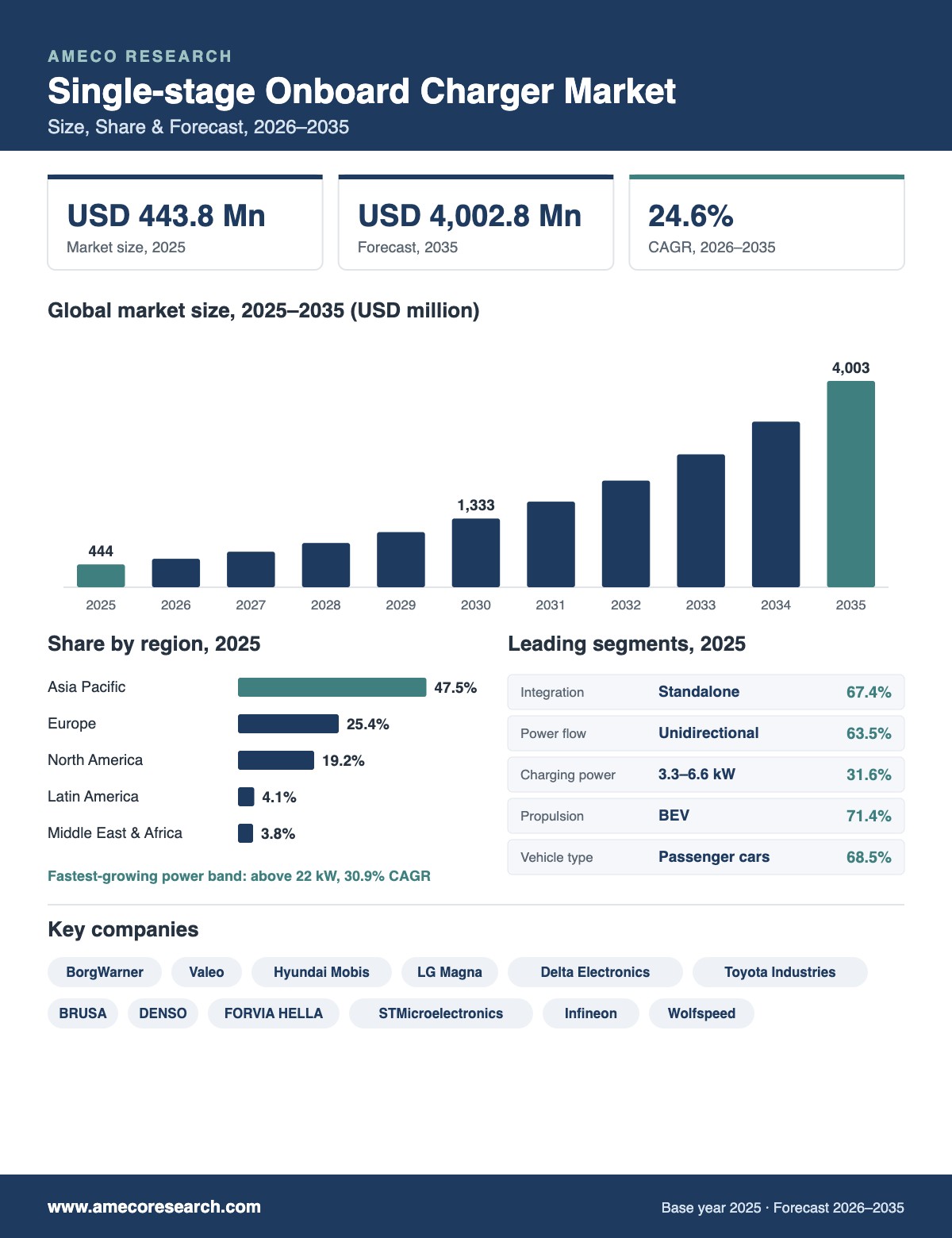
The global single-stage onboard charger market size was valued at USD 443.8 million in 2025 and is projected to reach USD 4,002.8 million by 2035, growing at a CAGR of 24.6% from 2026 to 2035. The market is estimated at USD 553.0 million in 2026, with Asia Pacific holding the largest share and battery electric vehicles driving the fastest growth.
A single-stage onboard charger (OBC) is the power electronics unit inside an electric vehicle that converts AC grid power into DC power for the traction battery using one integrated conversion stage. Instead of the conventional two-stage design, a power factor correction (PFC) rectifier followed by an isolated DC-DC converter, a single-stage OBC combines both functions, removing the large DC-link capacitor and cutting the number of magnetic and semiconductor components.
The result is a smaller, lighter and lower-cost charger with fewer conversion losses, which matters as automakers push for higher power density, 800 V platforms and bidirectional charging. Advances in silicon carbide (SiC) and gallium nitride (GaN) power semiconductors and digital control are making single-stage topologies practical at 6.6 kW, 11 kW and 22 kW ratings, opening a fast-growing niche within the wider EV onboard charger market.
Single-stage Onboard Charger Market Key Takeaways
Single-stage Onboard Charger Market Report Scope
| Report Attribute | Details |
| Single-stage Onboard Charger Market Size in 2025 | USD 443.8 Million |
| Single-stage Onboard Charger Market Size in 2026 | USD 553.0 Million |
| Single-stage Onboard Charger Market Forecast by 2035 | USD 4,002.8 Million |
| Single-stage Onboard Charger Market CAGR (2026–2035) | 24.6% |
| Historical Data | 2021–2024 |
| Base Year | 2025 |
| Forecast Period | 2026–2035 |
| Largest Region | Asia Pacific (47.5% share in 2025) |
| Segments Covered | Integration Type, Power Flow, Charging Power, Semiconductor Material, Propulsion Type, Vehicle Type and Region |
| Regional Scope | North America, Europe, Asia Pacific, Latin America, and Middle East & Africa |
| Key Companies Profiled | BorgWarner, Valeo, Hyundai Mobis, LG Magna e-Powertrain, Delta Electronics, Toyota Industries, BRUSA HyPower, DENSO, FORVIA HELLA, STMicroelectronics, Infineon Technologies and Wolfspeed |
| Report Coverage | Market size and forecast, trends, drivers, restraints, opportunities, segment and regional analysis, competitive landscape, recent developments |
How Big Is the Single-stage Onboard Charger Market in 2026?
Ameco Research estimates the single-stage onboard charger market at USD 553.0 million in 2026, up about 25% from USD 443.8 million in 2025. The market is expected to reach roughly USD 1,332.8 million by 2030 and USD 4,002.8 million by 2035, as single-stage designs move from early programs into high-volume EV platforms and SiC and GaN devices become cheaper.
| Year | Single-stage Onboard Charger Market Size (USD Million) |
| 2025 | 443.8 |
| 2026 | 553.0 |
| 2028 | 858.5 |
| 2030 | 1,332.8 |
| 2032 | 2,069.3 |
| 2035 | 4,002.8 |
Latest Single-stage Onboard Charger Market Trends 2026
Single-stage topologies move into production
Automakers and Tier 1 suppliers are replacing two-stage chargers with single-stage designs to remove the DC-link capacitor, cut part counts and save space. The approach is especially attractive for compact cars, two- and three-wheelers and integrated power units where every liter and kilogram counts.
800 V platforms and silicon carbide
High-voltage 800 V architectures need chargers rated for 200–800 V outputs. SiC MOSFETs enable these designs with peak efficiency above 96% and power densities around 3 kW per liter at 22 kW, and BorgWarner is preparing series production of a bidirectional 800 V onboard charger for a North American automaker from January 2027.
GaN pushes power density further
Gallium nitride is emerging as the next step. The EU-funded HiPower 5.0 project, led by Fraunhofer IZM with partners including Infineon, Mercedes-Benz, Valeo and Mahle, aims to fit a 22 kW bidirectional onboard charger into just 4 liters using Infineon’s monolithic bidirectional GaN switch.
Bidirectional charging becomes standard
Vehicle-to-load, vehicle-to-home and vehicle-to-grid services are spreading, and single-stage bidirectional OBCs let carmakers add these features with little extra hardware. Bidirectional units are expected to make up more than 60% of the market by 2035.
Integration with DC-DC converters and inverters
Suppliers are combining the OBC with the DC-DC converter and power distribution unit in one housing, creating integrated "3-in-1" or multifunction units. Integrated single-stage OBCs are growing at about 26.5% a year, faster than standalone units.
Isolation-free and virtually isolated designs
New concepts that remove or shrink the transformer are gaining attention. In 2025, FORVIA HELLA partnered with Tau Motors to develop a virtually isolated onboard charger (viOBC), with HELLA Ventures also investing in the start-up.
Single-stage Onboard Charger Market Dynamics
Growth drivers
- Rising EV sales: global electric car sales passed 20 million units in 2025, about one in four new cars sold, and every plug-in vehicle needs an onboard charger.
- Need for smaller, lighter chargers: single-stage designs remove bulky capacitors and components, freeing space and weight for battery capacity and range.
- Lower system cost: fewer parts and a simpler bill of materials help automakers reduce the cost of entry-level and mid-range EVs.
- Expanding AC charging networks: more than 1.3 million public charging points were added worldwide in 2024, most of them AC chargers that rely on the vehicle’s onboard charger.
- Wide-bandgap semiconductors: SiC and GaN devices make high-frequency, high-efficiency single-stage conversion practical at higher power levels.
Restraints and challenges
- Design complexity: single-stage converters need advanced control to handle power factor correction, isolation and battery charging in one stage.
- Low-frequency ripple: without a large DC-link capacitor, twice-line-frequency ripple passes to the battery, which must be managed carefully to protect battery life.
- High cost of SiC and GaN parts: wide-bandgap devices are still more expensive than silicon, raising the cost of high-power and 800 V designs.
- Thermal and EMI challenges: higher power density and faster switching make heat removal and electromagnetic compatibility harder.
- Uneven EV demand: changes in subsidies, tariffs and EV sales growth in some markets can delay new vehicle programs.
Opportunities
- Vehicle-to-grid services create demand for bidirectional single-stage OBCs that turn EVs into mobile energy storage.
- Two- and three-wheelers in India and Southeast Asia need compact, low-cost chargers, an ideal fit for single-stage designs.
- Integrated power units that combine the OBC, DC-DC converter and inverter offer higher value per vehicle.
- Government EV programs such as India’s PM E-DRIVE scheme, with an outlay of INR 10,900 crore, and the EU’s AFIR charging rules support EV adoption.
- 22 kW three-phase charging in Europe and China opens room for high-power single-stage chargers.
Single-stage Onboard Charger Market Segment Analysis
By integration type: Why do standalone units lead?
Standalone single-stage OBCs accounted for 67.4% of revenue in 2025 because they are easy to fit into existing vehicle platforms and are supplied by many established Tier 1 suppliers. Integrated single-stage OBCs, combined with DC-DC converters or other power electronics, held 32.6% and are growing faster at about a 26.5% CAGR, expected to become the larger segment by 2035.
| Integration Type | Share (2025) | Key Highlights |
| Standalone Single-stage OBC | 67.4% | Separate charger module; easy to package across platforms |
| Integrated Single-stage OBC | 32.6% | Combined with DC-DC/PDU; fastest-growing at 26.5% CAGR |
By power flow: Is bidirectional charging taking over?
Unidirectional chargers held 63.5% share in 2025, as most current EVs only charge from the grid. Bidirectional chargers accounted for 36.5% and are growing faster as automakers add vehicle-to-load and vehicle-to-grid features; they are expected to represent more than 60% of the market by 2035.
| Power Flow | Share (2025) | Key Highlights |
| Unidirectional | 63.5% | Grid-to-vehicle charging only; lower cost |
| Bidirectional | 36.5% | Supports V2L, V2H and V2G; set to lead by 2035 |
By charging power
Chargers rated 3.3 kW to 6.6 kW held the largest share at 31.6% in 2025, common in plug-in hybrids, compact EVs and markets with single-phase home power. Chargers above 22 kW are the fastest-growing band at a 30.9% CAGR, driven by premium EVs and commercial vehicles that need faster AC charging.
| Charging Power | Share (2025) | Key Highlights |
| Up to 3.3 kW | 14.8% | Two-wheelers, three-wheelers and small PHEVs |
| 3.3–6.6 kW | 31.6% | Largest band; PHEVs and compact EVs |
| 6.6–11 kW | 27.2% | Mainstream BEVs; standard 11 kW three-phase in Europe |
| 11–22 kW | 19.3% | Premium BEVs and 800 V platforms |
| Above 22 kW | 7.1% | Fastest-growing at 30.9% CAGR; commercial vehicles and buses |
By semiconductor material: Will SiC overtake silicon?
Silicon devices still accounted for 44.6% of revenue in 2025 because of their low cost and maturity. Silicon carbide held 35.8% and is expected to become the largest material by 2035 as 800 V platforms spread, while GaN is emerging in compact, high-frequency chargers.
| Semiconductor Material | Share (2025) | Key Highlights |
| Silicon (Si) | 44.6% | Low cost and mature supply; common in 400 V chargers |
| Silicon Carbide (SiC) | 35.8% | High efficiency at 800 V; set to lead by 2035 |
| Gallium Nitride (GaN) & Others | 19.6% | Very high switching frequency and power density |
By propulsion type
Battery electric vehicles (BEVs) accounted for 71.4% of demand in 2025 and are the fastest-growing propulsion type at about a 26.6% CAGR, as BEVs use higher-rated chargers and dominate new EV launches. Plug-in hybrids (PHEVs) held 28.6%, mainly with lower-power 3.3–6.6 kW chargers.
| Propulsion Type | Share (2025) | Key Highlights |
| Battery Electric Vehicles (BEV) | 71.4% | Fastest-growing at 26.6% CAGR; higher charger ratings |
| Plug-in Hybrid Electric Vehicles (PHEV) | 28.6% | Smaller batteries and lower-power chargers |
By vehicle type
Passenger cars accounted for 68.5% of revenue in 2025. Light commercial vehicles held 12.4%, supported by electric delivery vans, while two- and three-wheelers held 12.2% and are a key opportunity for compact single-stage chargers in Asia.
| Vehicle Type | Share (2025) | Key Highlights |
| Passenger Cars | 68.5% | Largest segment; high EV volumes in China and Europe |
| Light Commercial Vehicles | 12.4% | Electric vans for e-commerce and urban delivery |
| Two- & Three-Wheelers | 12.2% | Compact, low-cost chargers for India and Southeast Asia |
| Heavy Commercial Vehicles & Buses | 6.9% | High-power AC charging for depots |
Single-stage Onboard Charger Market Regional Analysis
| Region | Share (2025) | Outlook |
| Asia Pacific | 47.5% | Largest market; China, South Korea, Japan and fast-growing India |
| Europe | 25.4% | EU CO2 targets, AFIR charging rules and 11–22 kW three-phase charging |
| North America | 19.2% | 800 V bidirectional programs and NEVI-funded charging |
| Latin America | 4.1% | Early EV adoption in Brazil, Mexico and Chile |
| Middle East & Africa | 3.8% | EV programs in the UAE, Saudi Arabia and South Africa |
Why does Asia Pacific dominate the single-stage onboard charger market?
Asia Pacific accounted for about 47.5% of global revenue in 2025. China is the world’s largest EV producer and home to many onboard charger and power semiconductor suppliers, South Korea and Japan host Hyundai Mobis, LG Magna, Toyota Industries and DENSO, and India is growing quickly under the PM E-DRIVE scheme. In 2025, Sterling Gtake E-Mobility partnered with Landworld Technology to produce onboard chargers and DC-DC converters in India.
How are Europe and North America developing?
Europe held about 25.4% of the market in 2025. Strict fleet CO2 targets, the AFIR regulation requiring charging pools along the TEN-T core network, and widespread 11 kW and 22 kW three-phase AC charging support demand for high-power single-stage chargers. North America represented about 19.2%, driven by 800 V bidirectional charger programs, federal NEVI charging funding and growing interest in vehicle-to-home backup power.
Single-stage Onboard Charger Market Segmentation
Single-stage Onboard Charger Market Leading Companies
The single-stage onboard charger market includes automotive Tier 1 power electronics suppliers, Asian charger specialists and power semiconductor companies that supply SiC and GaN devices and reference designs. Competition centers on power density, efficiency, bidirectional capability, 800 V readiness, cost and the ability to integrate the charger with other power electronics.
BorgWarner · Valeo · Hyundai Mobis · LG Magna e-Powertrain · Delta Electronics · Toyota Industries · BRUSA HyPower · DENSO · FORVIA HELLA · STMicroelectronics · Infineon Technologies · Wolfspeed
Recent developments
- May 2026: The EU-funded HiPower 5.0 project, led by Fraunhofer IZM with partners including Infineon, Mercedes-Benz, Valeo and Mahle, outlined its goal of a 22 kW bidirectional onboard charger in a 4-liter package using bidirectional GaN switches.
- September 2025: FORVIA HELLA and Tau Motors entered a development cooperation for a virtually isolated onboard charger (viOBC), with HELLA Ventures investing in Tau Motors.
- September 2025: Sterling Gtake E-Mobility partnered with Landworld Technology to supply onboard chargers, DC-DC converters and multifunction units in India, targeting about INR 450 crore in business by FY2030.
- Ongoing: BorgWarner is preparing to start series production in January 2027 of its SiC-based bidirectional 800 V onboard charger, rated 19.2 kW single-phase and 22 kW three-phase, for a major North American automaker.
Single-stage Onboard Charger Market: Frequently Asked Questions
How big is the single-stage onboard charger market?
The global single-stage onboard charger market was valued at USD 443.8 million in 2025 and is estimated at USD 553.0 million in 2026. Ameco Research projects it to reach USD 4,002.8 million by 2035, growing at a CAGR of 24.6% from 2026 to 2035.
What is the growth rate of the single-stage onboard charger market?
The market is expected to grow at a CAGR of 24.6% between 2026 and 2035, about nine times its 2025 size, as automakers adopt compact, lower-cost single-stage chargers in new battery electric and plug-in hybrid vehicles.
What is a single-stage onboard charger?
A single-stage onboard charger (OBC) is the in-vehicle device that converts AC power from a wall box or public AC charger into DC power to charge an EV battery, using one combined power conversion stage. It merges power factor correction (PFC) and isolated DC-DC conversion into a single stage, instead of the two separate stages used in conventional chargers.
What is the difference between single-stage and two-stage onboard chargers?
A two-stage OBC uses a PFC rectifier followed by a separate isolated DC-DC converter, linked by a large DC-link capacitor. A single-stage OBC performs both functions in one converter, removing the bulky DC-link capacitor and many components. This makes it smaller, lighter and cheaper, but it needs more advanced control and handles low-frequency ripple on the battery side.
Why is silicon carbide used in onboard chargers?
Silicon carbide (SiC) transistors switch faster and lose less energy than silicon parts, especially at 800 V. They let OBCs reach peak efficiency above 96% and power densities of around 3 kW per liter at 22 kW. SiC held about 35.8% of the market in 2025 and is expected to become the leading material by 2035.
What is a bidirectional onboard charger?
A bidirectional OBC can both charge the battery and send power back out, enabling vehicle-to-load (V2L), vehicle-to-home (V2H) and vehicle-to-grid (V2G) use. Bidirectional chargers held about 36.5% of the single-stage OBC market in 2025 and are expected to account for more than 60% by 2035.
Which region leads the single-stage onboard charger market?
Asia Pacific leads with about 47.5% of global revenue in 2025, driven by China’s EV production and fast growth in India, South Korea and Japan. Europe is the second-largest region with about 25.4%, supported by EU CO2 targets and the AFIR charging regulation.
Who are the key players in the single-stage onboard charger market?
Leading companies include BorgWarner, Valeo, Hyundai Mobis, LG Magna e-Powertrain, Delta Electronics, Toyota Industries, BRUSA HyPower, DENSO, FORVIA HELLA, STMicroelectronics, Infineon Technologies and Wolfspeed.
Related Automobile & Transportation Market Reports
- Automotive Headlamp Reflector Market Size, Share, Trends & Growth Opportunities Forecast to 2026 - 2035
- Hydrogen Buses Market Size, Share, Trends & Growth Opportunities Forecast to 2026 - 2035
- Electric Vehicle Charging Station Market Growth Opportunities and Forecast till 2035
- Electric Vehicle Market Growth Opportunities and Forecast till 2035
- Car Rental Market Size and Growth Opportunities and Forecast till 2026 - 2035