Battery Energy Storage System (BESS) Market Size, Share, Trends & Growth Opportunities Forecast to 2026 - 2035
Battery Energy Storage System (BESS) Market Size, Share & Trends Report, 2026–2035
LAST UPDATED: NOVEMBER 2026
The global battery energy storage system (BESS) market size was valued at USD 41.8 billion in 2025 and is projected to reach USD 198.5 billion by 2035, growing at a CAGR of 15.9% from 2026 to 2035. The market is estimated at USD 52.6 billion in 2026, as record solar and wind additions, AI data center power demand and falling lithium iron phosphate (LFP) battery prices drive giga-scale storage deployments. Asia Pacific holds the largest share, while the Middle East & Africa is the fastest-growing region.
A battery energy storage system (BESS) stores electricity in rechargeable batteries and delivers it back to the grid or to a site when it is needed. Modern systems are largely built from lithium iron phosphate (LFP) cells packed into containerized units of 5 MWh or more, together with power conversion systems (PCS), battery and energy management software, thermal management and fire safety equipment. BESS can respond in milliseconds, which makes it valuable for frequency regulation, peak shaving, renewable firming and backup power.
Battery storage has become the fastest-growing part of the power sector. Utilities and developers are pairing batteries with almost every new solar plant, grid operators are using them to replace gas peakers, and data center operators are adding storage to secure power for AI workloads. Battery pack prices have fallen sharply, and the battery energy storage system market is now growing in every major region, from China and the U.S. to Australia, Europe, India and the Gulf.
BESS Market Key Takeaways
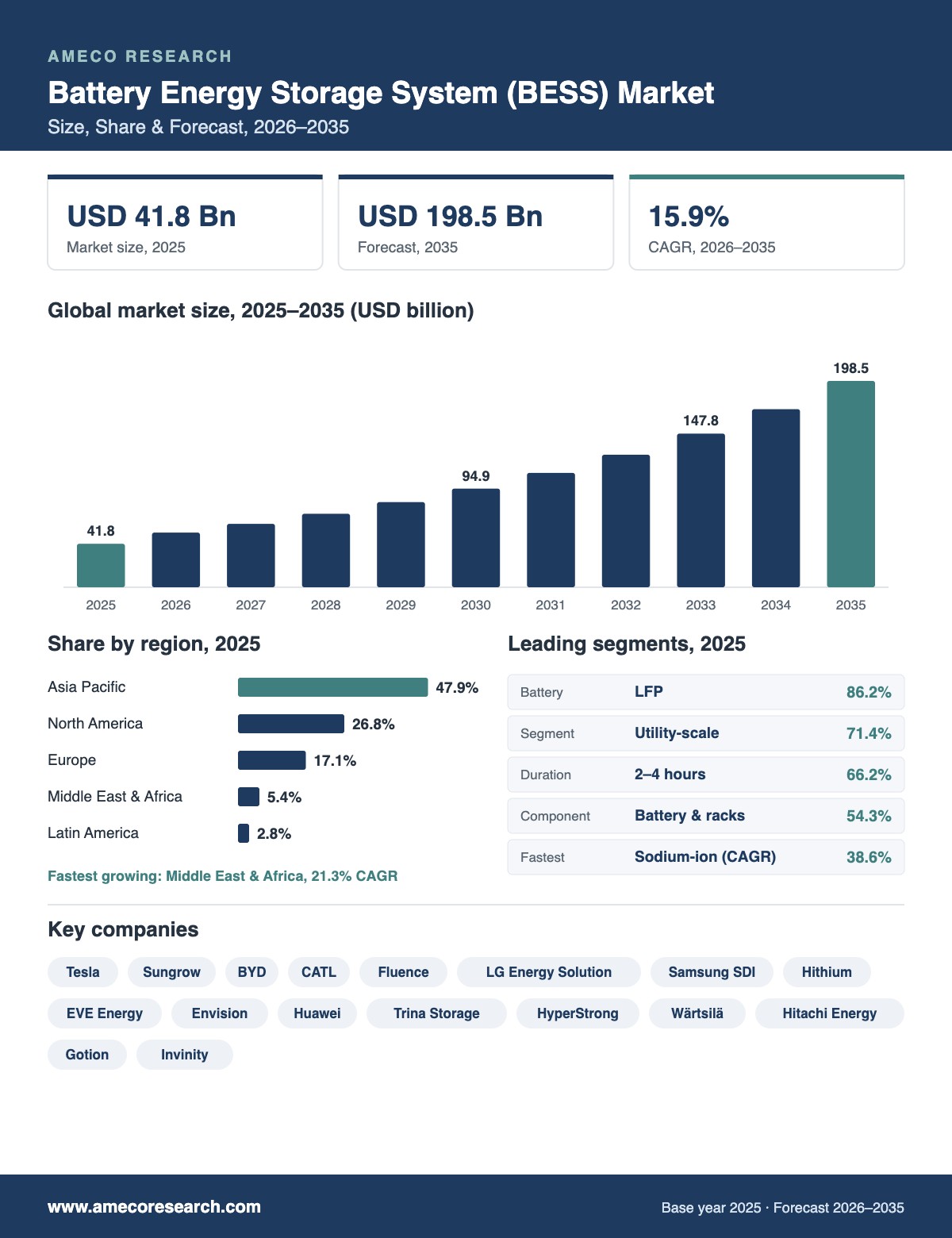 Infographic: Battery Energy Storage System (BESS) Market Size, Share, Trends & Growth Opportunities Forecast to 2026 - 2035 | Ameco Research
BESS Market Report Scope
| Report Attribute | Details |
| BESS Market Size in 2025 | USD 41.8 Billion |
| BESS Market Size in 2026 | USD 52.6 Billion |
| BESS Market Forecast by 2035 | USD 198.5 Billion |
| BESS Market CAGR (2026–2035) | 15.9% |
| Historical Data | 2021–2024 |
| Base Year | 2025 |
| Forecast Period | 2026–2035 |
| Largest Region | Asia Pacific (47.9% share in 2025) |
| Fastest-Growing Region | Middle East & Africa (21.3% CAGR) |
| Segments Covered | Battery Type, Component, Segment (Utility-Scale, C&I, Residential), Duration, Connection Type and Region |
| Regional Scope | North America, Europe, Asia Pacific, Latin America, and Middle East & Africa |
| Key Companies Profiled | Tesla, Sungrow, BYD, CATL, Fluence Energy, LG Energy Solution, Samsung SDI, Hithium, EVE Energy, Envision Energy, Huawei Digital Power, Trina Storage, HyperStrong, Wärtsilä, Hitachi Energy, Gotion High-Tech and Invinity Energy Systems |
| Report Coverage | Market size and forecast in USD and GWh, installation outlook, BESS pricing (USD/kWh), battery chemistry analysis, supply chain and trade policy, business models and revenue stacking, trends, drivers, restraints, opportunities, segment and regional analysis, competitive landscape, recent developments |
How Big Is the Battery Energy Storage System Market in 2026?
Ameco Research estimates the battery energy storage system market at USD 52.6 billion in 2026, up about 26% from USD 41.8 billion in 2025. Installed volumes are growing even faster than revenue: BloombergNEF expects a record 188 GW and 535 GWh of new storage worldwide in 2026, but falling system prices mean each gigawatt-hour generates less revenue. The market is expected to pass USD 90 billion by 2030, reaching about USD 94.9 billion, and climb to USD 198.5 billion by 2035.
| Year | BESS Market Size (USD Billion) |
| 2025 | 41.8 |
| 2026 | 52.6 |
| 2027 | 61.0 |
| 2028 | 70.7 |
| 2030 | 94.9 |
| 2032 | 127.5 |
| 2035 | 198.5 |
Latest BESS Market Trends 2026
Record installations in every major market
Global storage additions are set to reach a record 188 GW and 535 GWh in 2026, according to BloombergNEF. The U.S. installed a record 18.9 GWh in the second quarter of 2026, India’s tender-driven additions are expected to exceed 6 GW, and Australia’s annual additions are set to nearly double.
Data centers become a major buyer
AI data centers need large amounts of reliable power quickly. Operators are adding on-site BESS to manage grid connection limits, ride through outages and smooth fast GPU load swings, and Wood Mackenzie identifies data center demand as a key driver of U.S. utility-scale and longer-duration storage.
Longer durations and bigger blocks
Projects are moving from 1–2 hour systems to 4-hour and longer durations as batteries take over evening peaks. Containers have grown to 5–6 MWh and more using 500+ Ah LFP cells, cutting land, cabling and installation costs per kWh.
Sodium-ion and new chemistries reach the grid
In June 2026, CATL launched TENER Sodium, which it described as the world’s first field-validated sodium-ion BESS. Sodium-ion offers better cold-weather performance and avoids lithium, while flow batteries and iron-air systems target 8-hour-plus storage.
Chinese suppliers dominate, local supply grows
Chinese companies supplied about 76% of global BESS in 2025, and Tesla, Sungrow and BYD were the top three integrators. At the same time, U.S. tariffs and foreign-entity rules are driving new local cell production, such as Tesla’s first Nevada-made LFP cells shipped in 2026.
Giga-scale hybrid projects
Developers are building multi-gigawatt-hour solar-plus-storage plants designed to supply power around the clock, such as the 19 GWh battery project planned in Abu Dhabi alongside 5.2 GW of solar.
BESS Market Dynamics
Growth drivers
- Renewable integration: rapid solar and wind growth creates price swings and curtailment that batteries can capture and smooth.
- Falling costs: LFP cell prices and turnkey system prices have fallen sharply, making storage cheaper than gas peakers in many markets.
- Grid reliability and capacity needs: rising electricity demand from AI data centers, electrification and extreme weather increases the need for flexible capacity.
- Supportive policy: U.S. investment tax credits, China’s 2030 storage targets, India’s viability gap funding and tenders, and capacity markets in Europe and Australia support deployment.
- Revenue stacking: batteries earn from arbitrage, frequency services, capacity payments and congestion relief at the same time.
Restraints and challenges
- Grid connection queues: long interconnection wait times delay many projects.
- Price pressure: falling system prices squeeze margins for manufacturers and integrators.
- Trade and policy risk: tariffs, foreign-entity rules and changing incentives affect supply chains and project economics.
- Safety and permitting: fire incidents have led to stricter codes and local opposition in some areas.
- Revenue cannibalization: as more batteries join a market, arbitrage and ancillary service prices can fall.
Opportunities
- Long-duration storage of 8 hours or more for firm renewable power.
- Data center and industrial microgrids combining BESS with on-site generation.
- Emerging markets in India, the Middle East, Latin America, Africa and Southeast Asia.
- Grid-forming inverters that let batteries provide inertia and black-start services.
- Repowering, augmentation and second-life batteries for existing storage sites.
BESS Market Segment Analysis
By battery type: Why does LFP dominate?
Lithium iron phosphate (LFP) batteries accounted for 86.2% of BESS revenue in 2025, about USD 36.0 billion, because they offer long cycle life, strong safety and low cost. NMC and other lithium-ion chemistries held 7.9%, flow batteries 2.4%, lead-acid 1.8%, and sodium-ion and other emerging chemistries 1.7%. Sodium-ion is the fastest-growing battery type at about a 38.6% CAGR.
| Battery Type | Share (2025) | Key Highlights |
| Lithium Iron Phosphate (LFP) | 86.2% | Largest; standard for utility-scale and C&I storage |
| NMC & Other Lithium-Ion | 7.9% | Residential and space-constrained projects |
| Flow Batteries | 2.4% | Long-duration vanadium and zinc systems |
| Lead-Acid | 1.8% | Legacy backup and off-grid uses |
| Sodium-Ion & Others | 1.7% | Fastest-growing at 38.6% CAGR; cold-climate and low-cost storage |
By component
Battery cells, modules and racks made up 54.3% of BESS value in 2025. Engineering, integration, enclosures, thermal management and other balance-of-system costs accounted for 23.9%, power conversion systems (PCS) 14.6%, and energy management systems (EMS) and software 7.2%. Software is growing fastest as owners rely on AI-based trading and optimization to maximize revenue.
| Component | Share (2025) | Key Highlights |
| Battery Cells, Modules & Racks | 54.3% | Largest; LFP cells of 300–600+ Ah |
| Balance of System & Integration | 23.9% | Enclosures, HVAC, fire safety, EPC |
| Power Conversion System (PCS) | 14.6% | Inverters, including grid-forming designs |
| EMS & Software | 7.2% | Fastest-growing; trading and fleet optimization |
By segment: utility-scale, C&I and residential
Utility-scale (front-of-the-meter) storage held 71.4% of revenue in 2025, driven by solar-plus-storage plants, standalone grid batteries and capacity procurement. Commercial and industrial (C&I) storage accounted for 15.8% and is gaining momentum from data centers, factories and EV charging hubs. Residential storage held 12.8%, led by Europe, Australia, the U.S. and Japan.
| Segment | Share (2025) | Key Highlights |
| Utility-Scale (Front-of-the-Meter) | 71.4% | Largest; renewable firming, arbitrage and capacity |
| Commercial & Industrial (C&I) | 15.8% | Data centers, factories, peak shaving and backup |
| Residential | 12.8% | Home solar-plus-storage and backup power |
By duration and connection type
Systems with a duration of 2–4 hours accounted for 66.2% of revenue in 2025. Systems below 2 hours held 18.6%, mainly for frequency services, while systems above 4 hours held 15.2% and are the fastest-growing duration class at about a 22.4% CAGR. On-grid systems represented 88.7% of the market and off-grid systems, including islands, mines and remote communities, 11.3%.
| Duration / Connection | Share (2025) | Key Highlights |
| Below 2 Hours | 18.6% | Frequency regulation and fast response |
| 2–4 Hours | 66.2% | Largest; daily solar shifting and peak capacity |
| Above 4 Hours | 15.2% | Fastest-growing at 22.4% CAGR; long-duration firming |
| On-Grid | 88.7% | Utility, C&I and grid-tied residential |
| Off-Grid | 11.3% | Islands, mines, remote and microgrid sites |
BESS Market Regional Analysis
| Region | Share (2025) | Outlook |
| Asia Pacific | 47.9% | Largest; China, Australia, India, Japan and South Korea |
| North America | 26.8% | Record U.S. installs; data centers and tax credits |
| Europe | 17.1% | Germany, U.K., Italy, Spain; residential and grid-scale |
| Middle East & Africa | 5.4% | Fastest-growing at 21.3% CAGR; UAE and Saudi giga-projects |
| Latin America | 2.8% | Chile, Brazil and Mexico solar-plus-storage |
Why does Asia Pacific lead the BESS market?
Asia Pacific accounted for about 47.9% of revenue in 2025. China is both the largest market and the main manufacturing base, home to CATL, BYD, Sungrow, Hithium, EVE Energy, Envision and other leading suppliers, and has set a 300 GW storage deployment target for 2030. Australia is rapidly scaling grid batteries as coal plants retire, and India is expected to add more than 6 GW in 2026 through government tenders.
How is North America performing?
North America held about 26.8% of the market in 2025. The U.S. installed a record 18.9 GWh in the second quarter of 2026, with Texas, California and Arizona leading. Investment tax credits, data center demand and strong utility procurement support continued growth, while tariffs and foreign-entity rules are encouraging domestic cell and system manufacturing.
What makes the Middle East & Africa the fastest-growing region?
The Middle East and Africa represented about 5.4% of revenue in 2025 but is forecast to grow at a 21.3% CAGR. The UAE and Saudi Arabia are building some of the world’s largest battery projects to pair with solar, including the 19 GWh Abu Dhabi project, and South Africa and other African countries are adding storage to tackle power shortages.
How is Europe developing?
Europe accounted for about 17.1% of revenue in 2025. Germany and Italy lead residential storage, while the U.K., Italy, Germany and Spain are scaling grid-scale batteries through capacity markets and grid needs. The EU Batteries Regulation is shaping local sourcing, recycling and carbon footprint rules.
BESS Market Segmentation
BESS Market Leading Companies
The BESS market includes system integrators, battery cell makers and power electronics suppliers. Tesla, Sungrow and BYD were the top three integrators in 2025, and eight of the top ten integrators are based in China. CATL, BYD, EVE Energy, Hithium, LG Energy Solution and Samsung SDI lead in storage cells, while Fluence, Wärtsilä, Trina Storage, HyperStrong, Envision and Huawei Digital Power compete in integration, power conversion and software.
Tesla · Sungrow · BYD · CATL · Fluence Energy · LG Energy Solution · Samsung SDI · Hithium · EVE Energy · Envision Energy · Huawei Digital Power · Trina Storage · HyperStrong · Wärtsilä · Hitachi Energy · Gotion High-Tech · Invinity Energy Systems
Recent developments
- October 2026: BloombergNEF forecast record global storage additions of 188 GW / 535 GWh in 2026, rising to 209 GW / 638 GWh in 2027.
- October 2026: Tesla deployed 13.7 GWh of energy storage in the third quarter of 2026 and said its first LFP cells made in Nevada had shipped.
- October 2026: Wood Mackenzie and the American Clean Power Association reported a record 18.9 GWh of U.S. energy storage installed in the second quarter of 2026.
- June 2026: CATL launched TENER Sodium, described as the world’s first field-validated sodium-ion battery energy storage system.
- June 2026: Wood Mackenzie’s integrator ranking placed Tesla, Sungrow and BYD as the top three global BESS integrators for 2025, with Chinese suppliers holding 76% of the market.
- January 2025: Masdar and EWEC announced a round-the-clock renewable project in Abu Dhabi combining 5.2 GW of solar with 19 GWh of battery storage.
BESS Market: Frequently Asked Questions
How big is the battery energy storage system (BESS) market?
The global battery energy storage system market was valued at USD 41.8 billion in 2025 and is estimated at USD 52.6 billion in 2026. Ameco Research projects it to reach USD 198.5 billion by 2035, growing at a CAGR of 15.9% from 2026 to 2035.
What is a battery energy storage system?
A battery energy storage system (BESS) stores electricity in rechargeable batteries and releases it when needed. A typical system combines battery cells and racks, a power conversion system (inverter), a battery management system, an energy management system, thermal management and fire protection. BESS is used to shift solar and wind power, stabilize grids, cut peak demand charges and provide backup power.
How much battery storage will be installed in 2026?
BloombergNEF expects a record 188 GW and 535 GWh of energy storage to be added worldwide in 2026, up about 45% from 2025, with China, the U.S. and Australia accounting for about 62% of new installations. In the U.S., Wood Mackenzie and ACP reported a record 18.9 GWh installed in the second quarter of 2026 alone.
Which battery type dominates the BESS market?
Lithium iron phosphate (LFP) batteries dominate, with about 86.2% of BESS revenue in 2025, because they are safer, last longer and cost less than NMC batteries. Sodium-ion is the fastest-growing chemistry, after CATL launched the first field-validated sodium-ion BESS in June 2026, while flow batteries serve long-duration projects.
What is the largest application of battery energy storage?
Utility-scale (front-of-the-meter) storage held about 71.4% of BESS revenue in 2025, used for solar and wind firming, energy arbitrage, frequency regulation and capacity. Commercial and industrial storage held 15.8%, including fast-growing data center projects, and residential storage held 12.8%.
How much does a battery energy storage system cost?
Turnkey utility-scale BESS prices fell sharply in 2024 and 2025 and are now well below USD 200 per kWh in most markets, and close to USD 100 per kWh in China, because of cheaper LFP cells, larger 5–6 MWh containers and intense competition. Prices vary with duration, location, grid connection and tariffs.
Which region leads the BESS market?
Asia Pacific led with about 47.9% of revenue in 2025, driven by China, which is the largest market and makes most of the world’s storage batteries. North America is second with 26.8%. The Middle East and Africa is the fastest-growing region at about a 21.3% CAGR, led by giga-scale projects in the UAE and Saudi Arabia.
Who are the leading companies in the battery energy storage system market?
Tesla, Sungrow and BYD were the top three BESS integrators in 2025, and Chinese companies supplied about 76% of global systems. Other key companies include CATL, Fluence Energy, LG Energy Solution, Samsung SDI, Hithium, EVE Energy, Envision Energy, Huawei Digital Power, Trina Storage, HyperStrong, Wärtsilä and Hitachi Energy.
Related Energy and Power Market Reports
- Solid State Transformer (SST) Market Size, Share, Trends & Growth Opportunities Forecast to 2026 - 2035
- Data Center Battery Market Size, Share, Trends & Growth Opportunities Forecast to 2026 - 2035
- Biogas Market Growth Opportunities and Forecast till 2032
- Mobile Generators Market Growth Opportunities and Forecast till 2032
- Residual Gas Analyzers Market Growth Opportunities and Forecast till 2032