Press Release
Battery Energy Storage System (BESS) Market to Reach USD 198.5 Billion by 2035, Growing at 15.9% CAGR | Ameco Research
Date : Nov 19, 2026
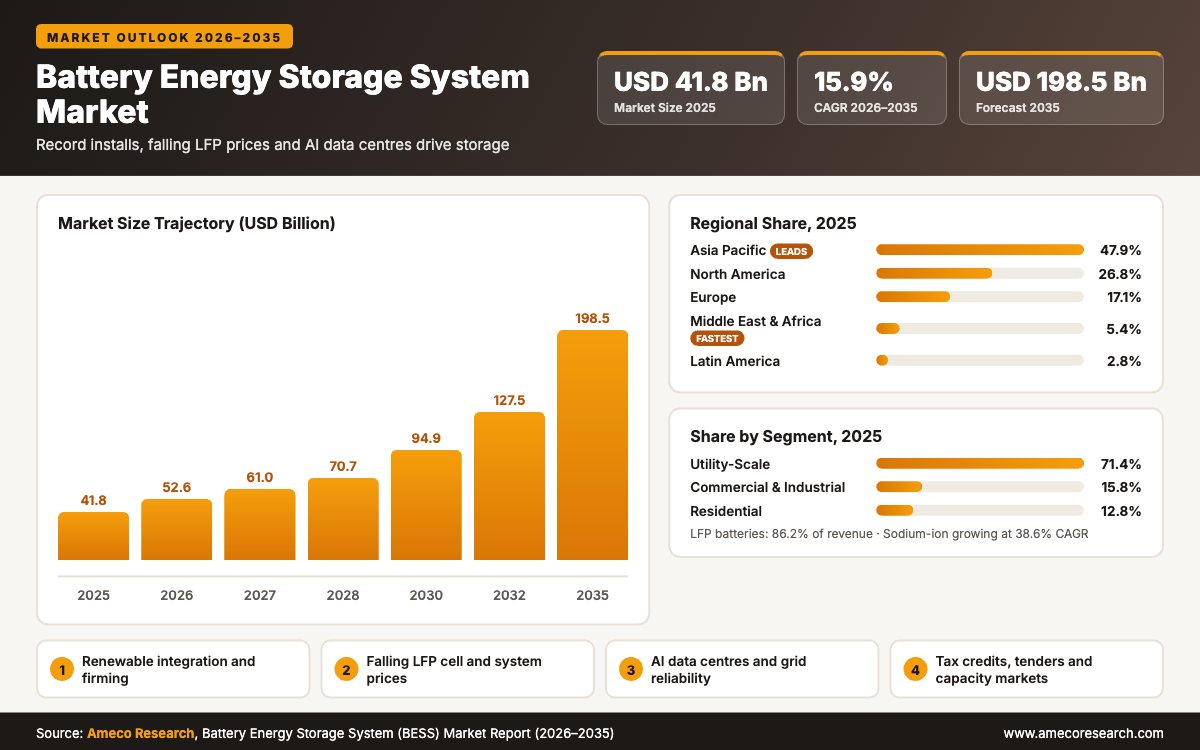
Pune, India, November 19, 2026 — The global battery energy storage system (BESS) market is projected to grow from USD 41.8 billion in 2025 to USD 198.5 billion by 2035, at a CAGR of 15.9% from 2026 to 2035, according to the new Battery Energy Storage System (BESS) Market report from Ameco Research. The market is estimated at USD 52.6 billion in 2026 as record solar and wind additions, AI data centre power demand, and falling lithium iron phosphate (LFP) battery prices drive giga-scale storage projects worldwide.
A battery energy storage system stores electricity in rechargeable batteries and delivers it back to the grid or to a site when it is needed. Modern systems are built mainly from LFP cells packed into containerised units of 5 MWh or more, together with power conversion systems (PCS), battery and energy management software, thermal management, and fire safety equipment. Because batteries respond in milliseconds, BESS is valuable for frequency regulation, peak shaving, renewable firming, and backup power. Utilities now pair batteries with almost every new solar plant, grid operators use them to replace gas peakers, and data centre operators add storage to secure power for AI workloads.
Battery Energy Storage System Market Size and Forecast
Ameco Research estimates the BESS market at USD 52.6 billion in 2026, up about 26% from 2025. Installed volumes are growing even faster than revenue: industry forecasts point to a record 188 GW and 535 GWh of new storage worldwide in 2026, but falling system prices mean each gigawatt-hour generates less revenue. The market is expected to pass USD 90 billion by 2030, reaching about USD 94.9 billion, and climb to USD 198.5 billion by 2035.
| Year | BESS Market Size (USD Billion) |
|---|---|
| 2025 | 41.8 |
| 2026 | 52.6 |
| 2027 | 61.0 |
| 2028 | 70.7 |
| 2030 | 94.9 |
| 2032 | 127.5 |
| 2035 | 198.5 |
Key Takeaways
- Market size: USD 41.8 billion in 2025, about USD 52.6 billion in 2026, and USD 198.5 billion by 2035.
- Growth rate: 15.9% CAGR from 2026 to 2035.
- Leading region: Asia Pacific, with about 47.9% of 2025 revenue.
- Fastest-growing region: Middle East & Africa, at a 21.3% CAGR.
- Leading battery type: LFP, at 86.2%; sodium-ion is growing fastest at about 38.6% CAGR.
- Leading segment: Utility-scale storage, at 71.4%.
- Leading duration: 2–4 hour systems, at 66.2%; systems above 4 hours are growing fastest.
What Is Driving the BESS Market?
Renewable integration
Rapid growth in solar and wind creates midday price dips, evening peaks, and curtailment. Batteries capture cheap surplus power and release it when demand is high, turning variable renewables into dispatchable supply.
Falling costs
LFP cell prices and turnkey system prices have fallen sharply, making battery storage cheaper than new gas peaker plants in many markets. Larger 500+ Ah cells and 5–6 MWh containers are cutting land, cabling, and installation costs per kWh.
Grid reliability and AI data centres
Rising electricity demand from AI data centres, electrification, and extreme weather is increasing the need for flexible capacity. Data centre operators are adding on-site BESS to manage grid connection limits, ride through outages, and smooth fast GPU load swings.
Supportive policy and revenue stacking
U.S. investment tax credits, China’s 2030 storage targets, India’s viability gap funding and tenders, and capacity markets in Europe and Australia support deployment. Batteries can also earn from several revenue streams at once — arbitrage, frequency services, capacity payments, and congestion relief.
Key BESS Market Trends in 2026
- Record installations: The U.S. installed a record 18.9 GWh in the second quarter of 2026, India’s tender-driven additions are expected to exceed 6 GW, and Australia’s annual additions are set to nearly double.
- Longer durations: Projects are moving from 1–2 hour systems to 4-hour and longer durations as batteries take over evening peaks.
- Sodium-ion reaches the grid: In June 2026, CATL launched TENER Sodium, described as the world’s first field-validated sodium-ion BESS, while flow batteries and iron-air systems target 8-hour-plus storage.
- Chinese suppliers dominate, local supply grows: Chinese companies supplied about 76% of global BESS in 2025, while U.S. tariffs and foreign-entity rules are driving local cell production, including Tesla’s first Nevada-made LFP cells shipped in 2026.
- Giga-scale hybrid projects: Developers are building multi-gigawatt-hour solar-plus-storage plants for round-the-clock power, such as the 19 GWh battery project planned in Abu Dhabi alongside 5.2 GW of solar.
Challenges
Long grid interconnection queues delay many projects. Falling system prices squeeze margins for cell makers and integrators, and tariffs, foreign-entity rules, and changing incentives add supply chain and policy risk. Fire incidents have led to stricter codes and local opposition in some areas. As more batteries join a market, arbitrage and ancillary service prices can fall, so owners increasingly rely on software and trading to protect returns.
How a Grid Battery Earns Money
A utility-scale battery typically combines several income streams. Energy arbitrage means charging when power is cheap, often around midday solar peaks, and discharging when prices rise in the evening. Ancillary services pay batteries to keep grid frequency stable, a job they do faster than any power plant. Capacity payments reward batteries for being available during peak demand, and congestion relief helps grid operators avoid costly network upgrades.
Stacking these revenues is what makes many projects bankable. It is also why energy management software is the fastest-growing component of BESS value: AI-based trading and optimisation tools decide when to charge, discharge, or hold capacity to earn the most from each market.
Segment Analysis
| Battery Type | Share, 2025 | Key Highlights |
|---|---|---|
| Lithium iron phosphate (LFP) | 86.2% | Largest; utility-scale and C&I standard |
| NMC & other lithium-ion | 7.9% | Residential and space-constrained projects |
| Flow batteries | 2.4% | Long-duration vanadium and zinc systems |
| Lead-acid | 1.8% | Legacy backup and off-grid uses |
| Sodium-ion & others | 1.7% | Fastest growing at 38.6% CAGR |
By component, battery cells, modules, and racks made up 54.3% of BESS value, balance of system and integration 23.9%, power conversion systems 14.6%, and energy management systems and software 7.2%, the fastest-growing component. By duration, 2–4 hour systems held 66.2%, systems below 2 hours 18.6%, and systems above 4 hours 15.2%, growing fastest at about 22.4% CAGR. On-grid systems represented 88.7% of the market.
| Segment | Share, 2025 | Key Highlights |
|---|---|---|
| Utility-scale (front-of-the-meter) | 71.4% | Renewable firming, arbitrage, capacity |
| Commercial & industrial (C&I) | 15.8% | Data centres, factories, EV charging hubs |
| Residential | 12.8% | Home solar-plus-storage and backup |
Regional Outlook
| Region | Share, 2025 | Outlook |
|---|---|---|
| Asia Pacific | 47.9% | Largest; China, Australia, India, Japan, South Korea |
| North America | 26.8% | Record U.S. installs; data centres and tax credits |
| Europe | 17.1% | Germany, U.K., Italy, Spain |
| Middle East & Africa | 5.4% | Fastest growing at 21.3% CAGR; UAE and Saudi giga-projects |
| Latin America | 2.8% | Chile, Brazil, Mexico solar-plus-storage |
China is both the largest market and the main manufacturing base, with a 300 GW storage deployment target for 2030. Australia is scaling grid batteries as coal plants retire, and India is adding storage through government tenders. In North America, Texas, California, and Arizona lead installations. The Middle East & Africa is the fastest-growing region as the UAE and Saudi Arabia build some of the world’s largest solar-plus-storage projects and South Africa adds storage to tackle power shortages.
Competitive Landscape
The BESS market includes system integrators, battery cell makers, and power electronics suppliers. Tesla, Sungrow, and BYD were the top three integrators in 2025, and eight of the top ten integrators are based in China. CATL, BYD, EVE Energy, Hithium, LG Energy Solution, and Samsung SDI lead in storage cells, while Fluence, Wärtsilä, Trina Storage, HyperStrong, Envision, and Huawei Digital Power compete in integration, power conversion, and software. Hitachi Energy, Gotion High-Tech, and Invinity Energy Systems are also profiled. Tesla deployed 13.7 GWh of energy storage in the third quarter of 2026. For supplier benchmarking, make an inquiry with Ameco Research.
Opportunities Ahead
- Long-duration storage of 8 hours or more for firm renewable power.
- Data centre and industrial microgrids combining BESS with on-site generation.
- Emerging markets in India, the Middle East, Latin America, Africa, and Southeast Asia.
- Grid-forming inverters, repowering, augmentation, and second-life batteries.
For related coverage, see Ameco Research’s Data Center Battery Market, Energy Storage as a Service (ESaaS) Market, Battery Technology Market, and Solid State Transformer Market reports.
Report Scope
| Attribute | Details |
|---|---|
| Market size (2025 / 2026) | USD 41.8 billion / USD 52.6 billion |
| Market size (2035) | USD 198.5 billion |
| CAGR (2026–2035) | 15.9% |
| Historical data / base year | 2021–2024 / 2025 |
| Segments covered | Battery type, component, segment, duration, connection type, region |
| Regions covered | North America, Europe, Asia Pacific, Latin America, Middle East & Africa |
Who Should Read This Report
- Utilities, independent power producers, and storage developers.
- Battery cell makers, integrators, and PCS suppliers.
- Data centre operators and industrial energy buyers.
- Investors and lenders in energy transition infrastructure.
The full report covers market size in USD and GWh, installation outlook, BESS pricing, battery chemistry, supply chain and trade policy, business models, and company profiles. To access it, buy the report.
Frequently Asked Questions
How big is the battery energy storage system market?
The BESS market was USD 41.8 billion in 2025, is estimated at USD 52.6 billion in 2026, and is projected to reach USD 198.5 billion by 2035, according to Ameco Research.
What is the growth rate of the BESS market?
The market is forecast to grow at a CAGR of 15.9% from 2026 to 2035.
Which battery is used most in energy storage?
Lithium iron phosphate (LFP) batteries account for 86.2% of BESS revenue thanks to their long cycle life, safety, and low cost.
Which region is growing fastest?
The Middle East & Africa is the fastest-growing region at a 21.3% CAGR, while Asia Pacific is the largest market.
Who are the top BESS companies?
Leading companies include Tesla, Sungrow, BYD, CATL, Fluence Energy, LG Energy Solution, Samsung SDI, and Hithium.
Conclusion
Battery storage has become the fastest-growing part of the power sector. With a 15.9% CAGR and a forecast value of USD 198.5 billion by 2035, the BESS market will be shaped by renewable integration, AI data centre demand, longer-duration systems, new chemistries, and the balance between Chinese supply and local manufacturing.
Explore the complete Battery Energy Storage System (BESS) Market report for detailed forecasts and competitive analysis.
About Ameco Research
Ameco Research is a market research and consulting firm that provides syndicated reports, custom research, and strategic advisory services across technology, healthcare, energy, automotive, chemicals, and consumer markets. Its analysts combine primary interviews with secondary research to help clients identify growth opportunities and make confident decisions.
Contact Us
Ameco Research
201, Vaidehi-Saaket, Baner - Pashan Link Rd, Pashan, Pune 411021
Phone: +91 898 322 5533
Email: [email protected]
Website: www.amecoresearch.com