Engine Fastener Market Size and Growth Opportunities and Forecast till 2026 - 2035
Engine Fastener Market Size, Share & Trends Report, 2026–2035
LAST UPDATED: OCTOBER 2026
The global Engine Fastener Market size was valued at USD 28.3 billion in 2025 and is projected to reach USD 45.9 billion by 2035, growing at a CAGR of 5% from 2026 to 2035. Growth is driven by global vehicle and hybrid powertrain production, demand for high-strength and lightweight fasteners in modern engines, rising aircraft engine output, and replacement demand from commercial vehicles, off-highway machines and gensets.
Engine fasteners are the bolts, screws, nuts, studs and related parts that hold engine components together, such as cylinder heads, crankshafts, connecting rods, manifolds, oil pans and accessory brackets. They must withstand high temperatures, pressure, vibration and repeated loading, so they are made from high-strength alloy steels, stainless steels, titanium and nickel alloys, often with special coatings. Engine fasteners are used in gasoline and diesel engines for cars, trucks, buses, two-wheelers, marine and power generation, as well as in aircraft engines.
Engine Fastener Market Key Takeaways
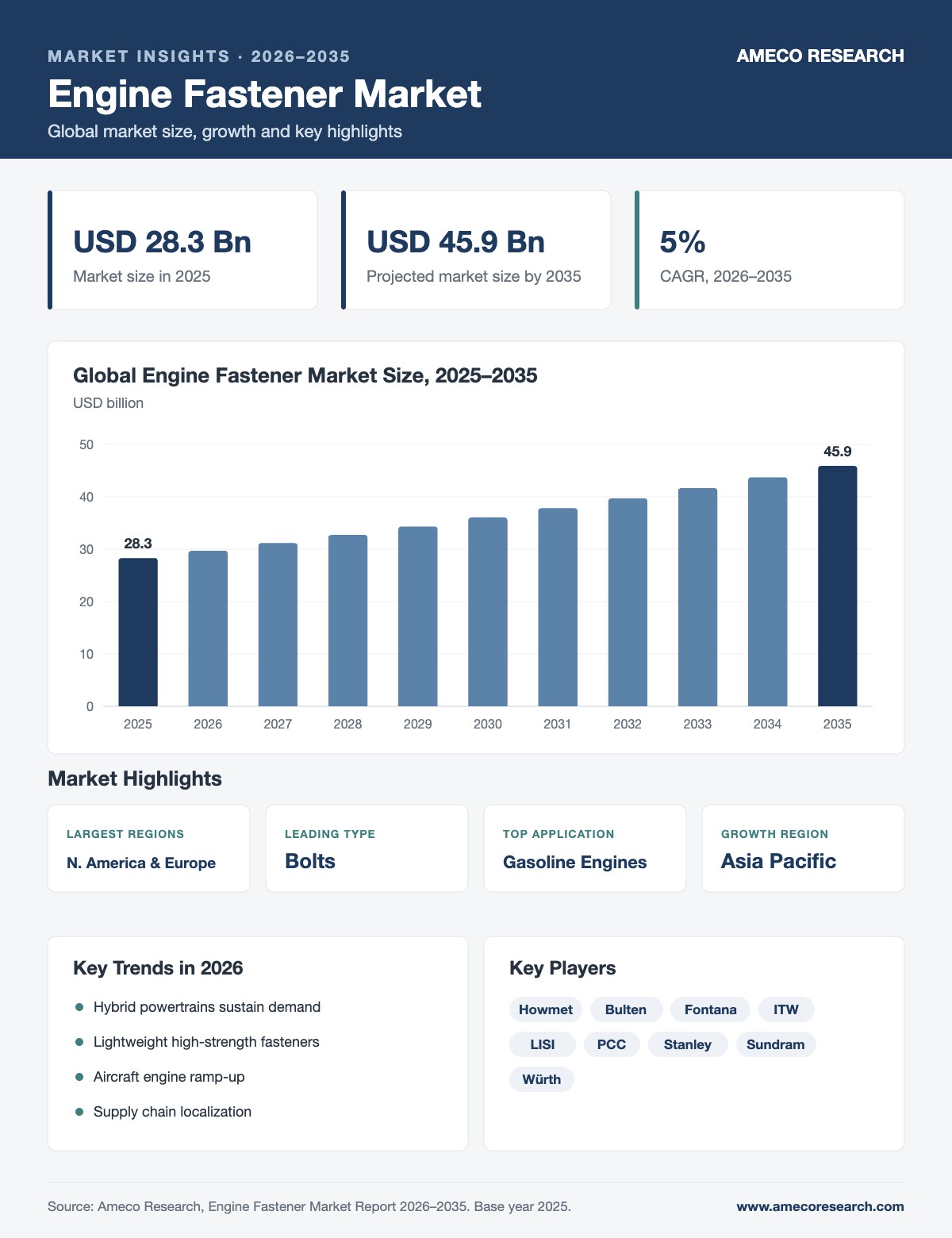 Infographic: Engine Fastener Market Size and Growth Opportunities and Forecast till 2026 - 2035 | Ameco Research
Engine Fastener Market Report Scope
| Report Attribute | Details |
| Engine Fastener Market Size in 2025 | USD 28.3 Billion |
| Engine Fastener Market Forecast by 2035 | USD 45.9 Billion |
| Engine Fastener Market CAGR (2026–2035) | 5% |
| Analysis Period | 2023–2035 |
| Base Year | 2025 |
| Forecast Period | 2026–2035 |
| Segments Covered | by Type, by Application, and By Region |
| Regional Scope | North America, Europe, Asia Pacific, Latin America, and Middle East & Africa |
| Key Companies Profiled | Arconic Inc. (Howmet Aerospace), Bulten AB, Fontana Gruppo S.r.l., Illinois Tool Works Inc., Lisi Aerospace, National Aerospace Fasteners Corporation, Precision Castparts Corp., Stanley Black & Decker, Inc., Sundram Fasteners Limited, and Würth Group |
| Report Coverage | Market Trends, Drivers, Restraints, Opportunities, Competitive Analysis, Player Profiling, Regulation Analysis |
Engine Fastener Market Size Forecast, 2023–2035
The table below shows the year-by-year size of the global engine fastener market. Revenue is expected to grow about 1.6 times between 2025 and 2035, reaching roughly USD 36.0 billion by 2030.
| Year | Market Size (USD Billion) |
| 2023 (historical) | 25.7 |
| 2024 (historical) | 27.0 |
| 2025 (base year) | 28.3 |
| 2026 (forecast) | 29.7 |
| 2027 (forecast) | 31.2 |
| 2028 (forecast) | 32.7 |
| 2029 (forecast) | 34.3 |
| 2030 (forecast) | 36.0 |
| 2031 (forecast) | 37.8 |
| 2032 (forecast) | 39.7 |
| 2033 (forecast) | 41.7 |
| 2034 (forecast) | 43.7 |
| 2035 (forecast) | 45.9 |
Latest Engine Fastener Market Trends (2026)
Hybrid powertrains sustain engine demand
Slower-than-expected battery EV adoption in some markets and strong growth of hybrid vehicles mean internal combustion engines remain in high volume, supporting demand for engine fasteners alongside new EV fastener needs.
Lightweight and high-strength fasteners
Downsized turbocharged engines run hotter and at higher pressures, requiring stronger, lighter fasteners made from advanced steels, titanium and nickel alloys.
Aircraft engine production ramp-up
Aircraft engine makers are increasing output of new-generation engines for narrowbody and widebody jets, raising demand for high-temperature aerospace engine fasteners.
Stricter emissions rules
Euro 7, US EPA and China emissions standards drive new engine designs, aftertreatment systems and turbochargers that need specialized fasteners.
Commercial vehicles and off-highway
Trucks, construction and agricultural machines and generator sets continue to rely on diesel and alternative-fuel engines, keeping demand steady for heavy-duty fasteners.
Localization of supply chains
Automakers and engine makers are sourcing fasteners closer to assembly plants in India, Mexico and Eastern Europe to cut lead times and tariff exposure.
Engine Fastener Market Dynamics
Growth drivers
- Global vehicle and engine production
- Growth of hybrid powertrains
- Demand for high-strength, heat-resistant fasteners
- Rising aircraft engine output
- Replacement demand in commercial and off-highway vehicles
Restraints and challenges
- Long-term shift to battery electric vehicles
- Volatile steel, titanium and nickel prices
- Price pressure from automakers
- Strict quality and certification requirements
Opportunities
Key opportunities include fasteners for hybrid and alternative-fuel engines, titanium and nickel alloy fasteners for aircraft engines, lightweight designs for downsized engines, aftermarket and service parts, and fast-growing vehicle production in India and Southeast Asia.
Engine Fastener Market Segment Analysis
By type
The market is segmented into nuts, screws and bolts. Bolts hold the largest share because they are used in critical joints such as cylinder heads, crankshafts and connecting rods, while screws and nuts are used across covers, brackets and accessories.
By application
Applications include diesel engines and gasoline engines. Gasoline engines account for the most units in passenger cars, while diesel engines in trucks, buses, off-highway machines and gensets use heavier, higher-value fasteners.
Engine Fastener Market Regional Analysis
North America and Europe are the largest markets for engine fasteners because of the number of automotive and aerospace manufacturers in these regions.
The Asia Pacific region is expected to witness significant growth, driven by rising automotive and aerospace demand in China, India, Japan, South Korea and Southeast Asia.
Latin America and the Middle East & Africa are expected to show moderate growth.
Engine Fastener Market Segmentation
Engine Fastener Market Leading Companies
The engine fastener market includes global automotive fastener specialists, aerospace fastener makers and diversified industrial groups. Companies compete on metallurgy, precision, quality certifications, engineering support, global production footprint and long-term supply contracts with engine makers. Key players profiled in this report include Arconic Inc. (Howmet Aerospace), Bulten AB, Fontana Gruppo S.r.l., Illinois Tool Works Inc., Lisi Aerospace, National Aerospace Fasteners Corporation, Precision Castparts Corp., Stanley Black & Decker, Inc., Sundram Fasteners Limited, and Würth Group.
Arconic Inc. (Howmet Aerospace)Bulten ABFontana Gruppo S.r.l.Illinois Tool Works Inc.Lisi AerospaceNational Aerospace Fasteners CorporationPrecision Castparts Corp.Stanley Black & Decker, Inc.Sundram Fasteners LimitedWürth Group
Key Questions Answered in This Report
- What is the size of the engine fastener market in 2025, and how large will it be by 2030 and 2035?
- What are the main growth drivers, restraints and opportunities through 2035?
- Which by type and by application segments will grow the fastest?
- Which regions and countries offer the largest and fastest-growing opportunities?
- How are hybrid powertrains, aircraft engine output and lightweighting shaping demand in 2026?
- Who are the leading companies, and what strategies are they using to compete?
Research Methodology
Our estimates draw on interviews with fastener manufacturers, engine makers, automotive and aerospace OEMs, and distributors, supported by secondary data from annual reports, investor materials, trade and customs data, standards bodies and industry journals. Bottom-up estimates of company revenues and top-down estimates of application demand are reconciled through data triangulation, and the model is updated with 2026 developments to forecast the market through 2035.
Related Reports
- Automotive Engineering Services Market Report
- Automotive Operating Systems Market Report
- Automotive Electric HVAC Compressor Market Report
- Automotive Turbocharger Market Report
- Automotive Digital Cockpit Market Report
Engine Fastener Market: Frequently Asked Questions
How big is the engine fastener market?
The global engine fastener market was valued at USD 28.3 billion in 2025 and is expected to reach USD 45.9 billion by 2035.
What is the growth rate of the engine fastener market?
The engine fastener market is projected to grow at a CAGR of 5% from 2026 to 2035.
What will the engine fastener market be worth in 2030?
The engine fastener market is projected to reach about USD 36.0 billion in 2030, growing at a CAGR of 5%.
What is driving growth in the engine fastener market?
Key drivers are global vehicle and engine production, growth of hybrids, demand for high-strength heat-resistant fasteners, aircraft engine output and replacement demand.
What is engine fastener?
Engine fasteners are the bolts, screws, nuts and studs that hold engine parts together and must withstand heat, pressure and vibration.
Which region leads the engine fastener market?
North America and Europe are the largest markets, while Asia Pacific is expected to witness significant growth.
Which segment holds the largest share of the engine fastener market?
Bolts are the leading type, and gasoline engines are the largest application by volume.
What are the latest trends in the engine fastener market?
The main 2026 trends are hybrid powertrains sustain engine demand, lightweight and high-strength fasteners, aircraft engine production ramp-up, stricter emissions rules, commercial vehicles and off-highway and localization of supply chains.
What are the main challenges in the engine fastener market?
The main challenges are the long-term shift to battery EVs, volatile metal prices, price pressure from automakers and strict quality requirements.
What materials are engine fasteners made from?
Most engine fasteners are made from heat-treated alloy steel, while high-temperature and aerospace engines use stainless steel, titanium and nickel-based superalloys.
Who are the key players in the engine fastener market?
Leading companies include Arconic Inc. (Howmet Aerospace), Bulten AB, Fontana Gruppo S.r.l., Illinois Tool Works Inc., Lisi Aerospace, National Aerospace Fasteners Corporation, Precision Castparts Corp., Stanley Black & Decker, Inc., Sundram Fasteners Limited, and Würth Group.