Automotive Turbocharger Market Size and Growth Opportunities and Forecast till 2026 - 2035
Automotive Turbocharger Market Size, Share & Trends Report, 2026–2035
LAST UPDATED: OCTOBER 2026
The global Automotive Turbocharger Market size was valued at USD 18.8 billion in 2025 and is projected to reach USD 38.7 billion by 2035, growing at a CAGR of 7.5% from 2026 to 2035. Growth is driven by engine downsizing to meet stricter CO2 and emission rules, rising use of turbocharged gasoline engines, strong hybrid vehicle sales that pair small turbo engines with electric motors, electric turbochargers, and steady demand from commercial vehicles and the aftermarket.
An automotive turbocharger is a forced-induction device that uses exhaust gas to spin a turbine connected to a compressor, which pushes more air into the engine. This lets a smaller engine produce the power of a larger one while using less fuel and emitting less CO2. Main technologies include wastegate turbochargers, variable geometry or variable nozzle turbochargers (VGT/VNT), twin-turbo systems and electrically assisted turbochargers. Turbochargers are used in gasoline and diesel passenger cars, light and heavy commercial vehicles, and hybrid powertrains.
Automotive Turbocharger Market Key Takeaways
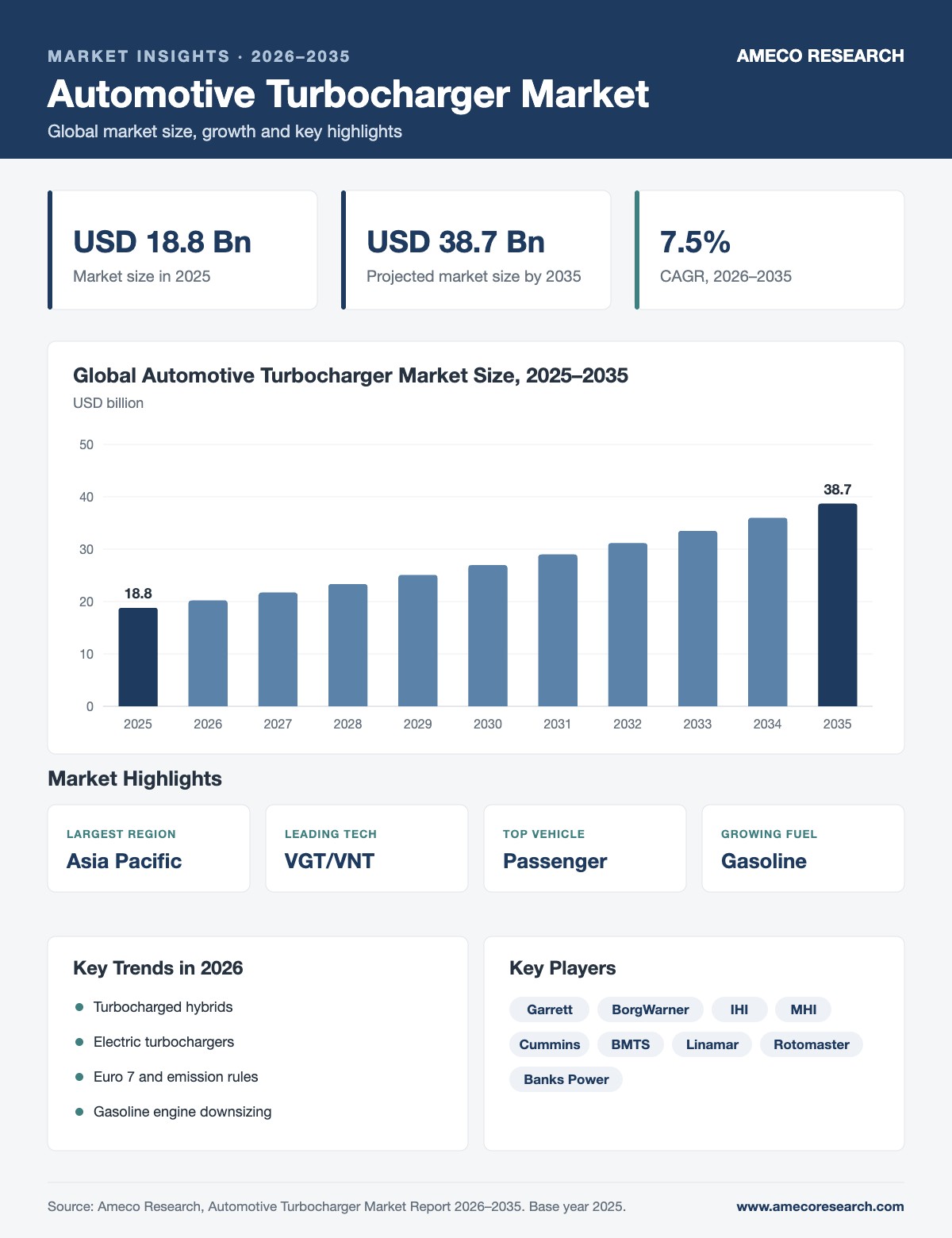 Infographic: Automotive Turbocharger Market Size and Growth Opportunities and Forecast till 2026 - 2035 | Ameco Research
Automotive Turbocharger Market Report Scope
| Report Attribute | Details |
| Automotive Turbocharger Market Size in 2025 | USD 18.8 Billion |
| Automotive Turbocharger Market Forecast by 2035 | USD 38.7 Billion |
| Automotive Turbocharger Market CAGR (2026–2035) | 7.5% |
| Analysis Period | 2023–2035 |
| Base Year | 2025 |
| Forecast Period | 2026–2035 |
| Segments Covered | by Vehicle, by Fuel, by Technology, by Distribution Channel, and By Region |
| Regional Scope | North America, Europe, Asia Pacific, Latin America, and Middle East & Africa |
| Key Companies Profiled | Garrett Motion Inc., BorgWarner Inc., IHI Corporation, Mitsubishi Heavy Industries, Cummins Inc., BMTS Technology, Linamar Corporation, Rotomaster International, Banks Power, and Magnum Performance Turbos |
| Report Coverage | Market Trends, Drivers, Restraints, Opportunities, Competitive Analysis, Player Profiling, Regulation Analysis |
Automotive Turbocharger Market Size Forecast, 2023–2035
The table below shows the year-by-year size of the global automotive turbocharger market. Revenue is expected to grow about 2.1 times between 2025 and 2035, reaching roughly USD 27.0 billion by 2030.
| Year | Market Size (USD Billion) |
| 2023 (historical) | 16.3 |
| 2024 (historical) | 17.5 |
| 2025 (base year) | 18.8 |
| 2026 (forecast) | 20.2 |
| 2027 (forecast) | 21.7 |
| 2028 (forecast) | 23.3 |
| 2029 (forecast) | 25.1 |
| 2030 (forecast) | 27.0 |
| 2031 (forecast) | 29.0 |
| 2032 (forecast) | 31.2 |
| 2033 (forecast) | 33.5 |
| 2034 (forecast) | 36.0 |
| 2035 (forecast) | 38.7 |
Latest Automotive Turbocharger Market Trends (2026)
Turbocharged hybrids
Many new hybrid and plug-in hybrid vehicles pair small turbocharged gasoline engines with electric motors, and slower battery electric growth in some markets has extended demand for these powertrains.
Electric turbochargers
Electrically assisted turbochargers use a small motor to spin the compressor instantly, eliminating turbo lag and recovering energy, and are moving from performance cars into wider use.
Stricter emission rules
Euro 7 in Europe and tighter fuel economy and emission standards in the U.S., China and India push automakers toward downsized, turbocharged engines with advanced aftertreatment.
Gasoline downsizing
Turbocharged gasoline engines are replacing larger naturally aspirated engines, while the diesel share in passenger cars has declined in Europe.
Commercial vehicles and alternative fuels
Trucks and buses continue to rely on turbocharged diesel engines, and turbochargers are being developed for hydrogen and natural gas engines.
EV transition pressure
The long-term shift to battery electric vehicles will reduce demand in some segments, so suppliers are diversifying into electric compressors, fuel cell air compressors and thermal products.
Automotive Turbocharger Market Dynamics
Growth drivers
- Demand for fuel-efficient gasoline and diesel engines
- Stricter emission and CO2 regulations worldwide
- Engine downsizing for passenger and commercial vehicles
- Growth of hybrid vehicles with small turbo engines
- Vehicle production growth in emerging economies
Restraints and challenges
- Growth of battery electric vehicles
- High component cost and complexity
- Turbo lag and heat management challenges
- Decline of diesel passenger cars in some markets
Opportunities
Key opportunities include electric turbochargers, turbochargers for hybrid and hydrogen engines, aftermarket replacement and performance upgrades, and rising vehicle production in India and Southeast Asia.
Automotive Turbocharger Market Segment Analysis
By vehicle
The market is segmented into LCVs, passenger vehicles and HCVs. Passenger vehicles dominate, while heavy commercial vehicles remain a steady market because nearly all truck engines are turbocharged.
By fuel and technology
Fuel types include gasoline and diesel. Diesel has historically held a large share, while gasoline turbochargers are growing faster with engine downsizing and hybrids. Technologies include wastegate, VGT/VNT and twin turbo, with VGT/VNT holding the largest share.
By distribution channel
Channels include aftermarket and OEM. OEM fitment accounts for most sales, while the aftermarket grows with the large installed base of turbocharged vehicles.
Automotive Turbocharger Market Regional Analysis
Asia Pacific is the largest market, supported by vehicle production growth in China, India, Indonesia and Thailand and a strong base of Japanese and Chinese turbocharger makers.
Europe is the second-largest market, where turbocharged engines are standard for meeting CO2 targets. North America holds a significant share, supported by demand for fuel-efficient vehicles, pickups and EPA emission rules.
Latin America and the Middle East & Africa are smaller markets, with demand from commercial vehicles and growing passenger car production.
Automotive Turbocharger Market Segmentation
Automotive Turbocharger Market Leading Companies
The automotive turbocharger market includes a few large global turbocharger makers, engine manufacturers with in-house turbo units, Chinese producers and aftermarket and performance specialists. Companies compete on efficiency, durability, electric turbo technology, cost and long-term supply contracts with automakers. Key players profiled in this report include Garrett Motion Inc., BorgWarner Inc., IHI Corporation, Mitsubishi Heavy Industries, Cummins Inc., BMTS Technology, Linamar Corporation, Rotomaster International, Banks Power, and Magnum Performance Turbos.
Garrett Motion Inc.BorgWarner Inc.IHI CorporationMitsubishi Heavy IndustriesCummins Inc.BMTS TechnologyLinamar CorporationRotomaster InternationalBanks PowerMagnum Performance Turbos
Key Questions Answered in This Report
- What is the size of the automotive turbocharger market in 2025, and how large will it be by 2030 and 2035?
- What are the main growth drivers, restraints and opportunities through 2035?
- Which by vehicle and by fuel segments will grow the fastest?
- Which regions and countries offer the largest and fastest-growing opportunities?
- How are turbocharged hybrids, electric turbos and emission rules shaping turbocharger demand in 2026?
- Who are the leading companies, and what strategies are they using to compete?
Research Methodology
This report combines primary and secondary research. Primary research includes interviews with turbocharger and engine manufacturers, automakers, aftermarket distributors and vehicle production data. Secondary research covers company annual reports, investor presentations, government and trade association data, patent filings and industry publications. Market size is estimated using both bottom-up (company revenue and production data) and top-down (end-use demand) methods, and results are cross-checked through data triangulation before forecasts are built for 2026–2035.
Related Reports
- Automotive Digital Cockpit Market Report
- Automotive Electric HVAC Compressor Market Report
- Automotive Collision Repair Market Report
- Automotive Switches Market Report
- Automotive Operating Systems Market Report
Automotive Turbocharger Market: Frequently Asked Questions
How big is the automotive turbocharger market?
The global automotive turbocharger market was valued at USD 18.8 billion in 2025 and is expected to reach USD 38.7 billion by 2035.
What is the growth rate of the automotive turbocharger market?
The automotive turbocharger market is projected to grow at a CAGR of 7.5% from 2026 to 2035.
What will the automotive turbocharger market be worth in 2030?
The automotive turbocharger market is projected to reach about USD 27.0 billion in 2030, growing at a CAGR of 7.5%.
What is driving growth in the automotive turbocharger market?
Key drivers are demand for fuel-efficient engines, stricter emission rules, engine downsizing, hybrid vehicle growth and vehicle production in emerging economies.
What is automotive turbocharger?
An automotive turbocharger uses exhaust gas to drive a compressor that forces more air into the engine, allowing smaller engines to deliver more power with less fuel.
Which region leads the automotive turbocharger market?
Asia Pacific is the largest market, followed by Europe, with North America holding a significant share.
Which segment holds the largest share of the automotive turbocharger market?
Passenger vehicles dominate, VGT/VNT is the leading technology, and gasoline turbochargers are growing faster than diesel.
What are the latest trends in the automotive turbocharger market?
The main 2026 trends are turbocharged hybrids, electric turbochargers, stricter emission rules, gasoline downsizing, commercial vehicles and alternative fuels and eV transition pressure.
What are the main challenges in the automotive turbocharger market?
The main challenges are the growth of battery electric vehicles, high component cost, turbo lag and heat management, and declining diesel car sales.
What is an electric turbocharger?
An electric turbocharger adds a small electric motor to the turbo shaft, so it can spin up instantly without waiting for exhaust gas, reducing turbo lag and recovering energy.
Who are the key players in the automotive turbocharger market?
Leading companies include Garrett Motion Inc., BorgWarner Inc., IHI Corporation, Mitsubishi Heavy Industries, Cummins Inc., BMTS Technology, Linamar Corporation, Rotomaster International, Banks Power, and Magnum Performance Turbos.
Related Automobile & Transportation Market Reports
- Micro-Mobility Charging Infrastructure Market Size and Growth Opportunities and Forecast till 2026 - 2035
- Automotive Electric HVAC Compressor Market Size and Growth Opportunities and Forecast till 2026 - 2035
- Ride-Hailing Services Market Size and Growth Opportunities and Forecast till 2026 - 2035
- Hybrid Drive Train Market Size and Growth Opportunities and Forecast till 2026 - 2035
- Utility Terrain Vehicles (UTV) Market Size and Growth Opportunities and Forecast till 2026 - 2035