Automotive Digital Cockpit Market Size and Growth Opportunities and Forecast till 2026 - 2035
Automotive Digital Cockpit Market Size, Share & Trends Report, 2026–2035
LAST UPDATED: OCTOBER 2026
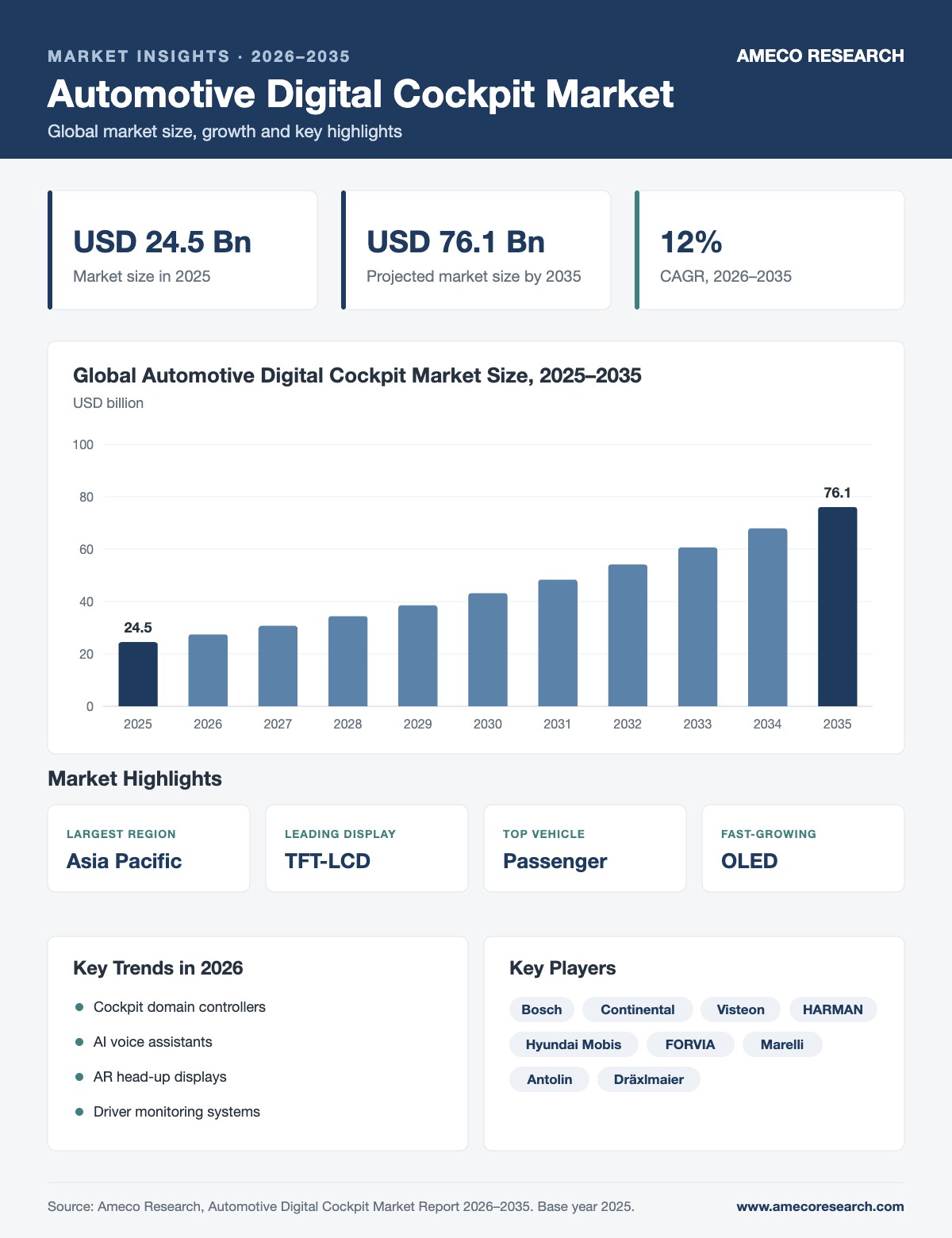
The global Automotive Digital Cockpit Market size was valued at USD 24.5 billion in 2025 and is projected to reach USD 76.1 billion by 2035, growing at a CAGR of 12% from 2026 to 2035. Growth is driven by larger and more numerous in-car displays, digital instrument clusters becoming standard, head-up displays including augmented reality versions, driver monitoring systems required by safety rules, cockpit domain controllers that run several screens on one chip, and software-defined vehicles with over-the-air updates and AI voice assistants.
An automotive digital cockpit is the integrated set of digital displays, controls and software that drivers and passengers use to interact with a vehicle. It includes the digital instrument cluster, central infotainment and passenger screens, head-up display (HUD), driver monitoring system, voice and gesture controls and connectivity features, increasingly run by a single cockpit domain controller. Display technologies include TFT-LCD, LCD and OLED, and systems are fitted in passenger and commercial vehicles.
Automotive Digital Cockpit Market Key Takeaways
Automotive Digital Cockpit Market Report Scope
| Report Attribute | Details |
| Automotive Digital Cockpit Market Size in 2025 | USD 24.5 Billion |
| Automotive Digital Cockpit Market Forecast by 2035 | USD 76.1 Billion |
| Automotive Digital Cockpit Market CAGR (2026–2035) | 12% |
| Analysis Period | 2023–2035 |
| Base Year | 2025 |
| Forecast Period | 2026–2035 |
| Segments Covered | by Equipment, by Display Technology, by Vehicle Type, and By Region |
| Regional Scope | North America, Europe, Asia Pacific, Latin America, and Middle East & Africa |
| Key Companies Profiled | Robert Bosch GmbH, Continental AG, Visteon Corporation, HARMAN International (a Samsung company), Hyundai Mobis, FORVIA (Faurecia), Marelli Holdings Co., Ltd., Grupo Antolin, DRÄXLMAIER Group, and Sintrones |
| Report Coverage | Market Trends, Drivers, Restraints, Opportunities, Competitive Analysis, Player Profiling, Regulation Analysis |
Automotive Digital Cockpit Market Size Forecast, 2023–2035
The table below shows the year-by-year size of the global automotive digital cockpit market. Revenue is expected to grow about 3.1 times between 2025 and 2035, reaching roughly USD 43.2 billion by 2030.
| Year | Market Size (USD Billion) |
| 2023 (historical) | 19.5 |
| 2024 (historical) | 21.9 |
| 2025 (base year) | 24.5 |
| 2026 (forecast) | 27.4 |
| 2027 (forecast) | 30.7 |
| 2028 (forecast) | 34.4 |
| 2029 (forecast) | 38.6 |
| 2030 (forecast) | 43.2 |
| 2031 (forecast) | 48.4 |
| 2032 (forecast) | 54.2 |
| 2033 (forecast) | 60.7 |
| 2034 (forecast) | 67.9 |
| 2035 (forecast) | 76.1 |
Latest Automotive Digital Cockpit Market Trends (2026)
Cockpit domain controllers
Automakers are moving from separate ECUs for each screen to one high-performance system-on-chip that runs the cluster, infotainment and passenger displays, lowering cost and enabling richer features.
AI and voice assistants
Generative AI voice assistants are being added to vehicles, letting drivers control navigation, climate and media through natural conversation.
AR head-up displays
Head-up displays are getting larger, with augmented reality versions that project navigation arrows and safety alerts onto the road view.
Driver monitoring systems
Camera-based driver monitoring that detects distraction and drowsiness is becoming standard as safety regulations and rating programs, especially in Europe, require it.
Larger and more screens
Pillar-to-pillar displays, passenger screens and rear-seat entertainment are spreading from luxury models into mainstream vehicles, especially in China.
Software-defined vehicles and OTA updates
Cockpit software is updated over the air, letting automakers add apps, features and subscriptions during the vehicle's life and making operating systems such as Android Automotive important.
Automotive Digital Cockpit Market Dynamics
Growth drivers
- Consumer demand for connected, personalized in-car experiences
- Shift to software-defined vehicles and over-the-air updates
- Safety rules requiring driver monitoring and better driver information
- Automakers using cockpit features to differentiate brands
- Falling display and chip costs
Restraints and challenges
- High cost of large displays and powerful processors
- Cybersecurity and data privacy risks
- Driver distraction concerns and regulation of touchscreens
- Complex software development and integration
Opportunities
Key opportunities include AR head-up displays, AI assistants, in-car apps and subscriptions, cockpit domain controllers for mid-range vehicles, and growing vehicle production in India and Southeast Asia.
Automotive Digital Cockpit Market Segment Analysis
By equipment
The market is segmented into digital instrument clusters, driver monitoring systems and head-up displays (HUD). Driver monitoring systems hold a significant share and continue to grow as safety rules require them, while HUDs are growing with augmented reality versions.
By display technology
Display technologies include TFT-LCD, LCD and OLED. TFT-LCD leads because of its cost and reliability, while OLED is expected to grow at a notable rate in premium vehicles thanks to better contrast and flexible shapes.
By vehicle type
Vehicle types include passenger vehicles and commercial vehicles. Passenger vehicles hold the largest share, while commercial vehicles are expected to grow at a significant rate as trucks and buses adopt digital clusters and driver monitoring.
Automotive Digital Cockpit Market Regional Analysis
Asia Pacific is the largest market, led by China, where automakers launch new models quickly with large screens and advanced cockpit software, along with Japan, South Korea and India.
Europe is expected to see substantial growth, with German automakers central to digital cockpit development and safety rules driving driver monitoring. North America is a major market for connected and premium vehicles.
Latin America and the Middle East & Africa are smaller markets, with adoption rising in new vehicle models.
Automotive Digital Cockpit Market Segmentation
Automotive Digital Cockpit Market Leading Companies
The automotive digital cockpit market includes Tier 1 electronics suppliers, interior system makers, consumer electronics and software companies, and automakers' own software units. Companies compete on cockpit domain controller platforms, display integration, software and user experience, safety certification and cost. Key players profiled in this report include Robert Bosch GmbH, Continental AG, Visteon Corporation, HARMAN International (a Samsung company), Hyundai Mobis, FORVIA (Faurecia), Marelli Holdings Co., Ltd., Grupo Antolin, DRÄXLMAIER Group, and Sintrones.
Robert Bosch GmbHContinental AGVisteon CorporationHARMAN International (a Samsung company)Hyundai MobisFORVIA (Faurecia)Marelli Holdings Co., Ltd.Grupo AntolinDRÄXLMAIER GroupSintrones
Key Questions Answered in This Report
- What is the size of the automotive digital cockpit market in 2025, and how large will it be by 2030 and 2035?
- What are the main growth drivers, restraints and opportunities through 2035?
- Which by equipment and by display technology segments will grow the fastest?
- Which regions and countries offer the largest and fastest-growing opportunities?
- How are cockpit domain controllers, AI assistants and AR head-up displays shaping the digital cockpit market in 2026?
- Who are the leading companies, and what strategies are they using to compete?
Research Methodology
Ameco Research built this forecast from a mix of primary and secondary research. Analysts spoke with Tier 1 suppliers, automakers, display and chip makers, and vehicle production data to validate pricing, volumes and demand trends, and reviewed company filings, trade statistics, regulatory documents and industry publications. The automotive digital cockpit market size was estimated with bottom-up and top-down approaches and validated through data triangulation, with 2025 as the base year and forecasts for 2026–2035.
Related Reports
- Automotive Turbocharger Market Report
- Automotive Electric HVAC Compressor Market Report
- Automotive Collision Repair Market Report
- Automotive Switches Market Report
- Automotive Operating Systems Market Report
Automotive Digital Cockpit Market: Frequently Asked Questions
How big is the automotive digital cockpit market?
The global automotive digital cockpit market was valued at USD 24.5 billion in 2025 and is expected to reach USD 76.1 billion by 2035.
What is the growth rate of the automotive digital cockpit market?
The automotive digital cockpit market is projected to grow at a CAGR of 12% from 2026 to 2035.
What will the automotive digital cockpit market be worth in 2030?
The automotive digital cockpit market is projected to reach about USD 43.2 billion in 2030, growing at a CAGR of 12%.
What is driving growth in the automotive digital cockpit market?
Key drivers are demand for connected in-car experiences, software-defined vehicles, safety rules for driver monitoring, brand differentiation and falling display and chip costs.
What is automotive digital cockpit?
An automotive digital cockpit is the integrated set of digital displays, controls and software, such as the instrument cluster, infotainment screens, HUD and driver monitoring, that drivers use to interact with the vehicle.
Which region leads the automotive digital cockpit market?
Asia Pacific is the largest market, led by China, while Europe is expected to see substantial growth.
Which segment holds the largest share of the automotive digital cockpit market?
TFT-LCD is the leading display technology, passenger vehicles hold the largest share, and driver monitoring systems are a significant and growing equipment segment.
What are the latest trends in the automotive digital cockpit market?
The main 2026 trends are cockpit domain controllers, aI and voice assistants, aR head-up displays, driver monitoring systems, larger and more screens and software-defined vehicles and OTA updates.
What are the main challenges in the automotive digital cockpit market?
The main challenges are the cost of large displays and processors, cybersecurity and privacy, driver distraction concerns and complex software integration.
What is a cockpit domain controller?
A cockpit domain controller is a single high-performance computer that runs the instrument cluster, infotainment and other displays in a vehicle, replacing several separate control units.
Who are the key players in the automotive digital cockpit market?
Leading companies include Robert Bosch GmbH, Continental AG, Visteon Corporation, HARMAN International (a Samsung company), Hyundai Mobis, FORVIA (Faurecia), Marelli Holdings Co., Ltd., Grupo Antolin, DRÄXLMAIER Group, and Sintrones.
Related Automobile & Transportation Market Reports
- Automotive Turbocharger Market Size and Growth Opportunities and Forecast till 2026 - 2035
- Micro-Mobility Charging Infrastructure Market Size and Growth Opportunities and Forecast till 2026 - 2035
- Automotive Electric HVAC Compressor Market Size and Growth Opportunities and Forecast till 2026 - 2035
- Ride-Hailing Services Market Size and Growth Opportunities and Forecast till 2026 - 2035
- Hybrid Drive Train Market Size and Growth Opportunities and Forecast till 2026 - 2035