Self-Service Technology Market Size and Growth Opportunities and Forecast till 2026 - 2035
Self-Service Technology Market Size, Share & Trends Report, 2026–2035
LAST UPDATED: OCTOBER 2026
The global Self-Service Technology Market size was valued at USD 45.0 billion in 2025 and is projected to reach USD 97.2 billion by 2035, growing at a CAGR of 8% from 2026 to 2035. Growth is driven by labor shortages and rising wages in retail and restaurants, consumer preference for fast, contactless service, self-ordering kiosks in quick service restaurants, self-checkout in stores, self-service check-in and bag drop at airports and hotels, smart vending, and AI and cashless payments built into kiosks.
Self-service technology (SST) lets customers complete transactions and access services without staff assistance. It includes kiosks for ordering, check-in, ticketing, information and payments, self-checkout systems, vending machines and automated teller machines (ATMs). SST is used in banking, retail, travel and tourism, quick service restaurants, healthcare, hospitality, education and government, and combines hardware such as touchscreens, card readers, scanners and printers with software and services.
Self-Service Technology Market Key Takeaways
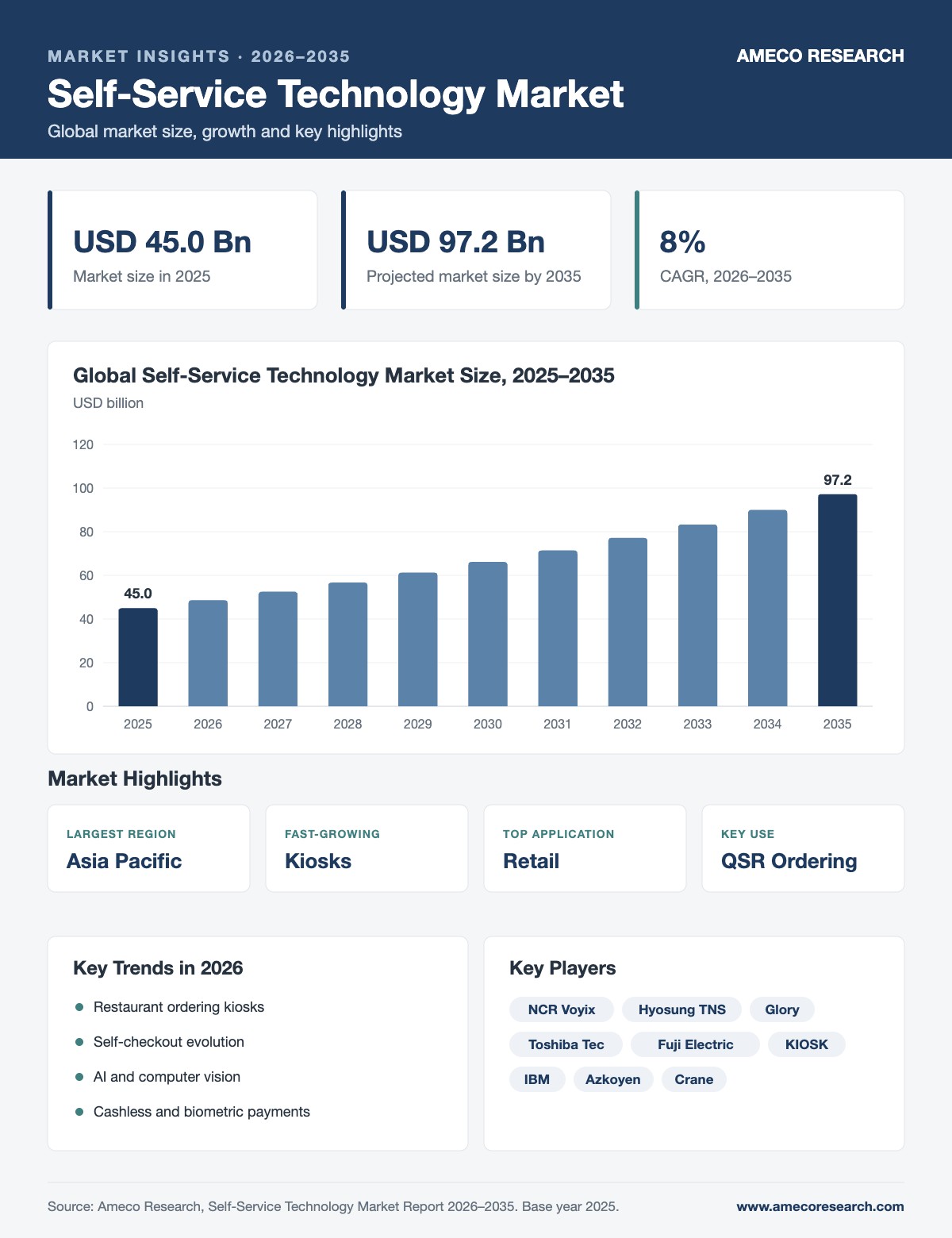 Infographic: Self-Service Technology Market Size and Growth Opportunities and Forecast till 2026 - 2035 | Ameco Research
Self-Service Technology Market Report Scope
| Report Attribute | Details |
| Self-Service Technology Market Size in 2025 | USD 45.0 Billion |
| Self-Service Technology Market Forecast by 2035 | USD 97.2 Billion |
| Self-Service Technology Market CAGR (2026–2035) | 8% |
| Analysis Period | 2023–2035 |
| Base Year | 2025 |
| Forecast Period | 2026–2035 |
| Segments Covered | by Product, by Application, and By Region |
| Regional Scope | North America, Europe, Asia Pacific, Latin America, and Middle East & Africa |
| Key Companies Profiled | NCR Voyix, Hyosung TNS, Glory Ltd., Toshiba Tec Corporation, Fuji Electric Retail Systems Co. Ltd, Kiosk Information Systems, Inc., IBM, Azkoyen S.A., Crane Merchandising Systems, HESS Cash Systems GmbH & Co., Maas International Europe B.V., and Vend-Rite |
| Report Coverage | Market Trends, Drivers, Restraints, Opportunities, Competitive Analysis, Player Profiling, Regulation Analysis |
Self-Service Technology Market Size Forecast, 2023–2035
The table below shows the year-by-year size of the global self-service technology market. Revenue is expected to grow about 2.2 times between 2025 and 2035, reaching roughly USD 66.1 billion by 2030.
| Year | Market Size (USD Billion) |
| 2023 (historical) | 38.6 |
| 2024 (historical) | 41.7 |
| 2025 (base year) | 45.0 |
| 2026 (forecast) | 48.6 |
| 2027 (forecast) | 52.5 |
| 2028 (forecast) | 56.7 |
| 2029 (forecast) | 61.2 |
| 2030 (forecast) | 66.1 |
| 2031 (forecast) | 71.4 |
| 2032 (forecast) | 77.1 |
| 2033 (forecast) | 83.3 |
| 2034 (forecast) | 90.0 |
| 2035 (forecast) | 97.2 |
Latest Self-Service Technology Market Trends (2026)
Restaurant self-ordering kiosks
Quick service restaurant chains are installing self-ordering kiosks to speed up service, increase order size with upselling and offset labor shortages.
Self-checkout evolution
Retailers continue to use self-checkout while redesigning it with fewer items per transaction, staff assistance and AI cameras to reduce errors and theft.
AI and computer vision
Kiosks and checkouts use computer vision to recognize products, verify age and detect missed scans, while AI assistants offer voice and chat interaction.
Cashless and biometric payments
Contactless cards, mobile wallets, QR codes and palm or face payments are being built into kiosks and vending machines.
Smart vending and micro markets
Connected vending machines and unattended micro markets with cashless payment and remote monitoring are expanding in offices, campuses and transport hubs.
Healthcare and government kiosks
Hospitals and clinics use check-in and payment kiosks, while governments use kiosks for documents, permits and transport services.
Self-Service Technology Market Dynamics
Growth drivers
- Labor shortages and rising wage costs
- Consumer demand for fast, convenient and contactless service
- Growth of cashless and mobile payments
- Digital transformation in retail, banking and travel
- Advances in touchscreen, AI and payment technology
Restraints and challenges
- High upfront hardware and integration costs
- Theft and errors at self-checkout
- Customer preference for human service in some settings
- Maintenance, security and accessibility requirements
Opportunities
Key opportunities include QSR and retail kiosks, healthcare check-in, smart vending and micro markets, airport and hotel self-service, and growing digital payment markets in Asia Pacific, Latin America and the Middle East.
Self-Service Technology Market Segment Analysis
By product
The market is segmented into kiosks, vending machines and ATMs. ATMs hold a large installed base in banking, while kiosks are expected to dominate new growth across retail, restaurants, travel and healthcare.
By application
Applications include banking, retail, travel & tourism, QSR, healthcare and others such as hospitality, education and government. Retail and banking hold the largest shares, while QSR and healthcare grow fastest.
Self-Service Technology Market Regional Analysis
Asia Pacific holds the largest share, supported by large retail and banking networks, transport hubs and fast adoption of cashless payments in China, Japan, India and Southeast Asia.
North America is a major market, with high labor costs driving self-checkout and restaurant kiosk adoption. Europe is a significant market with strong self-service in retail, transport and vending.
Latin America and the Middle East & Africa are growing markets, with kiosk and digital payment adoption in Brazil, Mexico and the Gulf.
Self-Service Technology Market Segmentation
Self-Service Technology Market Leading Companies
The self-service technology market includes ATM and cash handling makers, kiosk and self-checkout suppliers, vending machine manufacturers and software and payment providers. Companies compete on reliability, software, payment integration, security, service networks and total cost of ownership. Key players profiled in this report include NCR Voyix, Hyosung TNS, Glory Ltd., Toshiba Tec Corporation, Fuji Electric Retail Systems Co. Ltd, Kiosk Information Systems, Inc., IBM, Azkoyen S.A., Crane Merchandising Systems, HESS Cash Systems GmbH & Co., Maas International Europe B.V., and Vend-Rite.
NCR VoyixHyosung TNSGlory Ltd.Toshiba Tec CorporationFuji Electric Retail Systems Co. LtdKiosk Information Systems, Inc.IBMAzkoyen S.A.Crane Merchandising SystemsHESS Cash Systems GmbH & Co.Maas International Europe B.V.Vend-Rite
Key Questions Answered in This Report
- What is the size of the self-service technology market in 2025, and how large will it be by 2030 and 2035?
- What are the main growth drivers, restraints and opportunities through 2035?
- Which by product and by application segments will grow the fastest?
- Which regions and countries offer the largest and fastest-growing opportunities?
- How are restaurant kiosks, AI self-checkout and cashless payments shaping self-service technology in 2026?
- Who are the leading companies, and what strategies are they using to compete?
Research Methodology
Our estimates draw on interviews with kiosk, ATM and vending machine makers, retailers, banks, restaurants and payment providers, supported by secondary data from annual reports, investor materials, trade and customs data, standards bodies and industry journals. Bottom-up estimates of company revenues and top-down estimates of application demand are reconciled through data triangulation, and the model is updated with 2026 developments to forecast the market through 2035.
Related Reports
- Artificial Intelligence (AI) in Retail Market Report
- Payment Processing Solutions Market Report
- Automatic Toll Payment Machine Market Report
- Contactless Payment Market Report
- Point of Sale Display Market Report
Self-Service Technology Market: Frequently Asked Questions
How big is the self-service technology market?
The global self-service technology market was valued at USD 45.0 billion in 2025 and is expected to reach USD 97.2 billion by 2035.
What is the growth rate of the self-service technology market?
The self-service technology market is projected to grow at a CAGR of 8% from 2026 to 2035.
What will the self-service technology market be worth in 2030?
The self-service technology market is projected to reach about USD 66.1 billion in 2030, growing at a CAGR of 8%.
What is driving growth in the self-service technology market?
Key drivers are labor shortages and rising wages, demand for fast contactless service, cashless payments, digital transformation and advances in AI and touchscreen technology.
What is self-service technology?
Self-service technology lets customers complete transactions without staff, using kiosks, self-checkout systems, vending machines and ATMs.
Which region leads the self-service technology market?
Asia Pacific holds the largest share, while North America and Europe are major markets.
Which segment holds the largest share of the self-service technology market?
ATMs hold a large installed base, kiosks are expected to grow fastest, and retail and banking are the largest applications.
What are the latest trends in the self-service technology market?
The main 2026 trends are restaurant self-ordering kiosks, self-checkout evolution, aI and computer vision, cashless and biometric payments, smart vending and micro markets and healthcare and government kiosks.
What are the main challenges in the self-service technology market?
The main challenges are high upfront costs, theft and errors at self-checkout, preference for human service and maintenance and accessibility needs.
Why are restaurants adding self-ordering kiosks?
Kiosks speed up ordering, reduce wait times, increase average order value through suggested add-ons and help restaurants cope with staff shortages.
Who are the key players in the self-service technology market?
Leading companies include NCR Voyix, Hyosung TNS, Glory Ltd., Toshiba Tec Corporation, Fuji Electric Retail Systems Co. Ltd, Kiosk Information Systems, Inc., IBM, Azkoyen S.A., Crane Merchandising Systems, HESS Cash Systems GmbH & Co., Maas International Europe B.V., and Vend-Rite.
Related ICT and Media Market Reports
- Video Streaming Market Size and Growth Opportunities and Forecast till 2026 - 2035
- Roaming Tariff Market Size and Growth Opportunities and Forecast till 2026 - 2035
- Data Annotation Tools Market Size and Growth Opportunities and Forecast till 2026 - 2035
- 5G in Defense Market Size and Growth Opportunities and Forecast till 2026 - 2035
- Advanced Analytics Market Size and Growth Opportunities and Forecast till 2026 - 2035