Semiconductor Memory Market Size, Share, Trends & Growth Opportunities Forecast to 2026 - 2035
Semiconductor Memory Market Size, Share & Trends Report, 2026–2035
LAST UPDATED: NOVEMBER 2026
The global semiconductor memory market size was valued at USD 219.6 billion in 2025 and is estimated at USD 784.5 billion in 2026. It is projected to reach USD 1,418.2 billion by 2035, growing at a CAGR of 6.8% from 2026 to 2035. An AI-driven shortage of DRAM, high-bandwidth memory (HBM) and NAND flash more than tripled market revenue in 2026. Asia Pacific holds the largest share, while North America is the fastest-growing region.
Semiconductor memory refers to integrated circuits that store data in electronic devices. The market covers volatile memory, mainly DRAM and high-bandwidth memory (HBM), which holds data while a device is running, and non-volatile memory, mainly NAND and NOR flash, which keeps data when power is off. It also includes SRAM, EEPROM and emerging memories such as MRAM, ReRAM and phase-change memory.
Memory has become one of the most important parts of the AI economy. Every AI accelerator needs stacks of HBM, and AI servers use several times more DRAM and SSD storage than conventional servers. As AI data center spending surged, demand outran supply, prices rose sharply and memory became the largest segment of the global chip industry in 2026. The semiconductor memory market is now shaped by AI infrastructure, long-term supply agreements and a race to build new fabs.
Semiconductor Memory Market Key Takeaways
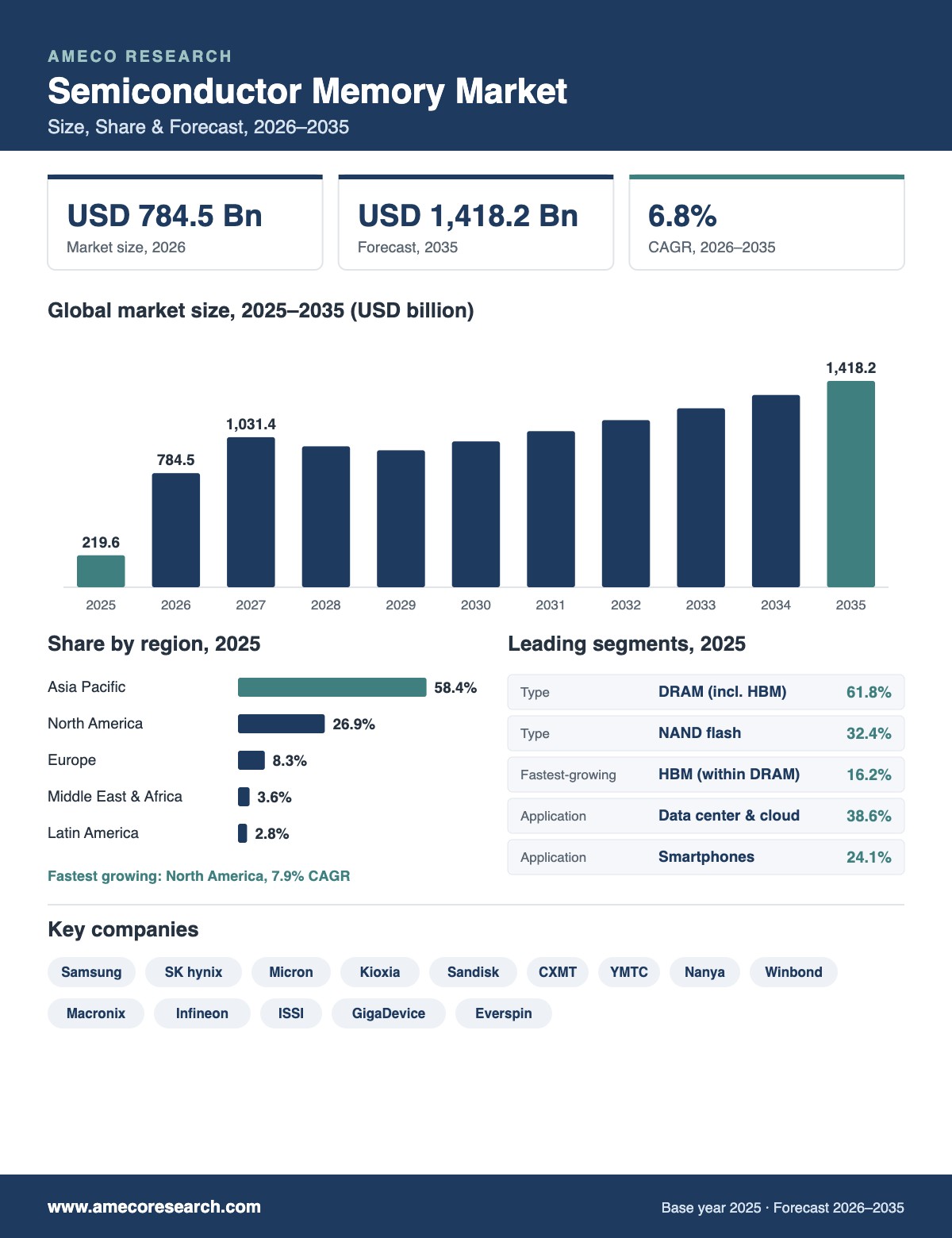 Infographic: Semiconductor Memory Market Size, Share, Trends & Growth Opportunities Forecast to 2026 - 2035 | Ameco Research
Semiconductor Memory Market Report Scope
| Report Attribute | Details |
| Semiconductor Memory Market Size in 2025 | USD 219.6 Billion |
| Semiconductor Memory Market Size in 2026 | USD 784.5 Billion |
| Semiconductor Memory Market Forecast by 2035 | USD 1,418.2 Billion |
| Semiconductor Memory Market CAGR (2026–2035) | 6.8% |
| Historical Data | 2021–2024 |
| Base Year | 2025 |
| Forecast Period | 2026–2035 |
| Largest Region | Asia Pacific (58.4% share in 2025) |
| Fastest-Growing Region | North America (7.9% CAGR) |
| Segments Covered | Type, Application and Region |
| Regional Scope | North America, Europe, Asia Pacific, Latin America, and Middle East & Africa |
| Key Companies Profiled | Samsung Electronics, SK hynix, Micron Technology, Kioxia, Sandisk, CXMT (ChangXin Memory), YMTC, Nanya Technology, Winbond Electronics, Macronix International, Infineon Technologies, Integrated Silicon Solution (ISSI), GigaDevice and Everspin Technologies |
| Report Coverage | Market size and forecast, DRAM, HBM and NAND pricing and supply analysis, capacity and fab investment, trends, drivers, restraints, opportunities, segment and regional analysis, competitive landscape, recent developments |
How Big Is the Semiconductor Memory Market in 2026?
Ameco Research estimates the semiconductor memory market at USD 784.5 billion in 2026, more than three times the USD 219.6 billion recorded in 2025. Memory contract prices rose sharply each quarter in 2026 as AI servers absorbed HBM, DDR5 and enterprise SSD supply. Revenue is expected to rise further to about USD 1,031.4 billion in 2027, ease in 2028 and 2029 as new capacity comes online, and then grow steadily to USD 1,418.2 billion by 2035.
| Year | Semiconductor Memory Market Size (USD Billion) |
| 2025 | 219.6 |
| 2026 | 784.5 |
| 2027 | 1,031.4 |
| 2028 | 968.7 |
| 2029 | 941.3 |
| 2030 | 1,002.5 |
| 2032 | 1,148.6 |
| 2035 | 1,418.2 |
Latest Semiconductor Memory Market Trends 2026
The AI memory supercycle
AI data centers have created the biggest memory shortage in more than a decade. The Spring 2026 WSTS forecast projected memory revenue to grow by about 250% in 2026 to more than USD 800 billion, making memory over half of global semiconductor sales. SK hynix reported third-quarter 2026 revenue of KRW 104.6 trillion and a record 80% operating margin.
HBM moves to HBM4
High-bandwidth memory is the fastest-growing product. SK hynix expects HBM4 to overtake HBM3E in shipments and revenue in the fourth quarter of 2026, and has finalized 2027 HBM volumes and pricing with major customers. Samsung and Micron are also ramping HBM4 for NVIDIA, AMD and custom AI chips.
Long-term agreements replace spot buying
Customers are signing multi-year supply deals to secure memory. SK hynix had long-term agreements with 14 major customers by the third quarter of 2026, covering more than half of its planned 2027 and 2028 capacity, and said its DRAM and HBM output is effectively sold out through 2029.
Price surge hits devices
DRAM average selling prices rose by high-20s percent quarter over quarter in the third quarter of 2026, and NAND prices by mid-20s percent. Higher memory costs are raising prices of smartphones, PCs and consoles and squeezing device makers’ margins.
Enterprise SSDs and high-layer NAND
AI inference and data lakes are driving demand for high-capacity enterprise SSDs. Makers are shifting to 300-plus layer NAND, such as SK hynix’s 321-layer TLC, and quad-level cell (QLC) drives.
New fabs and supply diversification
Memory makers are investing heavily in new capacity, including Kioxia and Sandisk’s plan to invest more than USD 31 billion in Japan through 2032, Micron’s new U.S. fabs, and expansion by Chinese makers CXMT and YMTC.
Semiconductor Memory Market Dynamics
Growth drivers
- AI infrastructure: AI accelerators need HBM, and AI servers use several times more DRAM and flash storage than standard servers.
- Data center and cloud expansion: hyperscalers are spending record amounts on servers, storage and networking.
- On-device AI: AI smartphones and PCs need more and faster DRAM, such as LPDDR5X, and larger storage.
- Automotive electronics: advanced driver assistance, autonomous driving and software-defined vehicles need more memory per car.
- 5G, IoT and edge computing: connected devices and edge servers add steady demand for DRAM, NAND and NOR flash.
Restraints and challenges
- Price cycles: memory prices swing sharply as supply and demand shift, causing booms and downturns.
- High capital costs: leading-edge DRAM and NAND fabs cost tens of billions of dollars.
- Technology complexity: HBM stacking, advanced packaging and 300-plus layer NAND are hard to manufacture at high yields.
- Geopolitics and export controls: U.S. restrictions on advanced chips and tools to China affect supply chains and Chinese makers.
- Demand destruction: high memory prices can reduce sales of smartphones, PCs and other consumer devices.
Opportunities
- HBM4 and custom HBM with logic base dies designed for specific AI chips.
- CXL memory expansion and memory pooling for AI and cloud servers.
- Processing-in-memory (PIM) to reduce data movement in AI workloads.
- Emerging memories such as MRAM, ReRAM and phase-change memory for embedded and edge AI.
- Automotive-grade memory for autonomous and software-defined vehicles.
Semiconductor Memory Market Segment Analysis
By type: Why does DRAM lead?
DRAM, including HBM, accounted for 61.8% of revenue in 2025, or about USD 135.7 billion. HBM alone represented about 16.2% of total memory revenue and is the fastest-growing product. NAND flash held 32.4%, driven by enterprise SSDs, smartphones and PCs. NOR flash, SRAM, EEPROM and emerging memories made up the rest.
| Type | Share (2025) | Key Highlights |
| DRAM (incl. HBM) | 61.8% | Largest; server DDR5, LPDDR5X and HBM for AI |
| – of which HBM | 16.2% | Fastest-growing; HBM3E and HBM4 for AI accelerators |
| NAND Flash | 32.4% | Enterprise SSDs, smartphones and PCs |
| NOR Flash | 2.1% | Code storage in automotive, industrial and IoT |
| SRAM | 1.6% | High-speed cache and networking |
| Emerging Memory (MRAM, ReRAM, PCM) | 0.7% | Embedded and edge AI applications |
| Others (ROM, EEPROM) | 1.4% | Configuration and small data storage |
By application: Where is memory used most?
Data center and cloud servers accounted for 38.6% of revenue in 2025 and are the fastest-growing application, as AI training and inference absorb HBM, high-capacity DDR5 and enterprise SSDs. Smartphones and mobile devices held 24.1%, PCs and laptops 13.8%, and consumer electronics 8.7%. Automotive, at 6.2%, is one of the fastest-growing non-data center uses.
| Application | Share (2025) | Key Highlights |
| Data Center & Cloud Servers | 38.6% | Largest and fastest-growing; AI servers, HBM and enterprise SSDs |
| Smartphones & Mobile Devices | 24.1% | LPDDR5X and UFS storage for AI phones |
| PCs & Laptops | 13.8% | DDR5 and client SSDs; AI PC upgrades |
| Consumer Electronics | 8.7% | TVs, consoles, wearables and smart home |
| Automotive | 6.2% | ADAS, infotainment and autonomous driving |
| Industrial | 4.9% | Factory automation, medical and IoT |
| Others (Networking, Telecom, Aerospace) | 3.7% | 5G infrastructure, networking and defense |
Semiconductor Memory Market Regional Analysis
| Region | Share (2025) | Outlook |
| Asia Pacific | 58.4% | Largest; South Korea, China, Taiwan and Japan production and demand |
| North America | 26.9% | Fastest-growing at 7.9% CAGR; AI data centers and new U.S. fabs |
| Europe | 8.3% | Automotive, industrial and data center demand |
| Middle East & Africa | 3.6% | AI data center build-outs in the Gulf |
| Latin America | 2.8% | Consumer electronics and data center growth |
Why does Asia Pacific dominate the semiconductor memory market?
Asia Pacific accounted for about 58.4% of global revenue in 2025. South Korea’s Samsung Electronics and SK hynix together supply most of the world’s DRAM and HBM, Japan’s Kioxia produces NAND with Sandisk, Taiwan is home to Nanya, Winbond and Macronix, and China’s CXMT and YMTC are expanding rapidly. The region is also the world’s main hub for smartphone, PC and server assembly.
What makes North America the fastest-growing region?
North America held about 26.9% of the market in 2025 and is forecast to grow at a 7.9% CAGR from 2026 to 2035. U.S. hyperscalers and AI companies are the largest buyers of HBM and server memory, and Micron is building new fabs in Idaho and New York, supported by CHIPS Act funding. SK hynix is also building an advanced HBM packaging plant in Indiana.
How is Europe developing?
Europe represented about 8.3% of revenue in 2025. Demand comes mainly from automotive, industrial and data center customers. Infineon is a major supplier of NOR flash and specialty memory for cars and industrial systems, and new AI data centers are adding demand for server memory.
Semiconductor Memory Market Segmentation
Semiconductor Memory Market Leading Companies
The semiconductor memory market is highly concentrated. Samsung Electronics, SK hynix and Micron Technology control most of the world’s DRAM and nearly all HBM supply, while Samsung, SK hynix (with Solidigm), Kioxia, Sandisk, Micron and YMTC lead NAND flash. Specialty and embedded memory suppliers include Nanya, Winbond, Macronix, Infineon, ISSI, GigaDevice and Everspin. Competition centers on HBM technology and yields, process node leadership, capacity, long-term customer agreements and cost.
Samsung Electronics · SK hynix · Micron Technology · Kioxia · Sandisk · CXMT (ChangXin Memory) · YMTC · Nanya Technology · Winbond Electronics · Macronix International · Infineon Technologies · Integrated Silicon Solution (ISSI) · GigaDevice · Everspin Technologies
Recent developments
- October 2026: SK hynix reported third-quarter 2026 revenue of KRW 104.62 trillion and a record 80% operating margin, said it had long-term agreements with 14 major customers and that its DRAM and HBM output is effectively sold out through 2029.
- August 2026: Kioxia and Sandisk announced plans to jointly invest more than USD 31 billion in Japan through 2032 to expand flash memory production.
- Spring 2026: WSTS forecast that memory revenue would grow by about 250% in 2026 to more than USD 800 billion, and by a further 32% in 2027.
- February 2026: The Semiconductor Industry Association reported 2025 memory sales of about USD 223 billion, around 28% of global semiconductor sales.
Semiconductor Memory Market: Frequently Asked Questions
How big is the semiconductor memory market?
The global semiconductor memory market was valued at USD 219.6 billion in 2025 and is estimated to jump to about USD 784.5 billion in 2026, driven by an AI-led memory shortage and sharply higher DRAM, HBM and NAND prices. Ameco Research projects it to reach USD 1,418.2 billion by 2035, growing at a CAGR of 6.8% from 2026 to 2035.
Why is the memory market growing so fast in 2026?
AI data centers need huge amounts of high-bandwidth memory (HBM), server DDR5 and enterprise SSDs. Memory makers shifted capacity to HBM, leaving conventional DRAM and NAND in short supply, so contract prices rose steeply through 2026. SK hynix reported a record 80% operating margin in the third quarter of 2026 and said its DRAM and HBM output is effectively sold out through 2029.
What are the main types of semiconductor memory?
The main types are DRAM, including high-bandwidth memory (HBM), which provides fast working memory for computers, servers and phones; NAND flash, used for storage in SSDs, phones and memory cards; NOR flash, used to store code in embedded systems; SRAM, used for on-chip cache; and emerging non-volatile memories such as MRAM, ReRAM and phase-change memory.
What is HBM and why does it matter?
High-bandwidth memory (HBM) stacks DRAM dies vertically and connects them to a processor with very wide, fast links. It is essential for AI accelerators such as NVIDIA and AMD GPUs and custom AI chips. HBM accounted for about 16.2% of memory revenue in 2025 and is the fastest-growing product, with HBM4 expected to overtake HBM3E in shipments from late 2026.
Which type of memory has the largest share?
DRAM, including HBM, is the largest segment with about 61.8% of revenue in 2025, followed by NAND flash at 32.4%. The remaining share comes from NOR flash, SRAM, EEPROM and emerging memories.
Which region leads the semiconductor memory market?
Asia Pacific leads with about 58.4% of revenue in 2025, home to Samsung and SK hynix in South Korea, Kioxia in Japan, CXMT and YMTC in China, and major electronics assembly hubs. North America is the fastest-growing region at about a 7.9% CAGR, driven by AI data center demand and new U.S. memory fabs.
Will memory prices fall after 2027?
Memory is a cyclical industry. Ameco Research expects growth to continue into 2027 and then a correction in 2028 and 2029 as new fabs from Samsung, SK hynix, Micron and Chinese makers add supply. Long-term agreements and rising AI demand should keep the market well above pre-2026 levels, with steady growth resuming from 2030.
Who are the key players in the semiconductor memory market?
Leading companies include Samsung Electronics, SK hynix, Micron Technology, Kioxia, Sandisk, CXMT (ChangXin Memory), YMTC, Nanya Technology, Winbond Electronics, Macronix International, Infineon Technologies, Integrated Silicon Solution (ISSI), GigaDevice and Everspin Technologies.
Related Electronics & Semiconductor Market Reports
- Humanoid Robot Market Size, Share, Trends & Growth Opportunities Forecast to 2026 - 2035
- Android TV Market Growth Opportunities and Forecast till 2032
- Flexible Electronics Market Size and Growth Opportunities and Forecast till 2026 - 2035
- Circuit Breaker Market Growth Opportunities and Forecast till 2032
- Flexible Display Market Growth Opportunities and Forecast till 2032