Press Release
Agentic AI Market to Reach USD 240.60 Billion by 2035, Growing at 42.6% CAGR | Ameco Research
Date : Nov 12, 2026
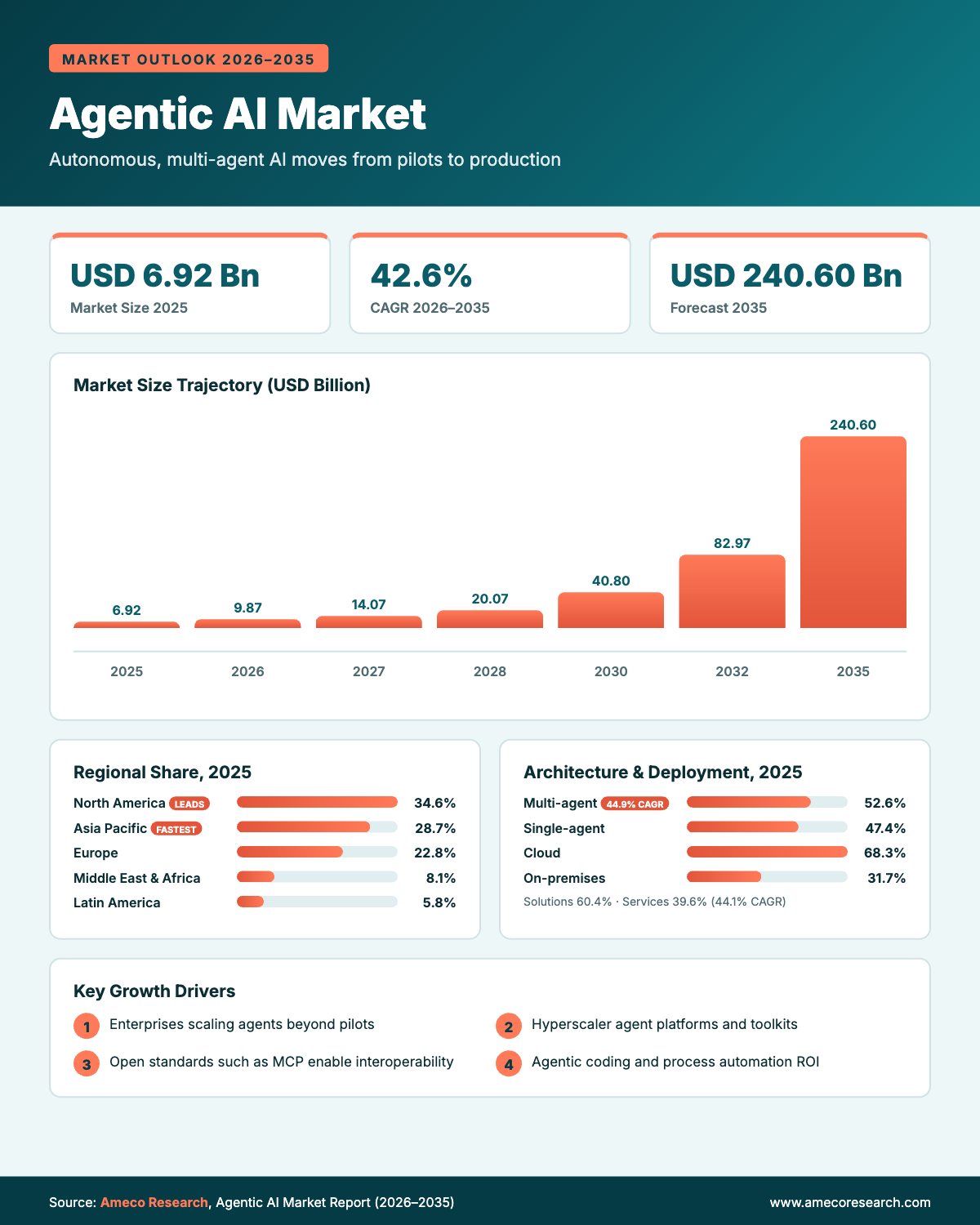
Pune, India, November 12, 2026 — The global agentic AI market is set to grow from USD 6.92 billion in 2025 to USD 240.60 billion by 2035, expanding at a compound annual growth rate (CAGR) of 42.6% between 2026 and 2035, according to the new Agentic AI Market report from Ameco Research. The study finds that enterprises are moving beyond chat-style assistants toward AI agents that plan, call tools, and complete multi-step business tasks with limited human supervision.
Agentic AI refers to software systems built on large language models and other AI techniques that can set sub-goals, reason over context, use enterprise applications and data, and act on a user’s behalf. Where earlier generative AI tools produced text or code on request, agents run workflows end to end: triaging service tickets, reconciling invoices, writing and testing code, or coordinating with other agents. The report shows that this shift from “answering” to “doing” is turning AI from an experimental budget line into an operational platform investment.
Agentic AI Market Size and Forecast
Ameco Research values the market at USD 6.92 billion in 2025 and expects it to reach USD 9.87 billion in 2026. Growth then compounds quickly as multi-agent deployments move into production, taking the market past USD 40 billion by 2030 and to USD 240.60 billion by 2035. The forecast is based on a 2025 base year, with historical analysis covering 2022 to 2024.
| Year | Market Size (USD Billion) |
|---|---|
| 2025 | 6.92 |
| 2026 | 9.87 |
| 2027 | 14.07 |
| 2028 | 20.07 |
| 2030 | 40.80 |
| 2032 | 82.97 |
| 2035 | 240.60 |
Key Takeaways
- Market size: USD 6.92 billion in 2025, forecast to reach USD 240.60 billion by 2035.
- Growth rate: 42.6% CAGR from 2026 to 2035.
- Leading region: North America, with a 34.6% share (about USD 2.39 billion) in 2025.
- Fastest-growing region: Asia Pacific, at a 44.6% CAGR.
- Largest architecture: Multi-agent systems, at 52.6% of revenue and a 44.9% CAGR.
- Fastest-growing end use: Healthcare, at a 46.2% CAGR.
What Is Driving the Agentic AI Market?
Enterprises are scaling agents beyond pilots
The report cites the McKinsey State of AI 2026 survey, which found that around 40% of large organisations are now scaling AI agents in at least one function. Early deployments focused on customer service and IT help desks; the next wave is reaching finance, procurement, HR operations, and software engineering, where agents can take on whole processes rather than single steps.
Hyperscalers and software vendors now ship agent platforms
Building an agent no longer requires a research team. Microsoft Copilot Studio and Agent 365, Google Gemini Enterprise, Amazon Bedrock AgentCore, OpenAI AgentKit, and Salesforce Agentforce give enterprises managed tooling for orchestration, memory, identity, and monitoring. This packaging shortens time to value and moves agentic AI into standard procurement cycles.
Open standards make agents interoperable
In December 2025, the Linux Foundation launched the Agentic AI Foundation to steward open projects such as the Model Context Protocol (MCP), AGENTS.md, and goose. Shared protocols let agents from different vendors connect to the same tools and data, lowering lock-in concerns. The same month, Fujitsu demonstrated cross-vendor agent collaboration, an early sign of the multi-agent supply chains the report expects to become common.
Agentic coding is proving measurable returns
Software development is one of the clearest early use cases. Coding agents that write, test, and refactor code across repositories give engineering leaders a concrete productivity metric, which helps justify wider rollouts into other departments.
Key Market Trends
- Multi-agent orchestration: Specialist agents that hand off tasks to one another are replacing single general-purpose assistants for complex workflows.
- Governance as a buying criterion: Agent identity, permissions, audit trails, and human-in-the-loop controls are now part of vendor evaluations, not afterthoughts.
- Security for autonomous actions: Prompt injection, tool misuse, and data leakage are driving demand for agent-specific security and observability layers.
- Outcome-based pricing: Vendors are experimenting with pricing per resolved case or completed task rather than per seat.
- Vertical agents: Pre-built agents for claims processing, clinical documentation, and network operations are shortening deployment times in regulated sectors.
Challenges
Reliability remains the main barrier. Agents that act on live systems must handle edge cases, recover from errors, and avoid compounding mistakes across long task chains. Enterprises also face integration work to expose legacy applications through secure APIs, along with questions about accountability when an autonomous system makes a costly decision. Inference costs for long-running, multi-step tasks can be significant, and regulatory frameworks such as the EU AI Act add compliance obligations for higher-risk use cases. The report notes that vendors able to prove dependable, auditable outcomes are best placed to win larger contracts.
Segment Analysis
By component, solutions held 60.4% of revenue in 2025, while services (39.6%) are expanding faster at a 44.1% CAGR as enterprises seek help with integration, change management, and governance design. By architecture, multi-agent systems led with 52.6%, ahead of single-agent systems at 47.4%. Cloud deployment accounted for 68.3% of the market, with on-premises and private deployment at 31.7%, favoured by regulated industries. Large enterprises represented 64.8% of demand, although SMEs (35.2%) are the faster-growing group at a 45.3% CAGR as packaged agents lower the skills barrier.
| Application | Share, 2025 | Note |
|---|---|---|
| Autonomous process automation | 23.6% | Largest application |
| Predictive analytics & decision support | 19.3% | — |
| Intelligent virtual assistants | 18.4% | Fastest growing, 45.8% CAGR |
| RPA integration | 14.7% | — |
| Smart manufacturing / IIoT | 13.2% | — |
| Others | 10.8% | — |
By end use, IT and telecom led with 25.7%, followed by BFSI at 19.2% and healthcare at 15.3%. Healthcare is the fastest-growing vertical at a 46.2% CAGR, supported by agents for prior authorisation, clinical documentation, and revenue cycle management. Manufacturing (10.2%), retail (9.4%), government (7.1%), automotive (5.1%), and other sectors (8.0%) make up the rest.
Regional Outlook
| Region | Share, 2025 | Highlights |
|---|---|---|
| North America | 34.6% | About USD 2.39 billion; home to most agent platform vendors |
| Asia Pacific | 28.7% | Fastest growing at 44.6% CAGR |
| Europe | 22.8% | Governance-led adoption under the EU AI Act |
| Middle East & Africa | 8.1% | Government digital programmes |
| Latin America | 5.8% | BFSI and retail automation |
North America’s lead reflects early enterprise adoption and the concentration of model developers and cloud providers. Asia Pacific is catching up quickly as Alibaba Cloud, Baidu, and regional system integrators launch agent platforms in local languages, and as governments in China, Japan, India, and Singapore promote AI-led productivity.
Competitive Landscape
The market combines cloud hyperscalers, model developers, enterprise software vendors, and automation specialists. Key companies profiled include Microsoft, Google, Amazon Web Services, Salesforce, IBM, NVIDIA, OpenAI, Anthropic, ServiceNow, UiPath, SAP, Oracle, Alibaba Cloud, Baidu, and Meta. Competition centres on agent orchestration, ecosystem integrations, security and governance features, and the ability to embed agents into systems of record. Partnerships between model providers and application vendors are frequent, as are acquisitions of agent-tooling start-ups. Readers who need company-level benchmarking can make an inquiry with the Ameco Research team.
Opportunities Ahead
- Agent governance, identity, and observability platforms for regulated industries.
- Packaged vertical agents for healthcare, insurance, and telecom network operations.
- Managed services that help SMEs deploy agents without in-house AI teams.
- Edge and on-premises agents for manufacturing and data-sensitive workloads.
Agentic AI sits within a wider AI ecosystem that Ameco Research also covers in its Enterprise AI Market, Machine Learning Market, AI in Asset Management Market, and Physical AI Market reports.
Report Scope
| Attribute | Details |
|---|---|
| Market size (2025) | USD 6.92 billion |
| Market size (2035) | USD 240.60 billion |
| CAGR (2026–2035) | 42.6% |
| Base year / historical data | 2025 / 2022–2024 |
| Segments covered | Component, architecture, deployment, enterprise size, application, end use, region |
| Regions covered | North America, Europe, Asia Pacific, Latin America, Middle East & Africa |
Who Should Read This Report
- CIOs, CTOs, and heads of automation planning agent roadmaps.
- Software vendors and system integrators building agent products and services.
- Investors assessing AI platform and infrastructure opportunities.
- Strategy and corporate development teams in BFSI, healthcare, telecom, and manufacturing.
The full study includes detailed segment forecasts, country-level data, and company profiles. Organisations ready to act on these findings can buy the report directly.
Frequently Asked Questions
How big is the agentic AI market?
The global agentic AI market was valued at USD 6.92 billion in 2025 and is projected to reach USD 240.60 billion by 2035, according to Ameco Research.
What is the growth rate of the agentic AI market?
The market is forecast to grow at a CAGR of 42.6% from 2026 to 2035, making it one of the fastest-growing segments of enterprise software.
Which region leads the agentic AI market?
North America held the largest share at 34.6% in 2025, while Asia Pacific is expected to grow fastest at a 44.6% CAGR.
What is the difference between agentic AI and generative AI?
Generative AI produces content such as text, images, or code in response to a prompt. Agentic AI uses those models as a reasoning engine but adds planning, memory, and tool use, so it can complete multi-step tasks and take actions inside business systems with limited human input.
Which applications use agentic AI the most?
Autonomous process automation is the largest application at 23.6% of revenue, followed by predictive analytics and decision support at 19.3%. Intelligent virtual assistants are growing fastest at a 45.8% CAGR.
Who are the key players in the agentic AI market?
Leading companies include Microsoft, Google, Amazon Web Services, Salesforce, IBM, NVIDIA, OpenAI, Anthropic, ServiceNow, UiPath, SAP, and Oracle.
Conclusion
Agentic AI is moving from proof of concept to production faster than most enterprise technologies before it. With a 42.6% CAGR and a forecast value of USD 240.60 billion by 2035, the market rewards vendors and adopters that pair autonomy with strong governance. Multi-agent architectures, open interoperability standards, and fast growth in Asia Pacific and healthcare will shape the next decade of competition.
Explore the complete Agentic AI Market report for full forecasts and competitive analysis.
About Ameco Research
Ameco Research is a market research and consulting firm that provides syndicated reports, custom research, and strategic advisory services across technology, healthcare, energy, automotive, chemicals, and consumer markets. Its analysts combine primary interviews with secondary research to help clients identify growth opportunities and make confident decisions.
Contact Us
Ameco Research
201, Vaidehi-Saaket, Baner - Pashan Link Rd, Pashan, Pune 411021
Phone: +91 898 322 5533
Email: [email protected]
Website: www.amecoresearch.com