Press Release
AI Inference Infrastructure Market to Reach USD 1,548.3 Billion by 2035, Growing at 21.3% CAGR | Ameco Research
Date : Nov 26, 2026
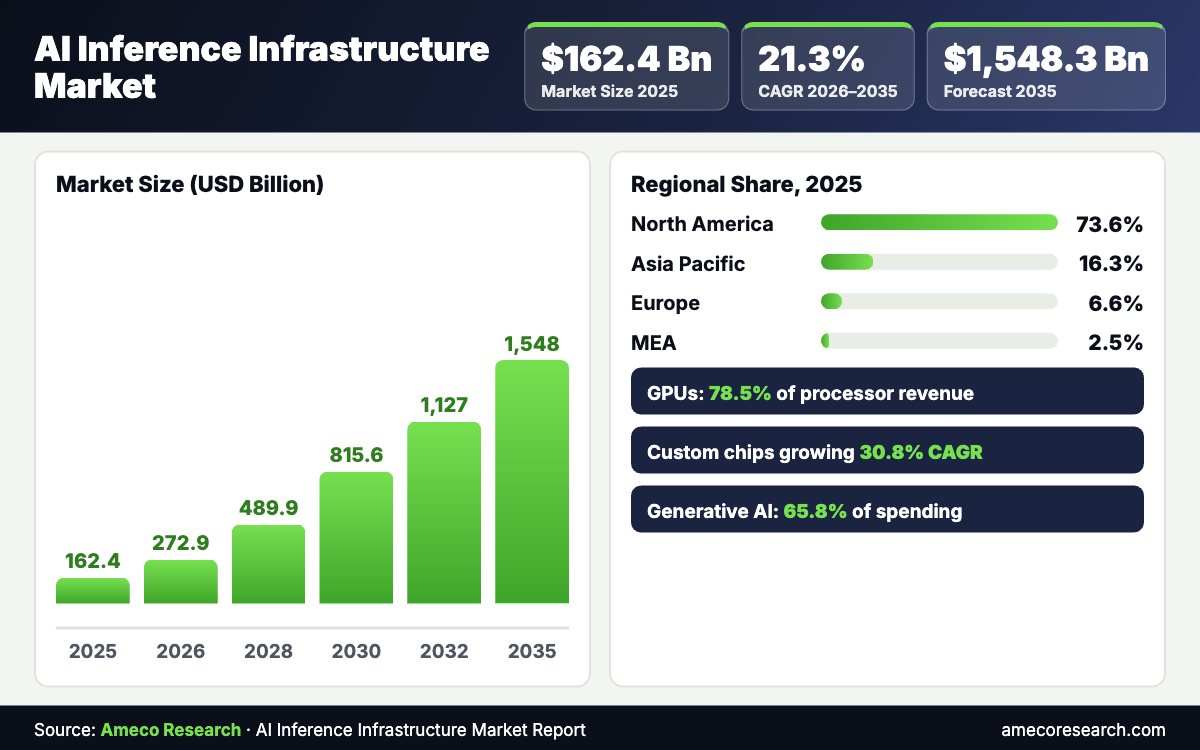
Pune, India, November 26, 2026 — The global AI inference infrastructure market is projected to grow from USD 162.4 billion in 2025 to USD 1,548.3 billion by 2035, at a CAGR of 21.3% from 2026 to 2035, according to the new AI Inference Infrastructure Market report from Ameco Research. The market is estimated at USD 272.9 billion in 2026 as generative AI, reasoning models, and AI agents push token volumes sharply higher and enterprises move AI from pilots into production.
AI inference infrastructure is the IT hardware used to run trained AI models in production: accelerated and CPU inference servers, storage, data-centre networking, and edge inference systems. Every chatbot answer, AI-generated image, code suggestion, search result, recommendation, and agent action is an inference workload. These workloads run on GPUs, custom accelerators such as TPUs and LPUs, CPUs, high-bandwidth memory (HBM), fast storage, and low-latency networks. While the first wave of AI investment focused on training ever-larger models, spending is now shifting decisively toward serving those models to users — making inference the main battleground for chipmakers, cloud providers, and data centre operators.
AI Inference Infrastructure Market Size and Forecast
Ameco Research estimates the market at USD 272.9 billion in 2026, up about 68% from 2025. Growth is driven by large deployments of inference-optimised systems such as NVIDIA Blackwell Ultra and Vera Rubin, Google Ironwood TPUs, AWS Trainium, and AMD Instinct, and by new capacity at neocloud providers. The market is expected to reach about USD 815.6 billion by 2030 and USD 1,548.3 billion by 2035.
| Year | Market Size (USD Billion) |
|---|---|
| 2025 | 162.4 |
| 2026 | 272.9 |
| 2027 | 366.0 |
| 2028 | 489.9 |
| 2030 | 815.6 |
| 2032 | 1,127.0 |
| 2035 | 1,548.3 |
Key Takeaways
- Market size: USD 162.4 billion in 2025, about USD 272.9 billion in 2026, and USD 1,548.3 billion by 2035.
- Growth rate: 21.3% CAGR from 2026 to 2035.
- Leading region: North America, with about 73.6% of 2025 revenue.
- Fastest-growing region: Asia Pacific, at a 27.4% CAGR.
- Leading component: Accelerated inference servers, at 79.6%; storage is growing fastest.
- Leading processor: GPUs, at 78.5%; custom ASICs and XPUs are growing fastest at 30.8% CAGR.
- Leading application: Generative AI and large language models, at 65.8% of spending.
What Is Driving the AI Inference Infrastructure Market?
Reasoning models and AI agents multiply token demand
Multi-step reasoning models and autonomous agents can use 10 to 100 times more tokens per task than simple chat. At GTC 2026, NVIDIA described an “inflection point of inference”, and hyperscalers and AI labs are now designing data centres primarily around serving models rather than training them.
Generative AI at mass scale
Consumer and enterprise AI assistants now serve hundreds of millions of users every day, while companies are moving AI into customer service, software development, finance, and operations, creating steady, growing inference demand.
Hyperscaler, neocloud, and sovereign AI investment
Cloud providers and GPU cloud specialists are building inference-optimised data centres worldwide, and governments are funding national AI infrastructure to keep data and models within their borders.
Falling cost per token
Lower-precision formats such as FP4, model distillation, mixture-of-experts architectures, and better serving software keep cutting the cost of each token. Cheaper tokens make more AI applications profitable, which in turn increases total inference demand.
Key AI Inference Infrastructure Trends in 2026
- Disaggregated inference: Inference is being split into a compute-heavy “prefill” stage and a memory-bound “decode” stage on different hardware. NVIDIA’s Groq 3 LPX rack, unveiled at GTC 2026 after its licensing deal with Groq reported at about USD 20 billion, pairs Rubin GPUs for prefill with SRAM-rich LPUs for fast decode.
- Custom silicon gains ground: Google’s inference-focused Ironwood TPU became generally available in late 2025, and AWS says more than half of the tokens on its Bedrock service run on its own Trainium chips. Broadcom and Marvell are designing custom accelerators for more hyperscalers and AI labs.
- Inference chip start-ups scale up: Cerebras raised about USD 5.5 billion in May 2026 in the largest U.S. IPO of the year, Etched shipped its first Sohu rack in August 2026, and AMD acquired Taalas, which hard-wires AI models into silicon.
- Memory becomes the bottleneck: Long-context and agentic workloads need huge amounts of fast memory for model weights and key-value (KV) caches. HBM4 is entering production, and vendors are adding KV-cache offload to DRAM and SSD tiers.
Challenges
Power availability is the biggest constraint: grid connections and electricity supply limit how fast new inference capacity can be built. HBM and advanced packaging remain tight, AI racks can cost several million dollars each, and annual chip launches shorten useful life and complicate depreciation planning. U.S. export controls also limit sales of advanced accelerators to China and some other markets.
Training vs Inference: Why the Spending Shift Matters
Training builds a model by processing huge datasets over weeks or months on large GPU clusters. Inference runs that trained model every time someone asks a question, generates an image, or lets an AI agent complete a task. Training is a periodic, very large job; inference is continuous and grows with every new user and every new application.
This difference changes what buyers need. Inference rewards low latency, high memory bandwidth, energy efficiency, and low cost per token rather than raw training throughput. That is why specialised inference chips, disaggregated architectures, and memory and storage tiers are attracting so much investment, and why the AI inference infrastructure market is expected to grow almost tenfold over the next decade.
Segment Analysis
| Component | Share, 2025 | Key Highlights |
|---|---|---|
| Accelerated inference servers (GPU / ASIC) | 79.6% | Largest; about USD 129.3 billion |
| Data-centre networking | 8.1% | Ethernet, InfiniBand, NICs, optics |
| Edge inference systems | 5.8% | Edge servers, robots, vehicle compute |
| CPU-only inference servers | 4.3% | Smaller models and classic ML |
| Storage | 2.2% | Fastest growing at 27.2% CAGR; RAG and KV-cache tiers |
| Processor Type | Share, 2025 | Key Highlights |
|---|---|---|
| GPUs | 78.5% | NVIDIA and AMD accelerators |
| Custom ASICs & XPUs | 15.0% | Fastest growing at 30.8% CAGR; TPU, Trainium, LPU, WSE |
| CPUs | 4.2% | Smaller models, pre- and post-processing |
| FPGAs & others | 2.3% | Low-latency, specialised workloads |
By deployment, cloud and hyperscale held 74.6%, enterprise on-premises, private, and sovereign AI 19.6%, and edge 5.8%. By application, generative AI and LLMs accounted for 65.8%, recommendation and search 21.8%, computer vision 7.0%, and speech and others 5.4%. By end user, hyperscale cloud providers held 61.8%, enterprises 19.5%, AI labs and neoclouds 13.2% (the fastest-growing group), and government and research 5.5%.
Regional Outlook
| Region | Share, 2025 | Outlook |
|---|---|---|
| North America | 73.6% | Largest; U.S. hyperscalers, AI labs, chip designers |
| Asia Pacific | 16.3% | Fastest growing at 27.4% CAGR |
| Europe | 6.6% | Sovereign AI and EU AI gigafactories |
| Middle East & Africa | 2.5% | Gulf AI campuses and sovereign programmes |
| Latin America | 1.0% | Early cloud and enterprise AI |
The U.S. hosts the largest cloud providers, leading AI model developers, and nearly all major AI chip designers. In Asia Pacific, China is building large inference clusters on domestic accelerators from Huawei and others, Japan, South Korea, and India are investing in sovereign AI compute, and Taiwan and South Korea supply most of the world’s AI chips, servers, and memory.
Competitive Landscape
NVIDIA leads the market with its GPUs, networking, software, and new Groq-based LPX systems. AMD, Intel, and Qualcomm compete in accelerators and CPUs; Google, AWS, and Microsoft deploy their own custom chips; Broadcom and Marvell design custom ASICs and supply networking; Cerebras and Groq offer specialised inference systems; SK hynix, Samsung, and Micron supply HBM and memory; and Dell, HPE, Supermicro, Arista, and CoreWeave provide servers, networks, and cloud capacity. Huawei is also profiled. For company benchmarking, make an inquiry with Ameco Research.
Opportunities Ahead
- Inference-optimised ASICs for specific model types and low-latency serving.
- Edge and on-device AI in PCs, smartphones, vehicles, robots, and telecom networks.
- Inference-as-a-service platforms with usage-based pricing.
- Memory and storage tiers for KV-cache offload, plus liquid cooling and power systems for dense racks.
For related coverage, see Ameco Research’s AI Data Center Market, GPU as a Service Market, High Bandwidth Memory (HBM) Market, and Sovereign AI Infrastructure Market reports.
Report Scope
| Attribute | Details |
|---|---|
| Market size (2025 / 2026) | USD 162.4 billion / USD 272.9 billion |
| Market size (2035) | USD 1,548.3 billion |
| CAGR (2026–2035) | 21.3% |
| Historical data / base year | 2021–2024 / 2025 |
| Segments covered | Component, processor type, deployment, application, end user, region |
| Regions covered | North America, Europe, Asia Pacific, Latin America, Middle East & Africa |
Who Should Read This Report
- Chipmakers, memory suppliers, and server and networking vendors.
- Cloud providers, neoclouds, and data centre operators.
- Enterprises planning AI deployment and infrastructure budgets.
- Investors tracking AI hardware and infrastructure.
The full report covers inference vs training spending, token volume and cost-per-token analysis, accelerator and memory technology, data centre power and cooling, and company profiles. To access it, buy the report.
Frequently Asked Questions
How big is the AI inference infrastructure market?
The market was USD 162.4 billion in 2025, is estimated at USD 272.9 billion in 2026, and is projected to reach USD 1,548.3 billion by 2035, according to Ameco Research.
What is the growth rate of the AI inference infrastructure market?
The market is forecast to grow at a CAGR of 21.3% from 2026 to 2035.
What is AI inference infrastructure?
It is the hardware used to run trained AI models in production, including GPU, custom-accelerator, and CPU servers with high-bandwidth memory, storage, data-centre networking, and edge inference systems.
Why is inference spending growing faster than training?
Reasoning models and AI agents use far more tokens per task, user numbers keep rising, and enterprises are moving AI into production, so inference demand grows continuously with usage.
Who are the leading AI inference infrastructure companies?
Key players include NVIDIA, AMD, Intel, Google, AWS, Microsoft, Broadcom, Marvell, Cerebras, Groq, and memory suppliers SK hynix, Samsung, and Micron.
Conclusion
Inference has become the commercial engine of AI. With a 21.3% CAGR and a forecast value of USD 1,548.3 billion by 2035, the market will be shaped by reasoning models and agents, custom silicon, memory and power constraints, and the race to lower the cost of every token.
Explore the complete AI Inference Infrastructure Market report for detailed forecasts and competitive analysis.
About Ameco Research
Ameco Research is a market research and consulting firm that provides syndicated reports, custom research, and strategic advisory services across technology, healthcare, energy, automotive, chemicals, and consumer markets. Its analysts combine primary interviews with secondary research to help clients identify growth opportunities and make confident decisions.
Contact Us
Ameco Research
201, Vaidehi-Saaket, Baner - Pashan Link Rd, Pashan, Pune 411021
Phone: +91 898 322 5533
Email: [email protected]
Website: www.amecoresearch.com