Sovereign AI Infrastructure Market Size, Share, Trends & Growth Opportunities Forecast to 2026 - 2035
Sovereign AI Infrastructure Market Size, Share & Trends Report, 2026–2035
LAST UPDATED: NOVEMBER 2026
The global sovereign AI infrastructure market size was valued at USD 54.8 billion in 2025 and is projected to reach USD 441.5 billion by 2035, growing at a CAGR of 20.7% from 2026 to 2035. The market is estimated at USD 81.2 billion in 2026, as governments, national champions and telecom operators build domestic AI factories, national supercomputers and sovereign clouds to keep data, models and compute under national control. Asia Pacific holds the largest share, while the Middle East & Africa is the fastest-growing region.
Sovereign AI infrastructure is the computing capacity that a nation owns or controls to develop and run artificial intelligence under its own laws and priorities. It includes national AI supercomputers, government and public-private AI data centers (often called AI factories), sovereign cloud platforms operated by local providers, GPU and accelerator clusters, high-speed networking and storage, power and cooling, and the software stacks used to train and serve national language models.
Sovereign AI has moved from policy debate to large-scale spending. NVIDIA reported that its sovereign AI business more than tripled to over USD 30 billion in fiscal 2026, the EU has launched a program to build up to seven AI gigafactories, and countries from Saudi Arabia and the UAE to India, Japan, South Korea and Canada are funding national compute. These programs make the sovereign AI infrastructure market one of the fastest-growing parts of global AI spending.
Sovereign AI Infrastructure Market Key Takeaways
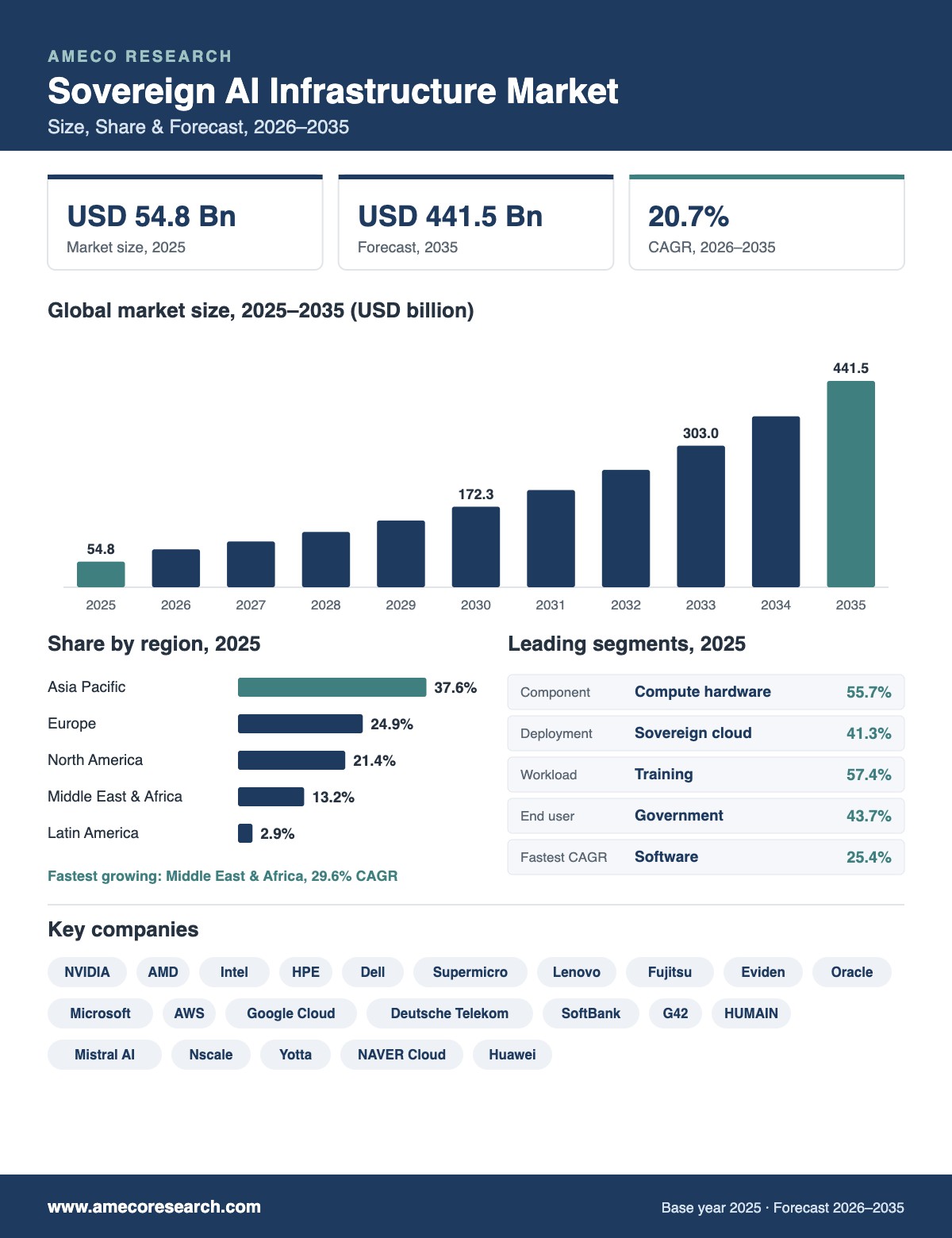 Infographic: Sovereign AI Infrastructure Market Size, Share, Trends & Growth Opportunities Forecast to 2026 - 2035 | Ameco Research
Sovereign AI Infrastructure Market Report Scope
| Report Attribute | Details |
| Market Size in 2025 | USD 54.8 Billion |
| Market Size in 2026 | USD 81.2 Billion |
| Market Forecast by 2035 | USD 441.5 Billion |
| CAGR (2026–2035) | 20.7% |
| Historical Data | 2021–2024 |
| Base Year | 2025 |
| Forecast Period | 2026–2035 |
| Largest Region | Asia Pacific (37.6% share in 2025) |
| Fastest-Growing Region | Middle East & Africa (29.6% CAGR) |
| Segments Covered | Component, Deployment Model, Workload, End User and Region |
| Regional Scope | North America, Europe, Asia Pacific, Latin America, and Middle East & Africa |
| Key Companies Profiled | NVIDIA, AMD, Intel, Hewlett Packard Enterprise, Dell Technologies, Super Micro Computer, Lenovo, Fujitsu, Eviden (Atos Group), Oracle, Microsoft, Amazon Web Services (AWS), Google Cloud, Deutsche Telekom, SoftBank Corp., G42 (Core42), HUMAIN, Mistral AI, Nscale, Yotta Data Services, NAVER Cloud and Huawei |
| Report Coverage | Market size and forecast, estimation methodology, national AI program tracker, AI factory and gigafactory pipeline (MW and GPUs), sovereign cloud analysis, policy and export-control analysis, trends, drivers, restraints, opportunities, segment and regional analysis, competitive landscape, recent developments |
How Big Is the Sovereign AI Infrastructure Market in 2026?
Ameco Research estimates the sovereign AI infrastructure market at USD 81.2 billion in 2026, up about 48% from USD 54.8 billion in 2025, as national AI factories in Europe, the Gulf and Asia move from announcement to construction and first GPU clusters go live. The market is expected to reach about USD 172.3 billion by 2030 and climb to USD 441.5 billion by 2035. Growth is slightly slower than for AI inference infrastructure overall because sovereign programs depend on public budgets and multi-year procurement cycles.
| Year | Market Size (USD Billion) |
| 2025 | 54.8 |
| 2026 | 81.2 |
| 2027 | 98.0 |
| 2028 | 118.3 |
| 2030 | 172.3 |
| 2032 | 251.1 |
| 2035 | 441.5 |
How We Estimated the Sovereign AI Infrastructure Market
There is no official statistic for total sovereign AI spending, so Ameco Research built the estimate from verifiable disclosures and clearly stated assumptions:
| Data Point | Value | How It Is Used |
| NVIDIA sovereign AI revenue, fiscal 2026 (Feb 2025–Jan 2026) | Over USD 30 billion, more than tripled year over year | Base anchor for 2025 accelerated computing spend |
| Accelerated computing share of sovereign AI build-outs | About 56% (assumption) | Grosses up to total spend including networking, storage, facilities, power, software and services: about USD 54.8 billion in 2025 |
| NVIDIA outlook | Sovereign opportunity to grow at least in line with the AI infrastructure market | Sets long-term growth close to, but below, AI infrastructure growth |
| Ameco AI Inference Infrastructure forecast | 21.3% CAGR (2026–2035) | Upper benchmark; sovereign growth set at 20.7% due to budget-driven procurement |
| National programs | EU AI gigafactories (EUR 30B+), IndiaAI Mission, HUMAIN, Stargate UAE, Canada, Japan, Korea | Checks regional shares and 2026–2028 ramp-up |
The sovereign AI infrastructure market is a subset of global AI infrastructure. For context, Ameco Research values the AI inference infrastructure market at USD 162.4 billion and the enterprise AI market at USD 105.8 billion in 2025; sovereign deployments span both training and inference and represent a growing share of national and public-sector AI spending.
Latest Sovereign AI Infrastructure Market Trends 2026
Europe moves from AI factories to AI gigafactories
On July 30, 2026, the EuroHPC Joint Undertaking launched its call for up to seven AI gigafactories, backed by up to EUR 10 billion in public funding and at least EUR 20 billion in private investment. The call closed on November 12, 2026, and Germany raised federal support for a national gigafactory to EUR 1 billion.
Gulf states build at gigawatt scale
Saudi Arabia’s HUMAIN brought AMD Instinct MI355X systems online in August 2026 and targets 1.9 GW of capacity by 2030, while the UAE’s Stargate UAE campus is planned at 1 GW, with the first 200 MW due in 2026.
National compute for national language models
India’s IndiaAI Mission made more than 45,000 GPUs available to researchers and start-ups by June 2026, Singapore launched its ASPIRE 2B supercomputer, and countries are training models in local languages for public services.
Telecom operators become sovereign AI providers
Deutsche Telekom opened its Industrial AI Cloud in Munich with about 10,000 NVIDIA Blackwell GPUs in February 2026, and operators such as SoftBank, Swisscom, Orange and Telenor are offering sovereign AI compute to governments and industry.
Hyperscalers launch sovereign regions
Microsoft, AWS, Google Cloud and Oracle are offering sovereign and dedicated cloud regions that keep data and operations within national borders, often in partnership with local operators.
Energy and grid access shape site selection
Sovereign AI campuses are being planned around power availability, from Nordic hydropower to Gulf solar and gas, as countries compete for gigawatt-scale grid connections.
Sovereign AI Infrastructure Market Dynamics
Growth drivers
- Data sovereignty and security: governments need sensitive citizen, health and defense data processed within national jurisdiction.
- Strategic autonomy: countries want to reduce reliance on a few foreign cloud providers and secure access to scarce AI chips.
- Economic competitiveness: national compute supports domestic AI start-ups, research and industry.
- Language and cultural representation: national language models require local data and dedicated training capacity.
- Public funding programs: EU, Gulf, Asian and Canadian programs are committing tens of billions of dollars to AI compute.
Restraints and challenges
- High capital cost: gigawatt-scale AI campuses cost tens of billions of dollars, straining public budgets.
- Power and grid constraints: limited grid capacity and long connection times delay projects.
- Export controls: U.S. rules on advanced AI chips affect which countries can buy leading accelerators and in what volume.
- Talent shortages: operating large AI clusters requires scarce engineering skills.
- Utilization risk: some national clusters may be underused if local demand and software ecosystems lag.
Opportunities
- Public-private AI factories combining government anchor demand with private operators.
- Sovereign inference services for public services, healthcare, finance and defense.
- Turnkey AI factory solutions from server makers, chip vendors and integrators.
- Emerging-market programs in Southeast Asia, Latin America and Africa.
- Energy-integrated AI campuses co-located with renewable and nuclear power.
Sovereign AI Infrastructure Market Segment Analysis
By component
Compute hardware, including GPU and accelerator systems, AI servers and supercomputers, accounted for 55.7% of spending in 2025, about USD 30.5 billion. Data center facilities, power and cooling held 16.2%, networking and storage 14.6%, software and platforms 7.3%, and services 6.2%. Software and platforms, including AI factory operating systems, model training stacks and sovereign cloud management, are the fastest-growing component at about a 25.4% CAGR.
| Component | Share (2025) | Key Highlights |
| Compute Hardware (GPU & Accelerator Systems) | 55.7% | Largest; AI servers, supercomputers and GPU clusters |
| Facilities, Power & Cooling | 16.2% | AI factory buildings, liquid cooling and grid connections |
| Networking & Storage | 14.6% | InfiniBand, Ethernet and high-performance storage |
| Software & Platforms | 7.3% | Fastest-growing at 25.4% CAGR; AI stacks and cloud platforms |
| Services | 6.2% | Design, integration, operations and managed AI |
By deployment model
Sovereign clouds and AI factories run by national champions and telecom operators held 41.3% of revenue in 2025 and are growing fastest. Government-owned national AI supercomputers and data centers accounted for 33.6%, hyperscaler sovereign and dedicated regions 18.9%, and on-premises and hybrid sovereign deployments by regulated enterprises 6.2%.
| Deployment Model | Share (2025) | Key Highlights |
| Sovereign Cloud & National Champion AI Factories | 41.3% | Largest and fastest-growing; telcos and local operators |
| Government-Owned Supercomputers & Data Centers | 33.6% | National labs, EuroHPC and defense systems |
| Hyperscaler Sovereign & Dedicated Regions | 18.9% | In-country regions with local control |
| On-Premises & Hybrid Sovereign Deployments | 6.2% | Regulated enterprises and agencies |
By workload: Is inference overtaking training?
Training, including national foundation and language models, accounted for 57.4% of sovereign AI infrastructure spending in 2025. Inference, which serves AI applications for public services, defense, healthcare and industry, held 42.6% and is growing faster at about a 24.8% CAGR. Ameco Research expects inference to become the larger workload by 2029 as national models move into everyday use.
| Workload | Share (2025) | Key Highlights |
| Training (Foundation & National Language Models) | 57.4% | Largest; national LLMs and research |
| Inference & AI Services | 42.6% | Fastest-growing at 24.8% CAGR; public services and industry |
By end user
Government and defense was the largest end user with 43.7% of revenue in 2025. Research and academic institutions held 18.2%, telecom and cloud providers 16.9%, banking and financial services 7.8%, healthcare and life sciences 6.4%, and industrial, energy and other users 7.0%.
| End User | Share (2025) | Key Highlights |
| Government & Defense | 43.7% | Largest; public services, security and defense AI |
| Research & Academia | 18.2% | National labs and university supercomputers |
| Telecom & Cloud Providers | 16.9% | Sovereign AI cloud services |
| BFSI | 7.8% | Regulated financial data and AI |
| Healthcare & Life Sciences | 6.4% | Patient data, drug discovery and genomics |
| Industrial, Energy & Others | 7.0% | Manufacturing, energy and automotive AI |
Sovereign AI Infrastructure Market Regional Analysis
| Region | Share (2025) | Outlook |
| Asia Pacific | 37.6% | Largest; China, Japan, South Korea, India, Singapore |
| Europe | 24.9% | EU AI factories, gigafactories and telco AI clouds |
| North America | 21.4% | U.S. national labs and Canada’s sovereign compute strategy |
| Middle East & Africa | 13.2% | Fastest-growing at 29.6% CAGR; Saudi Arabia and UAE |
| Latin America | 2.9% | Brazil’s national AI plan and regional clouds |
Why does Asia Pacific lead the sovereign AI infrastructure market?
Asia Pacific accounted for about 37.6% of revenue in 2025. China is building national computing networks with domestic accelerators, Japan is funding ABCI and private AI infrastructure through SoftBank and Sakura Internet, South Korea is expanding national GPU capacity, India’s IndiaAI Mission provides shared GPU access, and Singapore operates national AI supercomputers.
What makes the Middle East & Africa the fastest-growing region?
The Middle East and Africa held about 13.2% of the market in 2025 and is forecast to grow at a 29.6% CAGR. Saudi Arabia’s HUMAIN and the UAE’s G42 and Stargate UAE are building gigawatt-scale AI campuses with access to low-cost energy and large sovereign wealth funding, positioning the Gulf as a global AI compute hub.
How are Europe and North America developing?
Europe represented about 24.9% of revenue in 2025, supported by EuroHPC AI factories, the AI gigafactories program, national investments in France and Germany and sovereign clouds from telecom operators. North America held about 21.4%, led by U.S. Department of Energy AI supercomputers and Canada’s Sovereign AI Compute Strategy.
Sovereign AI Infrastructure Market Segmentation
Sovereign AI Infrastructure Market Leading Companies
NVIDIA is the leading technology supplier to sovereign AI programs, with AMD and Intel also supplying accelerators. Hewlett Packard Enterprise, Dell, Supermicro, Lenovo, Fujitsu and Eviden build national supercomputers and AI factories; Oracle, Microsoft, AWS and Google Cloud offer sovereign and dedicated cloud regions; and national champions such as Deutsche Telekom, SoftBank, G42, HUMAIN, Mistral AI, Nscale, Yotta, NAVER Cloud and Huawei operate sovereign AI capacity and models.
NVIDIA · AMD · Intel · Hewlett Packard Enterprise · Dell Technologies · Super Micro Computer · Lenovo · Fujitsu · Eviden (Atos Group) · Oracle · Microsoft · Amazon Web Services (AWS) · Google Cloud · Deutsche Telekom · SoftBank Corp. · G42 (Core42) · HUMAIN · Mistral AI · Nscale · Yotta Data Services · NAVER Cloud · Huawei
Recent developments
- November 2026: The EuroHPC Joint Undertaking’s call for up to seven EU AI gigafactories closed, with up to EUR 10 billion in public funding aimed at unlocking at least EUR 20 billion in private investment.
- August 2026: Saudi Arabia’s HUMAIN brought AMD Instinct MI355X systems online through its joint venture with AMD and Cisco.
- August 2026: Germany raised federal support for a national AI gigafactory to EUR 1 billion.
- June 2026: India’s IndiaAI Mission made more than 45,000 GPUs available, and Singapore launched its ASPIRE 2B national supercomputer.
- February 2026: NVIDIA said its sovereign AI business more than tripled to over USD 30 billion in fiscal 2026.
- February 2026: Deutsche Telekom and NVIDIA opened the Industrial AI Cloud in Munich with about 10,000 Blackwell GPUs.
Sovereign AI Infrastructure Market: Frequently Asked Questions
How big is the sovereign AI infrastructure market?
The global sovereign AI infrastructure market was valued at USD 54.8 billion in 2025 and is estimated at USD 81.2 billion in 2026. Ameco Research projects it to reach USD 441.5 billion by 2035, growing at a CAGR of 20.7% from 2026 to 2035.
What is sovereign AI infrastructure?
Sovereign AI infrastructure is the computing capacity a country controls to build and run AI on its own terms: national AI supercomputers and data centers, sovereign clouds operated under local law, GPU and accelerator clusters, high-speed networks and storage, power and cooling, and the software used to train and serve national language models. The goal is to keep critical data, models and compute within national jurisdiction.
Why are countries investing in sovereign AI?
Governments want to protect sensitive data, meet data-residency and security rules, support their own languages and culture in AI models, reduce dependence on foreign cloud providers, secure scarce GPU capacity and build domestic AI industries. Sovereign AI has also become part of national economic and defense strategy.
How did Ameco Research estimate the sovereign AI infrastructure market?
The estimate is anchored on NVIDIA’s disclosure that its sovereign AI business exceeded USD 30 billion in fiscal 2026 (roughly calendar 2025). Ameco Research assumes accelerated computing systems represent about 56% of sovereign AI infrastructure spending, with the rest going to networking, storage, facilities, power, cooling, software and services, giving USD 54.8 billion for 2025. Growth is cross-checked against national programs and Ameco’s AI inference infrastructure, AI data center and GPU-as-a-Service forecasts.
Which countries are leading in sovereign AI infrastructure?
Leading programs include the EU’s AI factories and AI gigafactories, Germany’s Industrial AI Cloud, France’s national AI compute, the U.K.’s AI Research Resource, Saudi Arabia’s HUMAIN, the UAE’s Stargate UAE campus, India’s IndiaAI Mission, Japan’s ABCI and SoftBank AI infrastructure, South Korea’s national GPU program, Singapore’s national supercomputers, Canada’s Sovereign AI Compute Strategy and China’s national computing network.
Which region leads the sovereign AI infrastructure market?
Asia Pacific led with about 37.6% of revenue in 2025, driven by China, Japan, South Korea, India and Singapore. Europe held 24.9% and North America 21.4%. The Middle East and Africa is the fastest-growing region at about a 29.6% CAGR, led by Saudi Arabia and the UAE.
What is the difference between sovereign AI and sovereign cloud?
Sovereign cloud refers to cloud services that keep data and operations under local legal control. Sovereign AI infrastructure is broader: it includes sovereign cloud but also national AI supercomputers, dedicated GPU clusters, AI factories, national language models and the energy and facilities that support them.
Who are the key companies in the sovereign AI infrastructure market?
Key companies include NVIDIA, AMD, Intel, Hewlett Packard Enterprise, Dell Technologies, Super Micro Computer, Lenovo, Fujitsu, Eviden, Oracle, Microsoft, AWS, Google Cloud, Deutsche Telekom, SoftBank Corp., G42 (Core42), HUMAIN, Mistral AI, Nscale, Yotta Data Services, NAVER Cloud and Huawei.
Related ICT and Media Market Reports
- AI Inference Infrastructure Market Size, Share, Trends & Growth Opportunities Forecast to 2026 - 2035
- Post-Quantum Cryptography (PQC) Market Size, Share, Trends & Growth Opportunities Forecast to 2026 - 2035
- GPU-as-a-Service Market Size, Share, Trends & Growth Opportunities Forecast to 2026 - 2035
- Agentic AI Market Size, Share, Trends & Growth Opportunities Forecast to 2026 - 2035
- Enterprise AI Market Size, Share, Trends & Growth Opportunities Forecast to 2026 - 2035