GPU-as-a-Service Market Size, Share, Trends & Growth Opportunities Forecast to 2026 - 2035
GPU-as-a-Service Market Size, Share & Trends Report, 2026–2035
LAST UPDATED: NOVEMBER 2026
The global GPU-as-a-Service (GPUaaS) market size was valued at USD 8.06 billion in 2025 and is projected to reach USD 111.97 billion by 2035, growing at a CAGR of 30.1% from 2026 to 2035. The market is estimated at USD 10.49 billion in 2026, with North America holding the largest share and Asia Pacific registering the fastest growth.
GPU-as-a-Service (GPUaaS) lets organizations rent graphics processing units in the cloud instead of buying, installing and operating their own hardware. Customers access GPUs on demand, through reserved capacity or by subscription, to train and run AI models, run high-performance computing (HPC) simulations, render 3D graphics, stream games and process video.
The generative AI boom has turned GPU capacity into one of the most sought-after resources in technology. Top-end GPUs such as NVIDIA’s H100, H200 and Blackwell series are expensive and often scarce, so AI labs, enterprises and start-ups increasingly rent them from hyperscalers such as AWS, Microsoft Azure, Google Cloud and Oracle, and from specialized GPU clouds, or neoclouds, such as CoreWeave, Nebius, Lambda and Crusoe.
GPU-as-a-Service Market Key Takeaways
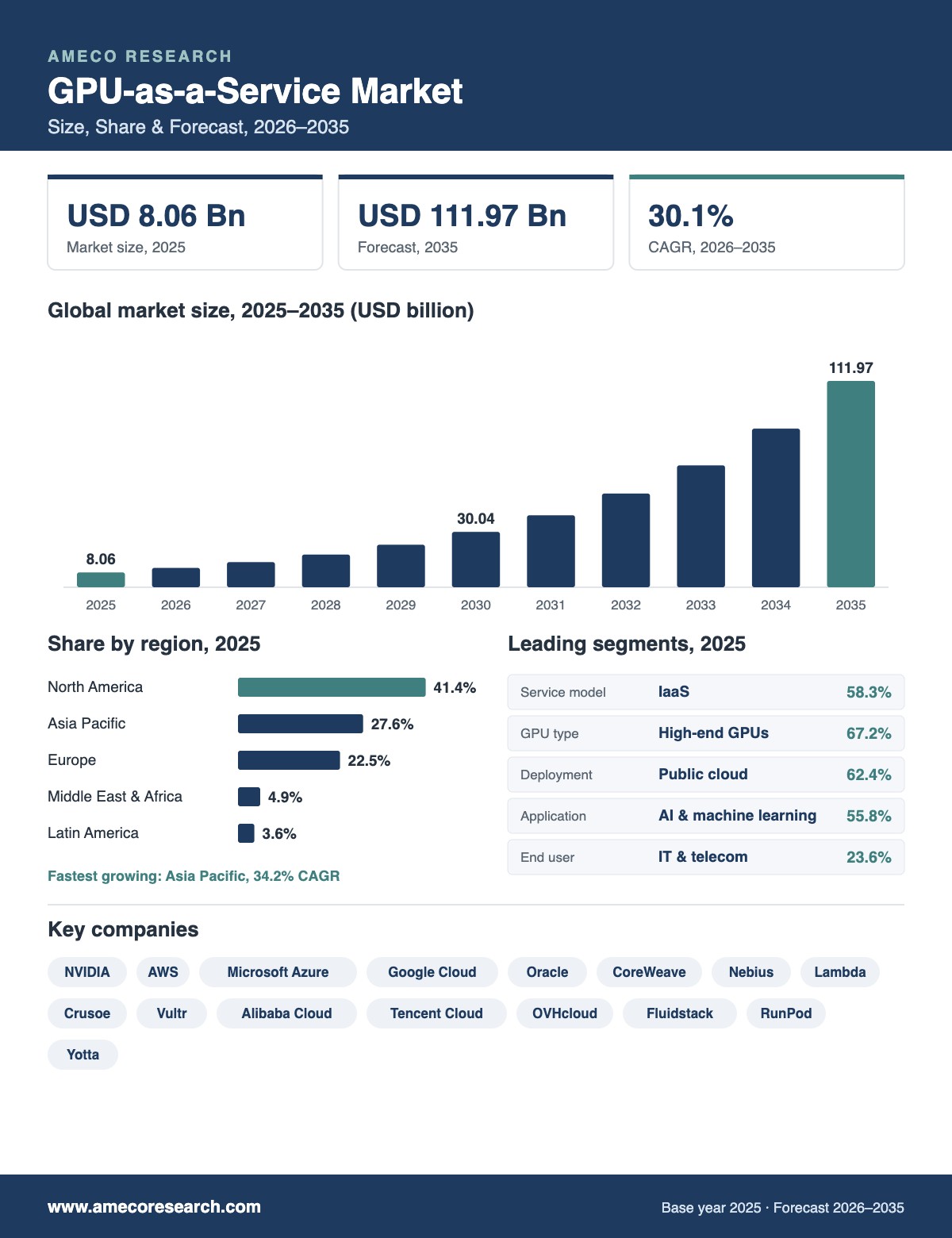 Infographic: GPU-as-a-Service Market Size, Share, Trends & Growth Opportunities Forecast to 2026 - 2035 | Ameco Research
GPU-as-a-Service Market Report Scope
| Report Attribute | Details |
| GPU-as-a-Service Market Size in 2025 | USD 8.06 Billion |
| GPU-as-a-Service Market Size in 2026 | USD 10.49 Billion |
| GPU-as-a-Service Market Forecast by 2035 | USD 111.97 Billion |
| GPU-as-a-Service Market CAGR (2026–2035) | 30.1% |
| Historical Data | 2021–2024 |
| Base Year | 2025 |
| Forecast Period | 2026–2035 |
| Largest Region | North America (41.4% share in 2025) |
| Fastest-Growing Region | Asia Pacific (34.2% CAGR) |
| Segments Covered | Service Model, GPU Type, Deployment Model, Pricing Model, Enterprise Size, Application, End User and Region |
| Regional Scope | North America, Europe, Asia Pacific, Latin America, and Middle East & Africa |
| Key Companies Profiled | NVIDIA (DGX Cloud), Amazon Web Services, Microsoft Azure, Google Cloud, Oracle Cloud Infrastructure, CoreWeave, Nebius, Lambda, Crusoe, Vultr, Alibaba Cloud, Tencent Cloud, OVHcloud, Fluidstack, RunPod and Yotta Data Services |
| Report Coverage | Market size and forecast, GPU pricing and capacity analysis, neocloud landscape, trends, drivers, restraints, opportunities, segment and regional analysis, competitive landscape, recent developments |
How Big Is the GPU-as-a-Service Market in 2026?
Ameco Research estimates the GPU-as-a-Service market at USD 10.49 billion in 2026, up about 30% from USD 8.06 billion in 2025, as AI labs and enterprises sign large, multi-year GPU capacity contracts and new Blackwell and Vera Rubin clusters come online. The market is expected to reach about USD 30.04 billion by 2030 and USD 111.97 billion by 2035.
| Year | GPU-as-a-Service Market Size (USD Billion) |
| 2025 | 8.06 |
| 2026 | 10.49 |
| 2027 | 13.64 |
| 2028 | 17.75 |
| 2030 | 30.04 |
| 2032 | 50.85 |
| 2035 | 111.97 |
Latest GPU-as-a-Service Market Trends 2026
Multibillion-dollar capacity deals
AI developers are locking in GPU capacity years ahead. In April 2026, CoreWeave expanded its agreement with Meta in a deal worth about USD 21 billion running through December 2032, including early deployments of NVIDIA’s Vera Rubin platform. In August 2026, Anthropic reportedly signed an agreement with Lambda worth about USD 35 billion for roughly 350 MW of capacity in Texas.
Rise of the neoclouds
Specialized GPU clouds such as CoreWeave, Nebius, Lambda, Crusoe, Fluidstack and RunPod are taking a growing share of AI compute. Nebius signed a multi-year deal worth about USD 17.4 billion with Microsoft in September 2025, showing that even hyperscalers buy capacity from neoclouds to meet demand.
Inference overtakes training as a growth engine
As generative AI products scale, demand is shifting from one-off model training to always-on inference. In March 2026, Perplexity signed a multi-year agreement with CoreWeave for dedicated NVIDIA Grace Blackwell clusters for AI inference.
Sovereign AI clouds
Governments in Europe, the Middle East, India and Asia are funding national GPU clouds so sensitive data and AI models stay within their borders, creating demand for local providers such as OVHcloud, Scaleway, IONOS, Yotta and Sakura Internet.
Power becomes the bottleneck
GPU clouds are now measured in megawatts. Access to grid power, liquid cooling and data center sites is a key constraint, pushing providers toward partnerships with energy companies and former crypto miners.
Flexible pricing and reserved capacity
Pay-as-you-go pricing still leads, but large buyers increasingly commit to reserved capacity for lower rates and guaranteed access, while spot and marketplace GPUs give start-ups and researchers cheaper options.
GPU-as-a-Service Market Dynamics
Growth drivers
- Generative AI demand: training and running large language models and multimodal AI needs huge amounts of GPU compute.
- High cost of owning GPUs: top-end GPU servers cost hundreds of thousands of dollars each, so renting avoids large upfront spending.
- Scalability and speed: cloud GPUs can be scaled up or down in minutes, matching bursty AI and HPC workloads.
- Access to the latest hardware: providers deploy new NVIDIA and AMD generations faster than most enterprises can.
- Wider adoption: SMEs, researchers and start-ups gain access to supercomputing-class power without building data centers.
Restraints and challenges
- GPU supply constraints: shortages of the newest GPUs, high-bandwidth memory and advanced packaging limit capacity.
- Power and data center limits: grid connections, cooling and permitting slow new capacity.
- Data sovereignty and compliance: rules on where data is stored and processed complicate cross-border GPU use.
- Cost over time: heavy, steady workloads can become more expensive to rent than to own.
- Concentration risk: dependence on a few chip suppliers and large customers creates financial and supply risks for providers.
Opportunities
- AI inference services as generative AI applications scale to millions of users.
- Sovereign and regional GPU clouds for governments and regulated industries.
- Hybrid and multi-cloud GPU orchestration across providers and on-premises clusters.
- Industry-specific AI platforms for healthcare, finance, automotive and media.
- Edge GPU services for low-latency AI, gaming and video applications.
GPU-as-a-Service Market Segment Analysis
By service model
Infrastructure-as-a-Service (IaaS), where customers rent raw GPU instances and clusters, accounted for 58.3% of revenue in 2025. Platform-as-a-Service (PaaS), including managed AI training, inference and model-serving platforms, held 41.7% and is growing faster at about a 31.8% CAGR.
| Service Model | Share (2025) | Key Highlights |
| IaaS | 58.3% | Largest; bare-metal and virtual GPU instances and clusters |
| PaaS | 41.7% | Faster-growing at 31.8% CAGR; managed AI training and inference platforms |
By GPU type
High-end GPUs, such as NVIDIA H100, H200, B200 and GB200 and AMD Instinct accelerators, accounted for 67.2% of revenue in 2025. Mid-range GPUs held 25.6%, used for smaller models, fine-tuning, rendering and inference, while low-end GPUs accounted for 7.2%.
| GPU Type | Share (2025) | Key Highlights |
| High-End | 67.2% | Largest; frontier AI training and large-scale inference |
| Mid-Range | 25.6% | Fine-tuning, inference, rendering and visualization |
| Low-End | 7.2% | Development, testing, gaming and light workloads |
By deployment model
Public cloud accounted for 62.4% of revenue in 2025. Hybrid and multi-cloud deployments held 20.6% and are the fastest-growing at about a 36.1% CAGR, reaching about 30% of revenue by 2035, as enterprises spread workloads across providers. Private cloud held 17.0%.
| Deployment Model | Share (2025) | Key Highlights |
| Public Cloud | 62.4% | Largest; hyperscalers and neoclouds |
| Hybrid & Multi-Cloud | 20.6% | Fastest-growing at 36.1% CAGR; workload portability |
| Private Cloud | 17.0% | Dedicated clusters for security and sovereignty |
By pricing model
Pay-as-you-go pricing accounted for 41.6% of revenue in 2025. Reserved and committed capacity held 28.7% and is gaining share as AI labs sign long-term contracts, followed by subscriptions at 17.8% and spot or preemptible instances at 11.9%.
| Pricing Model | Share (2025) | Key Highlights |
| Pay-As-You-Go | 41.6% | Largest; on-demand hourly billing |
| Reserved / Committed Capacity | 28.7% | Long-term contracts with guaranteed access |
| Subscription | 17.8% | Monthly plans and bundled platforms |
| Spot / Preemptible | 11.9% | Low-cost, interruptible capacity |
By enterprise size
Large enterprises accounted for 71.3% of revenue in 2025. Small and medium-sized enterprises held 28.7% and are growing faster at about a 33.4% CAGR, as GPU marketplaces and managed platforms make AI compute affordable for smaller teams.
| Enterprise Size | Share (2025) | Key Highlights |
| Large Enterprises | 71.3% | AI labs, hyperscale users and large corporates |
| SMEs | 28.7% | Faster-growing at 33.4% CAGR; start-ups and research teams |
By application: What are cloud GPUs used for?
AI and machine learning, including generative AI training and inference, accounted for 55.8% of revenue in 2025 and is growing at about a 33.2% CAGR. HPC held 15.6%, followed by graphics rendering and visualization at 9.8% and gaming at 7.9%.
| Application | Share (2025) | Key Highlights |
| AI & Machine Learning | 55.8% | Largest and fastest-growing at 33.2% CAGR; training and inference |
| High-Performance Computing | 15.6% | Scientific simulation, genomics and engineering |
| Graphics Rendering & Visualization | 9.8% | 3D design, VFX and digital twins |
| Gaming & Interactive Applications | 7.9% | Cloud gaming and game development |
| Video & Media Processing | 6.1% | Transcoding, streaming and editing |
| Data Analytics & Others | 4.8% | GPU-accelerated databases and analytics |
By end user
IT and telecommunications accounted for the largest share at 23.6% in 2025, followed by BFSI at 12.8% and healthcare and life sciences at 11.3%, where GPUs power drug discovery, medical imaging and genomics.
| End User | Share (2025) | Key Highlights |
| IT & Telecommunications | 23.6% | Largest; AI developers, SaaS and telecom AI |
| BFSI | 12.8% | Risk modeling, fraud detection and trading |
| Healthcare & Life Sciences | 11.3% | Drug discovery, imaging and genomics |
| Automotive & Mobility | 9.1% | Autonomous driving training and simulation |
| Manufacturing | 8.4% | Digital twins and industrial AI |
| Media & Entertainment | 8.1% | Rendering, VFX and content creation |
| Gaming | 7.2% | Cloud gaming and game AI |
| Retail & E-commerce | 6.0% | Recommendations and personalization |
| Government & Public Sector | 5.1% | Sovereign AI and research |
| Energy & Utilities | 4.4% | Seismic processing and grid optimization |
| Others | 4.0% | Education, research and other industries |
GPU-as-a-Service Market Regional Analysis
| Region | Share (2025) | Outlook |
| North America | 41.4% | Largest; about USD 3.34 billion in 2025; hyperscalers and neoclouds |
| Asia Pacific | 27.6% | Fastest-growing at 34.2% CAGR; China, India, Japan, South Korea |
| Europe | 22.5% | Sovereign cloud and enterprise AI demand |
| Middle East & Africa | 4.9% | National AI programs in Saudi Arabia and the UAE |
| Latin America | 3.6% | Growing AI adoption in Brazil and Mexico |
Why does North America dominate the GPU-as-a-Service market?
North America accounted for about 41.4% of global revenue in 2025, or about USD 3.34 billion. The U.S. is home to NVIDIA, the major hyperscalers, most leading neoclouds and the biggest AI labs, including OpenAI, Anthropic, Meta and Google. Massive private AI investment and multibillion-dollar capacity contracts keep the region in the lead.
What makes Asia Pacific the fastest-growing region?
Asia Pacific held about 27.6% of the market in 2025 and is forecast to grow at a 34.2% CAGR, raising its share to about a third of global revenue by 2035. Alibaba Cloud, Tencent Cloud and Baidu AI Cloud serve China’s AI boom, India’s national AI mission is funding shared GPU capacity through providers such as Yotta, and Japan, South Korea and Singapore are investing in sovereign AI infrastructure.
How is Europe developing?
Europe represented about 22.5% of revenue in 2025. Data protection rules and digital sovereignty goals are driving demand for European GPU clouds such as Nebius, OVHcloud, Scaleway, IONOS, Fluidstack and Genesis Cloud, alongside EU-backed AI factories and gigafactories.
GPU-as-a-Service Market Segmentation
GPU-as-a-Service Market Leading Companies
The GPU-as-a-Service market includes hyperscale cloud providers, specialized GPU clouds (neoclouds), regional and sovereign cloud operators and GPU marketplaces. Competition centers on access to the newest GPUs, price per GPU-hour, cluster size and networking, power capacity, reliability and software tools for training and inference.
NVIDIA (DGX Cloud) · Amazon Web Services · Microsoft Azure · Google Cloud · Oracle Cloud Infrastructure · CoreWeave · Nebius · Lambda · Crusoe · Vultr · Alibaba Cloud · Tencent Cloud · OVHcloud · Fluidstack · RunPod · Yotta Data Services
Recent developments
- August 2026: Anthropic reportedly signed an agreement with Lambda worth about USD 35 billion for roughly 350 MW of capacity at a data center in Texas.
- April 2026: CoreWeave expanded its agreement with Meta in a deal worth about USD 21 billion for AI cloud capacity through December 2032, including early NVIDIA Vera Rubin deployments.
- March 2026: Perplexity signed a multi-year agreement with CoreWeave for dedicated NVIDIA Grace Blackwell GPU clusters for AI inference.
- September 2025: Nebius signed a multi-year GPU infrastructure agreement with Microsoft worth about USD 17.4 billion.
GPU-as-a-Service Market: Frequently Asked Questions
How big is the GPU-as-a-Service market?
The global GPU-as-a-Service market was valued at USD 8.06 billion in 2025 and is estimated at USD 10.49 billion in 2026. Ameco Research projects it to reach USD 111.97 billion by 2035, growing at a CAGR of 30.1% from 2026 to 2035.
What is GPU-as-a-Service (GPUaaS)?
GPU-as-a-Service is a cloud model in which companies rent graphics processing units (GPUs) over the internet instead of buying and running their own hardware. Users pay by the hour, through reserved capacity or by subscription, and use the GPUs to train and run AI models, perform high-performance computing, render graphics and process video.
What is the growth rate of the GPU-as-a-Service market?
The market is expected to grow at a CAGR of 30.1% from 2026 to 2035, driven by demand for generative AI training and inference, shortages and high costs of buying GPUs outright, the rise of specialized GPU clouds (neoclouds), sovereign AI programs and wider adoption by small and mid-sized businesses.
What is a neocloud?
A neocloud is a cloud provider that specializes in renting GPU capacity for AI, rather than offering a full range of general cloud services. Examples include CoreWeave, Nebius, Lambda, Crusoe, Fluidstack and RunPod. Neoclouds often offer faster access to the newest NVIDIA GPUs and lower prices than general-purpose hyperscalers, and many have signed multibillion-dollar capacity deals with AI labs and big tech companies.
Which deployment model leads the GPU-as-a-Service market?
Public cloud is the largest deployment model, with about 62.4% of revenue in 2025. Hybrid and multi-cloud deployments are the fastest-growing, at about a 36.1% CAGR, as enterprises spread AI workloads across several providers and their own data centers.
How much does it cost to rent a GPU in the cloud?
Prices depend on the GPU, provider and commitment. Older and mid-range GPUs can cost well under USD 1 per hour, while top-end NVIDIA H100, H200 and Blackwell GPUs typically cost several dollars per GPU-hour on demand. Reserved capacity, long-term contracts and spot instances offer lower rates, and specialized GPU clouds are often cheaper than hyperscalers.
Which region leads the GPU-as-a-Service market?
North America leads with about 41.4% of revenue in 2025, or about USD 3.34 billion, home to the hyperscalers, NVIDIA and most leading neoclouds. Asia Pacific is the fastest-growing region at about a 34.2% CAGR, driven by China, India, Japan, South Korea and Singapore.
Who are the key players in the GPU-as-a-Service market?
Leading companies include NVIDIA (DGX Cloud), Amazon Web Services, Microsoft Azure, Google Cloud, Oracle Cloud Infrastructure, CoreWeave, Nebius, Lambda, Crusoe, Vultr, Alibaba Cloud, Tencent Cloud, OVHcloud, Fluidstack, RunPod and Yotta Data Services.
Related ICT and Media Market Reports
- Agentic AI Market Size, Share, Trends & Growth Opportunities Forecast to 2026 - 2035
- Enterprise AI Market Size, Share, Trends & Growth Opportunities Forecast to 2026 - 2035
- Data Center Cooling Market Size, Share, Trends & Growth Opportunities Forecast to 2026 - 2035
- AI Data Center Market Size, Share, Trends & Growth Opportunities Forecast to 2026 - 2035
- Physical AI Market Size, Share & Growth Forecast 2026–2035