Press Release
Data Center Cooling Market to Reach USD 109.23 Billion by 2035 at 18.0% CAGR as AI Drives Liquid Cooling Adoption
Date : Nov 04, 2026
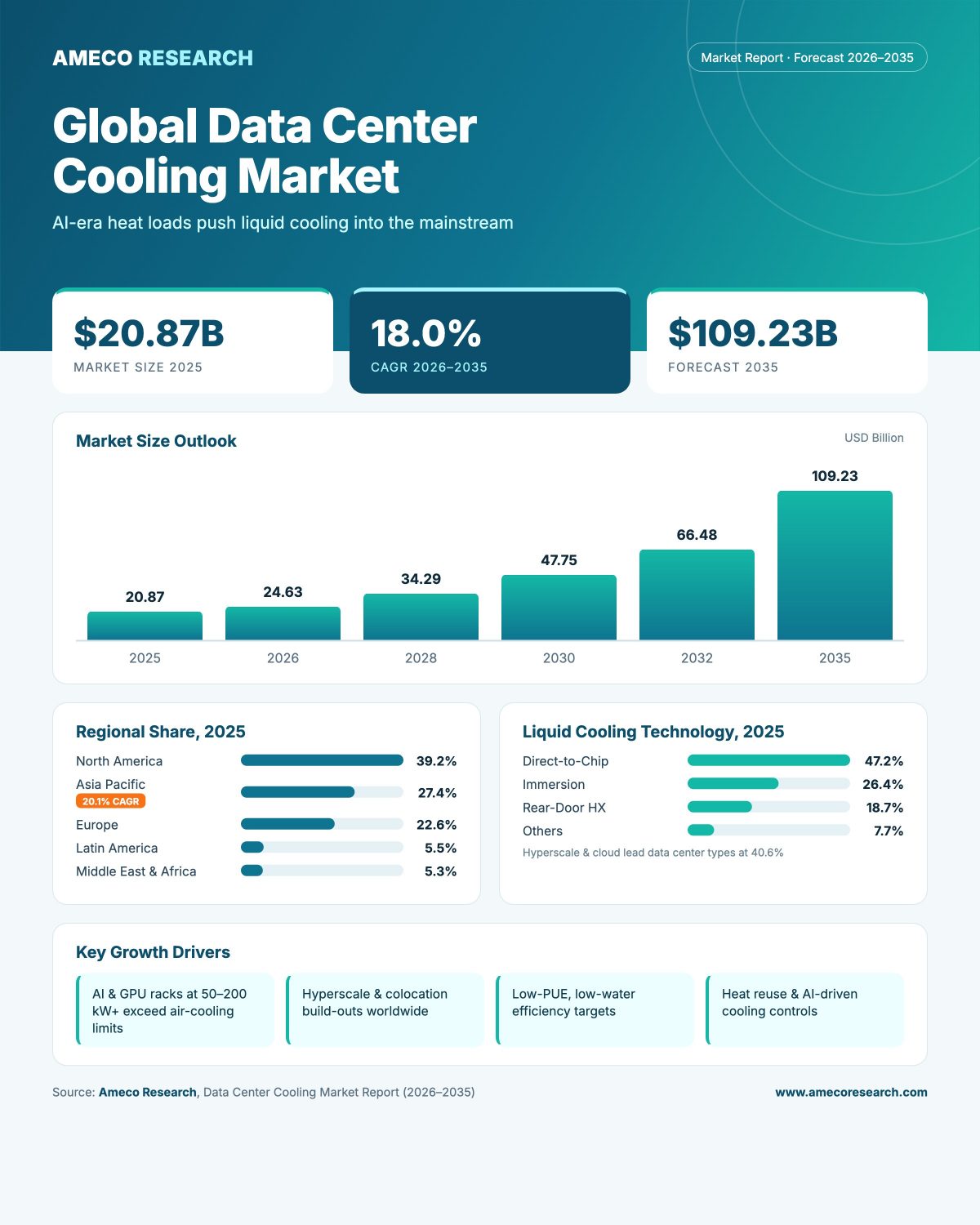
Pune, India, November 4, 2026 — The global Data Center Cooling Market was valued at USD 20.87 billion in 2025 and is projected to reach USD 109.23 billion by 2035, growing at a CAGR of 18.0% from 2026 to 2035, according to the new Data Center Cooling Market report from Ameco Research. The market is estimated at USD 24.63 billion in 2026. The study finds that AI and GPU workloads are pushing rack power far beyond what air cooling can handle, which is moving liquid cooling from a niche option to the default for new capacity.
As hyperscalers, colocation providers, and enterprises race to build AI-ready capacity, cooling has become one of the most important design decisions in any new data center. The 180-page report covers market size and forecasts, cooling technologies, rack density bands, regional demand, efficiency benchmarks, and the wave of acquisitions now reshaping the competitive landscape.
How Big Is the Data Center Cooling Market?
Data center cooling covers the equipment, fluids, controls, and services that remove heat from servers, storage, and networking hardware. It ranges from computer room air conditioners (CRAC), air handlers (CRAH), chillers, and aisle containment to liquid technologies such as direct-to-chip cold plates, rear-door heat exchangers (RDHx), and single-phase or two-phase immersion cooling.
Ameco Research expects the market to more than quintuple over the forecast period, passing roughly USD 48 billion by 2030 on the way to USD 109.23 billion by 2035:
| Year | Market Size (USD Billion) |
|---|---|
| 2025 (Base Year) | 20.87 |
| 2026 | 24.63 |
| 2028 | 34.29 |
| 2030 | 47.75 |
| 2032 | 66.48 |
| 2035 | 109.23 |
Data Center Cooling Market Key Takeaways
- Market size 2025: USD 20.87 billion
- Forecast 2035: USD 109.23 billion, at an 18.0% CAGR (2026–2035)
- Leading region: North America, with about 39.2% of 2025 revenue
- Fastest-growing region: Asia Pacific, at a 20.1% CAGR
- Largest component: Solutions, with 71.3% of revenue; services grow fastest
- Leading liquid technology: Direct-to-chip cooling, with 47.2% of liquid cooling technology revenue
- Largest data center type: Hyperscale and cloud, at 40.6%, followed by colocation at 30.8%
What Is Driving Demand for Data Center Cooling?
AI and High-Performance Computing Heat Loads
GPU and accelerator racks now draw 50–200 kW or more, compared with 5–10 kW for a typical enterprise rack a few years ago. At these densities air cooling reaches its practical limit, so every new AI cluster needs liquid cooling designed in from the start.
Hyperscale and Colocation Expansion
Record construction by cloud providers and colocation operators means cooling infrastructure is needed in every new data hall. Colocation providers in particular are building high-density, AI-ready suites so they can win tenants running GPU workloads.
Energy and Water Efficiency Targets
Rising power prices, ESG commitments, and new reporting rules all favor cooling designs with low power usage effectiveness (PUE) and low water usage. The report notes that direct-to-chip designs typically achieve a PUE of 1.10–1.20 and two-phase immersion as low as 1.02–1.07, compared with 1.55–1.67 for many legacy air-cooled sites.
Reliability and Edge Computing
Precise thermal control prevents throttling, hardware failures, and costly downtime. At the same time, edge computing for 5G, IoT, and real-time AI inference needs compact, self-contained cooling systems for distributed sites.
Data Center Cooling Market Trends in 2026
- Liquid cooling goes mainstream: Around one in five operators had deployed liquid cooling by early 2026, and roughly a third more plan to within two years. Direct-to-chip cold plates are the usual first step because they fit standard racks.
- AI platforms redefine thermal design: NVIDIA's Vera Rubin platform, in full production since early 2026, is fully liquid-cooled with 45°C coolant supply, which removes the need for mechanical chillers in most climates. Rack power is heading toward about 600 kW with Kyber-class racks expected in 2027.
- Consolidation accelerates: Schneider Electric took a controlling stake in Motivair, Eaton agreed to buy Boyd Thermal for USD 9.5 billion, Trane Technologies announced a deal for LiquidStack, and Ecolab completed its USD 4.75 billion acquisition of CoolIT Systems in July 2026.
- Water-free and closed-loop designs: Water scarcity and community scrutiny are pushing operators toward dry, closed-loop, and warm-water cooling, especially in water-stressed parts of the U.S., Southern Europe, the Middle East, and India.
- Heat reuse and AI-driven controls: Warm-water liquid loops make it practical to export waste heat to district heating networks, while AI-based control software tunes fans, pumps, and setpoints to cut cooling energy.
Challenges Facing the Data Center Cooling Industry
Liquid cooling raises upfront costs because it needs coolant distribution units (CDUs), manifolds, facility water loops, and compatible servers. Retrofitting older halls is limited by floor loading, ceiling height, piping routes, and electrical capacity. Many operators also still worry about leaks, coolant quality, and the new maintenance skills liquid systems require. Differing server designs, coolant chemistries, and connector types complicate multi-vendor deployments, and hotter summers are cutting free-cooling hours in many regions.
Data Center Cooling Market Segmentation Analysis
By Component
Solutions, which include chillers, CRAC and CRAH units, in-row coolers, CDUs, cold plates, immersion tanks, and heat rejection equipment, accounted for 71.3% of revenue in 2025. Services (28.7%) are growing fastest as operators outsource the design, installation, commissioning, and maintenance of increasingly complex liquid systems.
By Cooling Technology
| Cooling Technology | Share (2025) | Key Highlights |
|---|---|---|
| Direct-to-Chip Liquid Cooling | 47.2% | Cold plates on CPUs and GPUs; preferred for AI servers in standard racks |
| Immersion Cooling | 26.4% | Servers submerged in dielectric fluid; supports the highest densities |
| Rear-Door Heat Exchangers | 18.7% | Popular retrofit option for existing air-cooled halls |
| Others (In-Row, In-Rack, Spray) | 7.7% | Targeted cooling for mixed-density environments |
By cooling mechanism, single-phase systems held 63.1% share thanks to simpler fluid handling and broad vendor support, while two-phase systems (36.9%) are expanding in ultra-dense AI racks.
By Data Center Type and Rack Density
Hyperscale and cloud facilities lead with 40.6% share, followed by colocation (30.8%), enterprise (18.4%), and edge (10.2%), which is the fastest-growing type. By rack power density, the 50 to under 100 kW band was the largest at 30.4% in 2025, while the 100–200 kW and above-200 kW bands are growing fastest as GPU platforms scale. New-build facilities accounted for 57.3% of revenue and retrofits for 42.7%.
By End-Use Industry
IT and telecommunications led with 40.2% share in 2025, followed by BFSI (16.4%), healthcare and life sciences (11.3%), government and public sector (9.6%), manufacturing (8.1%), and energy and utilities (6.2%).
Regional Outlook for the Data Center Cooling Market
| Region | Share (2025) | Outlook |
|---|---|---|
| North America | 39.2% | Largest market; AI campus construction across Texas, Virginia, Georgia, Ohio, and the Midwest |
| Asia Pacific | 27.4% | Fastest-growing at a 20.1% CAGR; China, India, Japan, Singapore, Malaysia, and Australia |
| Europe | 22.6% | Shaped by energy-efficiency rules, heat reuse, and sovereign AI |
| Latin America | 5.5% | Emerging hubs in Brazil, Mexico, and Chile |
| Middle East & Africa | 5.3% | Hot-climate cooling demand at Gulf AI campuses and in South Africa |
In Asia Pacific, hot and humid climates limit free cooling, and India's gigawatt-scale AI campuses in Visakhapatnam and Jamnagar are adding significant new demand. In Europe, the EU Energy Efficiency Directive and growing interest in district heating, especially in the Nordics and Germany, are making liquid and heat-recovery designs more attractive.
Competitive Landscape: Key Companies in the Data Center Cooling Market
The market combines long-established HVAC and power companies with fast-growing liquid cooling specialists. Competition is shifting from individual products toward integrated thermal platforms that combine CDUs, cold plates, heat rejection, controls, and lifecycle services. Companies profiled include Schneider Electric, Vertiv, STULZ, Johnson Controls, Daikin Industries, Mitsubishi Electric, Carrier Global, Trane Technologies, Rittal, Airedale International, Eaton, CoolIT Systems (Ecolab), nVent, Munters, Delta Electronics, Submer, Green Revolution Cooling, and Iceotope.
Need details on company profiles, pricing, or methodology? Make an Inquiry and an Ameco Research analyst will get back to you.
Investment Opportunities Through 2035
- Waste heat recovery: Selling heat to district heating networks, greenhouses, and industrial processes turns cooling into a revenue or sustainability asset.
- AI-driven cooling optimization: Sensors, digital twins, and machine learning can cut energy use and predict equipment failures.
- Modular and prefabricated systems: Pre-built cooling skids and CDUs shorten deployment timelines for fast-moving AI projects.
- Retrofit services: Adding rear-door heat exchangers or direct-to-chip loops lets existing facilities host AI workloads without a full rebuild.
For the wider infrastructure picture, see Ameco Research's AI Data Center Market report, the Data Center Battery Market analysis, the Chillers Market report, and the District Heating and Cooling Market study.
Report Scope and Coverage
| Report Attribute | Details |
|---|---|
| Market Size in 2025 | USD 20.87 Billion |
| Market Forecast in 2035 | USD 109.23 Billion |
| CAGR (2026–2035) | 18.0% |
| Base Year | 2025 |
| Historical Data | 2021–2024 |
| Forecast Period | 2026–2035 |
| Segments Covered | Component, Cooling Technology, Cooling Mechanism, Data Center Type, Rack Power Density, Deployment Type, End-Use Industry, Region |
| Regions Covered | North America, Europe, Asia Pacific, Latin America, Middle East & Africa |
| Report Coverage | Market size and forecast, trends, drivers, restraints, opportunities, segment and regional analysis, competitive landscape, recent developments |
| Pages | 180 |
Who Should Read This Report?
- Data center operators and colocation providers choosing between air, direct-to-chip, and immersion cooling for new and existing halls.
- Investors and infrastructure funds evaluating thermal management companies, acquisition targets, and AI infrastructure exposure.
- Cooling, HVAC, and power equipment vendors sizing addressable markets by technology, rack density, and region.
- AI companies, cloud providers, and server OEMs planning the thermal requirements of next-generation accelerator platforms.
- Consultants, engineering firms, utilities, and policymakers assessing energy, water, and heat reuse implications.
How the Report Supports Decision-Making
- Investment planning: Ten-year forecasts and segment growth rates show where cooling spend is heading.
- Business strategy: Technology and rack-density shares reveal which product lines will grow fastest.
- Market entry: Regional and country analysis highlights high-growth geographies and local constraints such as climate and water.
- Competitive intelligence: Company profiles and recent deals show how leaders are positioning in liquid cooling.
Ready for the full data? Buy the Data Center Cooling Market Report for immediate access.
Conclusion
The Data Center Cooling Market is being rebuilt around liquid cooling. With the market forecast to grow from USD 20.87 billion in 2025 to USD 109.23 billion by 2035 at an 18.0% CAGR, the companies that master high-density thermal design, water efficiency, and heat reuse will capture the largest share of AI-era infrastructure spending. Ameco Research's report gives operators, vendors, and investors the data they need to plan with confidence.
Explore the Data Center Cooling Market Report
Preview the data tables and methodology, ask about pricing, licensing, and coverage, get immediate access to the complete 180-page study, or request additional segments, country-level data, and research beyond the report’s scope.
About Ameco Research
Ameco Research is a market research and consulting firm that provides syndicated reports, customized research, and data-driven insight across industries including ICT and media, semiconductors and electronics, energy, healthcare, and automotive. Its analysts help businesses, investors, and institutions find growth opportunities and make informed strategic decisions.
Contact Us
Ameco Research
201, Vaidehi-Saaket, Baner - Pashan Link Rd, Pashan, Pune, Maharashtra 411021, India
Phone: +91 898 322 5533
E-mail: [email protected]
Website: www.amecoresearch.com