Press Release
High Bandwidth Memory (HBM) Market to Reach USD 256.1 Billion by 2035, Growing at 15.8% CAGR | Ameco Research
Date : Nov 13, 2026
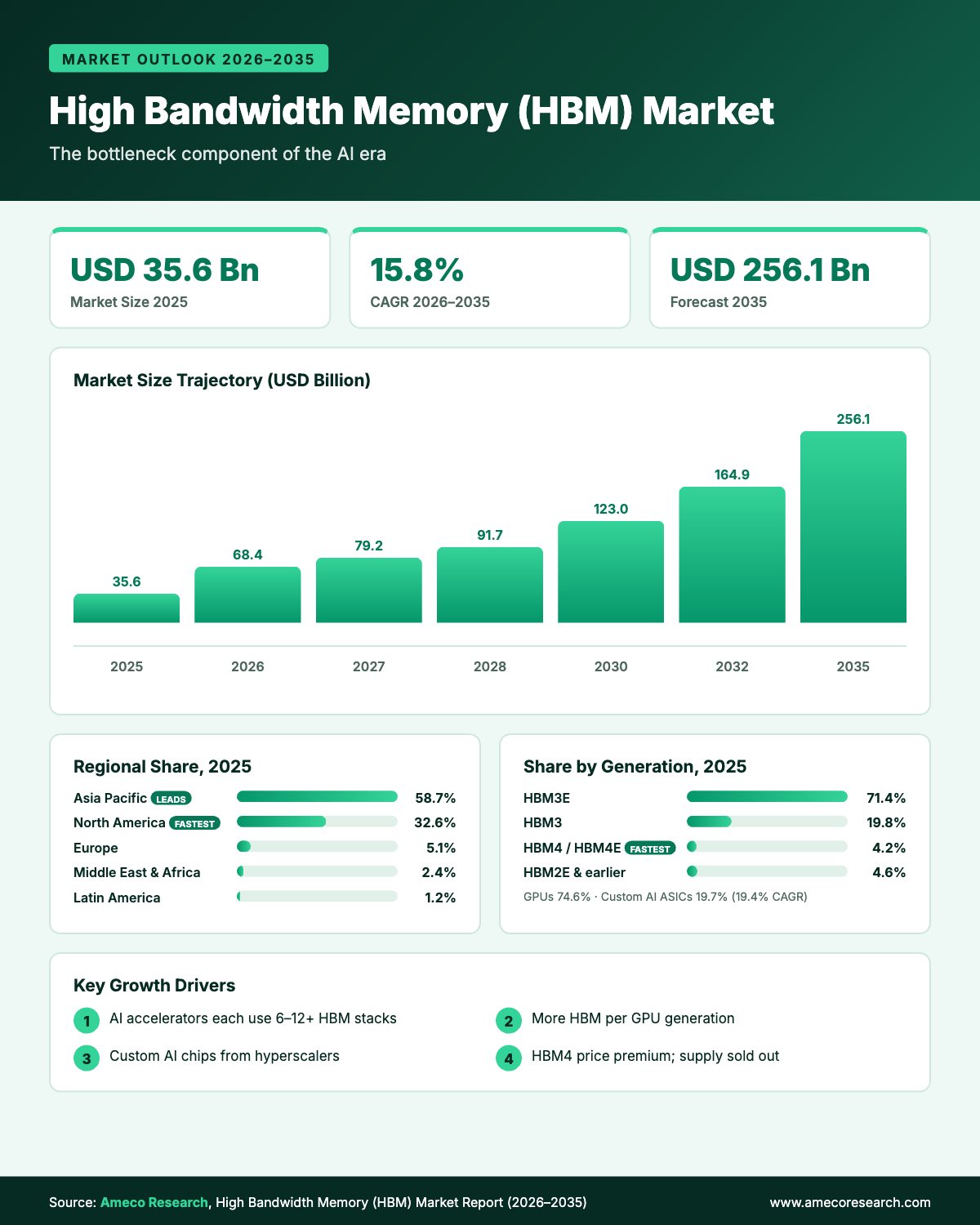
Pune, India, November 13, 2026 — The global high bandwidth memory (HBM) market is projected to grow from USD 35.6 billion in 2025 to USD 256.1 billion by 2035, at a CAGR of 15.8% from 2026 to 2035, according to the new High Bandwidth Memory (HBM) Market report from Ameco Research. The market is estimated at USD 68.4 billion in 2026, nearly double its 2025 level, as AI accelerators absorb every stack suppliers can make.
High bandwidth memory is a 3D-stacked DRAM technology in which several memory dies sit on top of a base die and are linked by thousands of through-silicon vias (TSVs). Each stack is placed beside a processor on a silicon interposer and connected through an extremely wide interface — 1,024 bits for HBM3E and 2,048 bits for HBM4 — delivering more than 1 TB/s of bandwidth per stack at lower power per bit than conventional memory. Every leading AI accelerator, including NVIDIA’s Blackwell and Vera Rubin GPUs, AMD’s Instinct series, Google’s TPUs, and AWS Trainium, depends on multiple HBM stacks, making HBM the single most strategic memory product of the AI era.
HBM Market Size and Forecast
Ameco Research estimates the HBM market at USD 68.4 billion in 2026, up about 92% from 2025, as shipments of NVIDIA Blackwell Ultra and Vera Rubin, AMD Instinct, and custom AI chips surge and HBM4 commands a much higher price per gigabyte than HBM3E. The market is expected to pass USD 100 billion by 2029, reach about USD 123.0 billion in 2030, and climb to USD 256.1 billion by 2035.
| Year | HBM Market Size (USD Billion) |
|---|---|
| 2025 | 35.6 |
| 2026 | 68.4 |
| 2027 | 79.2 |
| 2028 | 91.7 |
| 2030 | 123.0 |
| 2032 | 164.9 |
| 2035 | 256.1 |
Key Takeaways
- Market size: USD 35.6 billion in 2025, about USD 68.4 billion in 2026, and USD 256.1 billion by 2035.
- Growth rate: 15.8% CAGR from 2026 to 2035.
- Leading region: Asia Pacific, with about 58.7% of 2025 revenue.
- Fastest-growing region: North America, at a 16.9% CAGR.
- Leading generation: HBM3E, at 71.4% of revenue; HBM4 is growing fastest.
- Leading processor: GPUs consumed 74.6% of HBM; custom AI ASICs are growing fastest at about 19.4% CAGR.
- Supply: Only three suppliers make HBM at scale, and SK hynix says its output is sold out through 2029.
What Is Driving the HBM Market?
The AI data-centre build-out
Hyperscalers and AI labs are deploying millions of accelerators, and each one uses six to twelve or more HBM stacks. AI data centres accounted for 82.3% of HBM revenue in 2025, covering both model training and inference.
More HBM in every chip generation
Memory capacity per accelerator keeps climbing, from 80 GB on NVIDIA’s H100 to 288 GB on Blackwell Ultra and more on Vera Rubin. Large language models and reasoning models need high bandwidth to serve users quickly, so each new GPU generation carries more and faster HBM.
Custom AI chips widen the customer base
Google, AWS, Meta, Microsoft, and OpenAI are designing their own accelerators, many with Broadcom and Marvell, and all of them use HBM. Custom ASICs held 19.7% of HBM demand in 2025 and are the fastest-growing processor type.
Premium pricing
HBM sells at several times the price of standard DDR5 per gigabyte, and HBM4 carries a further premium. SK hynix has finalised 2027 HBM volumes and pricing with major customers at terms that reflect HBM4’s higher value.
Key HBM Market Trends in 2026
- HBM4 enters mass production: SK hynix prepared HBM4 mass production in September 2025, Samsung began HBM4 mass production in February 2026, and Micron started HBM4 volume shipments in the first quarter of 2026. SK hynix expects HBM4 to overtake HBM3E in shipments and revenue in the fourth quarter of 2026.
- Sold out through 2029: In October 2026, SK hynix said its DRAM and HBM output is effectively sold out through 2029, with long-term agreements covering more than half of its planned 2027 and 2028 capacity.
- Custom base dies: From HBM4, the base die can be made on a logic process by foundries such as TSMC and customised for a specific AI chip.
- Competition intensifies: SK hynix still leads with about half of HBM revenue, but Samsung regained ground in 2026 and Micron is expanding its share. All three were reported to have qualified HBM4 for NVIDIA’s Vera Rubin platform.
- Taller stacks and hybrid bonding: Suppliers are moving from 8-high to 12-high and 16-high stacks, with hybrid bonding in development for HBM4E and HBM5.
Challenges
Stacking 12 to 16 thinned dies with thousands of TSVs makes HBM yields lower and costs higher than standard DRAM. With only three large-scale suppliers, any production problem quickly becomes an industry bottleneck. HBM also depends on CoWoS and similar advanced packaging, which remains tight. Each HBM bit uses about three times more wafer area than DDR5, pulling capacity away from conventional DRAM and tightening the wider memory market. U.S. restrictions on HBM sales to China limit some demand and are pushing China to develop its own HBM.
How HBM Gets From Wafer to AI Chip
Producing HBM is far more involved than making standard DRAM. Memory makers first fabricate DRAM wafers, then thin each die and etch thousands of through-silicon vias so signals and power can pass vertically through the stack. The dies are stacked 8, 12, or 16 high on a base die and bonded together, then tested as a complete unit. The finished stacks are shipped to a foundry or packaging house, where they are mounted beside the GPU or ASIC on a silicon interposer using CoWoS or a similar process.
Each step adds cost and yield risk, which is why HBM capacity cannot be expanded as quickly as conventional memory and why packaging equipment makers such as Hanmi Semiconductor have become important suppliers. It also explains why the report sees advanced packaging and bonding technology as one of the most valuable opportunities in the market.
Segment Analysis
By generation
| Generation | Share, 2025 | Key Highlights |
|---|---|---|
| HBM3E | 71.4% | Largest; NVIDIA Blackwell, AMD MI350, custom ASICs |
| HBM3 | 19.8% | Earlier accelerators such as H100 and MI300 |
| HBM4 / HBM4E | 4.2% | Fastest growing; largest by revenue from 2027 |
| HBM2E & earlier | 4.6% | Legacy HPC, networking, FPGAs |
By stack height and processor
12-high stacks accounted for 51.4% of revenue in 2025, overtaking 8-high stacks at 44.1%, as AI chips moved to 36 GB HBM3E. 16-high and other configurations held 4.5% and will grow quickly with HBM4 and HBM4E. By processor type, GPUs consumed 74.6% of HBM, custom AI ASICs 19.7%, and FPGAs, CPUs, and others 5.7%.
| Application | Share, 2025 | Key Highlights |
|---|---|---|
| AI data centres (training & inference) | 82.3% | Hyperscale and AI lab clusters |
| HPC & supercomputing | 9.6% | Scientific computing, national labs |
| Networking | 4.4% | High-speed switches and routers |
| Automotive, edge & others | 3.7% | Autonomous driving, edge AI |
Regional Outlook
| Region | Share, 2025 | Outlook |
|---|---|---|
| Asia Pacific | 58.7% | Largest; production in South Korea, packaging in Taiwan |
| North America | 32.6% | Fastest growing at 16.9% CAGR |
| Europe | 5.1% | HPC, sovereign AI, automotive |
| Middle East & Africa | 2.4% | Gulf AI data-centre projects |
| Latin America | 1.2% | Emerging AI infrastructure |
South Korea is home to SK hynix and Samsung, which together make most of the world’s HBM; Taiwan’s TSMC packages HBM with AI processors using CoWoS; and Japan supplies key materials and equipment. North America is growing fastest because U.S. companies design most of the AI chips that use HBM, Micron is expanding production as the only U.S.-based HBM supplier, and SK hynix is building an HBM packaging plant in Indiana.
Competitive Landscape
HBM production is concentrated among SK hynix, Samsung Electronics, and Micron Technology, with China’s CXMT developing domestic HBM. The wider ecosystem profiled in the report includes TSMC (CoWoS packaging and HBM4 base dies), Amkor Technology, ASE Technology, NVIDIA, AMD, Broadcom, Marvell Technology, Rambus, and Hanmi Semiconductor. Competition centres on qualification with leading AI chipmakers, yields on taller stacks, packaging capacity, and custom base-die design. For supplier share or pricing analysis, make an inquiry with Ameco Research.
Opportunities Ahead
- HBM4E and HBM5 with higher bandwidth, taller stacks, and hybrid bonding.
- Custom HBM base dies co-designed with AI chipmakers.
- HBM for automotive and edge AI systems.
- Regional HBM production and packaging supported by onshoring incentives.
Related insights are available in Ameco Research’s Semiconductor Memory Market, Semiconductor Market, AI Data Center Market, and GPU as a Service Market reports.
Report Scope
| Attribute | Details |
|---|---|
| Market size (2025 / 2026) | USD 35.6 billion / USD 68.4 billion |
| Market size (2035) | USD 256.1 billion |
| CAGR (2026–2035) | 15.8% |
| Historical data / base year | 2021–2024 / 2025 |
| Segments covered | Generation, stack height, processor type, application, region |
| Regions covered | North America, Europe, Asia Pacific, Latin America, Middle East & Africa |
Who Should Read This Report
- Memory makers, foundries, and OSATs planning HBM and packaging capacity.
- AI chip designers and hyperscalers securing HBM supply.
- Equipment suppliers for TSV, bonding, and advanced packaging.
- Investors tracking AI hardware and the memory supply chain.
The full report covers pricing and supply, capacity and packaging, the HBM4, HBM4E, and HBM5 roadmap, supplier shares, and company profiles. To access it, buy the report.
Frequently Asked Questions
How big is the HBM market?
The HBM market was USD 35.6 billion in 2025, is estimated at USD 68.4 billion in 2026, and is projected to reach USD 256.1 billion by 2035, according to Ameco Research.
What is the growth rate of the HBM market?
The market is forecast to grow at a CAGR of 15.8% from 2026 to 2035.
What is the difference between HBM3E and HBM4?
HBM4 doubles the interface width to 2,048 bits from HBM3E’s 1,024 bits, raising bandwidth per stack, and allows the base die to be built on a logic process and customised for a specific AI chip.
Who makes HBM?
Only three companies produce HBM at scale: SK hynix, Samsung Electronics, and Micron Technology. China’s CXMT is developing domestic HBM.
Why is HBM in short supply?
AI accelerator demand is growing faster than capacity, HBM uses about three times more wafer area per bit than DDR5, and it relies on tight advanced packaging capacity.
Conclusion
HBM has become the bottleneck component of the AI economy. With a 15.8% CAGR and a forecast value of USD 256.1 billion by 2035, the market will be shaped by the HBM4 transition, custom base dies, taller stacks, and the race to add packaging capacity.
Explore the complete High Bandwidth Memory (HBM) Market report for detailed forecasts and competitive analysis.
About Ameco Research
Ameco Research is a market research and consulting firm that provides syndicated reports, custom research, and strategic advisory services across technology, healthcare, energy, automotive, chemicals, and consumer markets. Its analysts combine primary interviews with secondary research to help clients identify growth opportunities and make confident decisions.
Contact Us
Ameco Research
201, Vaidehi-Saaket, Baner - Pashan Link Rd, Pashan, Pune 411021
Phone: +91 898 322 5533
Email: [email protected]
Website: www.amecoresearch.com