AI-Powered Fraud Detection Market Size, Share, Trends & Growth Opportunities Forecast to 2026 - 2035
AI-Powered Fraud Detection Market Size, Share & Trends Report, 2026–2035
LAST UPDATED: NOVEMBER 2026
The global AI-powered fraud detection market size was valued at USD 14.75 billion in 2025 and is projected to reach USD 89.56 billion by 2035, growing at a CAGR of 19.8% from 2026 to 2035. The market is estimated at USD 17.62 billion in 2026, as banks, payment networks, merchants, insurers and governments replace rules-based systems with machine learning, behavioral biometrics and generative AI to stop payment fraud, identity fraud, account takeovers and AI-driven scams in real time. North America holds the largest share, while Asia Pacific is the fastest-growing region.
AI-powered fraud detection refers to software, platforms and managed services that use artificial intelligence to identify and stop fraud across payments, digital banking, e-commerce, insurance, telecom, healthcare and government services. Core capabilities include real-time transaction scoring, behavioral biometrics and device intelligence, identity verification and deepfake detection, graph analytics to uncover fraud rings and money mules, scam detection for real-time payments, and generative AI copilots that help investigators review alerts faster.
The scale of fraud is driving rapid adoption. The Nilson Report puts global card fraud losses at about USD 33 billion, Americans reported a record USD 15.9 billion in fraud losses to the FTC in 2025, and the Global Anti-Scam Alliance estimates USD 442 billion in scam losses across 42 countries. With fraudsters now using AI themselves, the AI-powered fraud detection market has become one of the largest and fastest-growing applications of AI in financial services.
AI-Powered Fraud Detection Market Key Takeaways
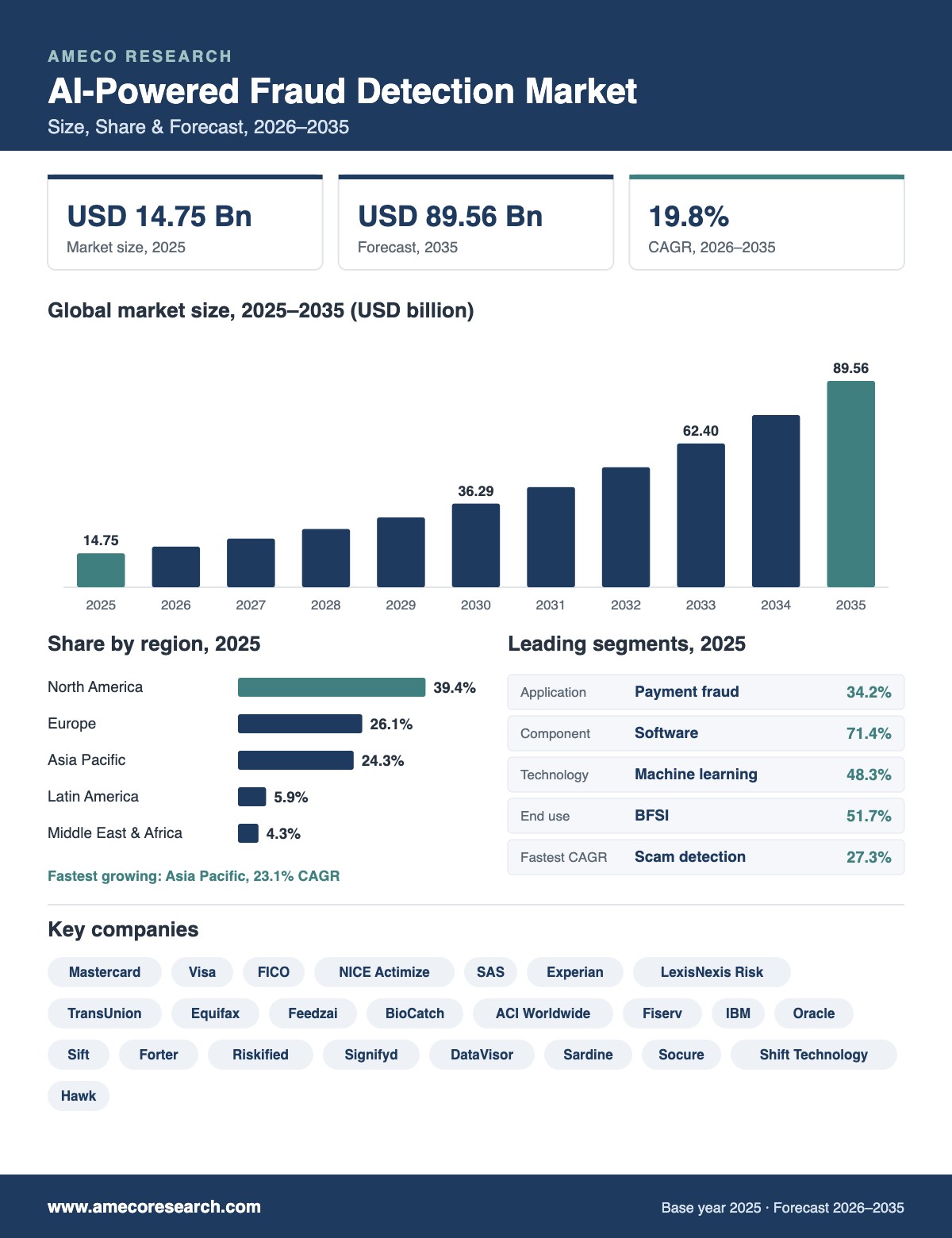 Infographic: AI-Powered Fraud Detection Market Size, Share, Trends & Growth Opportunities Forecast to 2026 - 2035 | Ameco Research
AI-Powered Fraud Detection Market Report Scope
| Report Attribute | Details |
| Market Size in 2025 | USD 14.75 Billion |
| Market Size in 2026 | USD 17.62 Billion |
| Market Forecast by 2035 | USD 89.56 Billion |
| CAGR (2026–2035) | 19.8% |
| Historical Data | 2021–2024 |
| Base Year | 2025 |
| Forecast Period | 2026–2035 |
| Largest Region | North America (39.4% share in 2025) |
| Fastest-Growing Region | Asia Pacific (23.1% CAGR) |
| Segments Covered | Application, Component, Technology, Deployment Mode, Organization Size, End-Use Industry and Region |
| Regional Scope | North America, Europe, Asia Pacific, Latin America, and Middle East & Africa |
| Key Companies Profiled | Mastercard, Visa (Featurespace), FICO, NICE Actimize, SAS Institute, Experian, LexisNexis Risk Solutions, TransUnion, Equifax (Kount), Feedzai, BioCatch, ACI Worldwide, Fiserv, IBM, Oracle, Sift, Forter, Riskified, Signifyd, DataVisor, Sardine, Socure, Shift Technology and Hawk |
| Report Coverage | Market size and forecast, estimation methodology, fraud loss benchmarks by channel, cost-of-fraud analysis, real-time payments and APP scam analysis, deepfake and AI-enabled fraud threats, regulatory analysis, trends, drivers, restraints, opportunities, segment and regional analysis, competitive landscape, recent developments |
How Big Is the AI-Powered Fraud Detection Market in 2026?
Ameco Research estimates the AI-powered fraud detection market at USD 17.62 billion in 2026, up about 19% from USD 14.75 billion in 2025, as banks and payment providers expand real-time scam detection, behavioral biometrics and generative AI tools for fraud teams. The market is expected to reach about USD 36.29 billion by 2030 and USD 89.56 billion by 2035. Growth tracks overall enterprise AI, supported by rising fraud volumes and regulation that shifts more scam losses onto banks and payment providers.
| Year | Market Size (USD Billion) |
| 2025 | 14.75 |
| 2026 | 17.62 |
| 2027 | 21.11 |
| 2028 | 25.29 |
| 2030 | 36.29 |
| 2032 | 52.09 |
| 2035 | 89.56 |
How We Estimated the AI-Powered Fraud Detection Market
There is no official statistic for AI fraud detection spending, so Ameco Research built the estimate from published fraud-loss and cost data and clearly stated assumptions:
| Data Point | Value | How It Is Used |
| Global card fraud losses (The Nilson Report) | About USD 33 billion a year; U.S. cards 41.87% of losses | Base loss pool; also supports the North America share |
| Cost of fraud per dollar lost (LexisNexis Risk Solutions, October 2026) | USD 5.47 for U.S. financial services firms, up from USD 4.00 in 2021 | About USD 4.47 of extra cost per dollar lost: roughly USD 147 billion a year in fraud management costs |
| Technology share of fraud management costs | About 25% (assumption) | About USD 36.9 billion in fraud prevention technology spending |
| AI share of fraud technology spending | About 40% (assumption) | AI-powered fraud detection about USD 14.75 billion in 2025 |
| U.S. consumer fraud losses (FTC) and global scam losses (GASA) | USD 15.9 billion in 2025 (FTC); USD 442 billion across 42 countries (GASA) | Supports fast growth in scam and APP fraud detection |
| Ameco Enterprise AI and AML Software reports | Enterprise AI USD 105.83 billion in 2025 at 20.1% CAGR; AML software 14.3% CAGR | AI fraud detection about 13.9% of enterprise AI; growth set at 19.8%, close to enterprise AI and above AML software |
For context, Ameco Research values the enterprise AI market at USD 105.83 billion in 2025 and the agentic AI market at USD 9.87 billion in 2026, and its anti-money laundering software report projects 14.3% annual growth. Fraud detection is the largest AI use case in banking and payments, and AI fraud tools increasingly share data and models with AML and identity verification platforms.
Latest AI-Powered Fraud Detection Market Trends 2026
Card networks buy AI fraud specialists
Visa agreed in August 2026 to acquire BioCatch, the behavioral biometrics company that protects more than 760 million consumers at over 350 financial institutions, for USD 2.4 billion in cash, after earlier acquiring Featurespace. Visa says it has invested USD 13 billion in technology over five years.
AI fights AI-enabled fraud
LexisNexis Risk Solutions’ 2026 True Cost of Fraud study found AI-generated techniques behind about 19% of U.S. fraud losses and 25% in Canada, while synthetic identity fraud made up 19% of losses and malicious bots 14% of U.S. monthly transactions.
Scam detection becomes a priority
Visa’s Fall 2026 threats report said its Scam Disruption practice identified more than USD 1.4 billion in potential fraud in the first half of 2026, 40% more than in the previous six months.
Real-time payments raise the stakes
In the U.K., authorized push payment fraud losses rose 19% to £576.4 million in 2025, while banks prevented £1.68 billion of unauthorized fraud. Mandatory reimbursement rules in the U.K. and verification of payee checks in the EU push banks to score payments in real time.
Behavioral biometrics and device intelligence
Banks are adding passive signals such as typing rhythm, device handling and session behavior to catch account takeovers and coached scam victims that pass passwords and one-time codes.
Generative AI copilots for fraud teams
Vendors are adding generative AI and AI agents that summarize alerts, explain model decisions and draft case notes and suspicious activity reports, reducing investigation time.
AI-Powered Fraud Detection Market Dynamics
Growth drivers
- Rising fraud and scam losses: card fraud, consumer scams and identity fraud continue to set records.
- Real-time and digital payments: instant payments leave no time for manual review, so every transaction must be scored by AI.
- AI-enabled attacks: deepfakes, synthetic identities and bots require AI-based defenses.
- Regulation and liability shift: scam reimbursement rules and payee verification push banks and payment providers to invest.
- Cost of fraud: each dollar of fraud costs U.S. financial firms USD 5.47, making prevention more cost-effective than recovery.
Restraints and challenges
- False positives: overly strict models decline good customers; 56% of firms say fraud controls have increased customer churn.
- Data privacy and sharing limits: rules on personal data restrict cross-institution data sharing.
- Model explainability: regulators require transparent and fair AI decisions.
- Legacy systems: older core banking and payment platforms slow real-time AI deployment.
- Skills shortage: fraud data science and model governance talent is scarce.
Opportunities
- Scam and APP fraud detection for real-time payment schemes worldwide.
- Deepfake and synthetic identity detection for onboarding and contact centers.
- Consortium and network intelligence that shares fraud signals across banks, telecoms and platforms.
- Fraud and AML convergence into unified financial crime platforms.
- Emerging markets with fast-growing digital payments in Asia Pacific, Latin America and Africa.
AI-Powered Fraud Detection Market Segment Analysis
By application
Payment and transaction fraud detection accounted for 34.2% of revenue in 2025, about USD 5.04 billion, covering card, digital wallet, real-time payment and wire transfer monitoring. Identity verification and account takeover protection held 22.6%, anti-money laundering and money mule detection 12.7%, e-commerce and merchant fraud prevention 12.3%, scam and APP fraud detection 9.8%, and insurance claims fraud detection 8.4%. Scam and APP fraud detection is the fastest-growing application at about a 27.3% CAGR.
| Application | Share (2025) | Key Highlights |
| Payment & Transaction Fraud Detection | 34.2% | Largest; card, wallet, wire and real-time payments |
| Identity Verification & Account Takeover Protection | 22.6% | Onboarding, synthetic identity and deepfake checks |
| AML & Money Mule Detection | 12.7% | Mule accounts and laundering networks |
| E-commerce & Merchant Fraud Prevention | 12.3% | Checkout fraud, chargebacks and promotion abuse |
| Scam & APP Fraud Detection | 9.8% | Fastest-growing at 27.3% CAGR; coached and impersonation scams |
| Insurance Claims Fraud Detection | 8.4% | Claims triage, staged accidents and document fraud |
By component
Software and platforms held 71.4% of revenue in 2025, including real-time fraud engines, identity and device intelligence platforms and case management tools. Services, including model development, managed fraud operations and consortium data services, accounted for 28.6%.
| Component | Share (2025) | Key Highlights |
| Software & Platforms | 71.4% | Largest; fraud engines, identity and device intelligence |
| Services | 28.6% | Managed fraud operations, model tuning and integration |
By technology: How fast is generative AI growing?
Machine learning, including supervised and unsupervised models for transaction scoring, accounted for 48.3% of the market in 2025. Behavioral biometrics and device intelligence held 17.6%, NLP and computer vision for document and deepfake checks 12.5%, and graph analytics and network detection 12.4%. Generative AI and agentic AI, used for investigator copilots, synthetic training data and automated case handling, held 9.2% and are the fastest-growing technology at about a 31.4% CAGR.
| Technology | Share (2025) | Key Highlights |
| Machine Learning (Supervised & Unsupervised) | 48.3% | Largest; real-time risk scoring |
| Behavioral Biometrics & Device Intelligence | 17.6% | Account takeover and scam victim signals |
| NLP & Computer Vision | 12.5% | Document, liveness and deepfake detection |
| Graph Analytics & Network Detection | 12.4% | Fraud rings and money mule networks |
| Generative AI & Agentic AI | 9.2% | Fastest-growing at 31.4% CAGR; investigator copilots |
By deployment mode and organization size
Cloud deployment accounted for 63.8% of revenue in 2025 and is growing faster, as banks and merchants adopt cloud fraud platforms and network-level services. On-premises deployments held 36.2%, mainly at large banks with strict data residency needs. Large enterprises accounted for 72.1% of spending, while small and medium-sized businesses held 27.9% and are adopting AI fraud tools quickly through payment providers and e-commerce platforms.
By end-use industry
Banking, financial services and insurance (BFSI) was the largest end-use industry with 51.7% of revenue in 2025. Retail and e-commerce held 17.2% and are growing fastest at about a 22.6% CAGR, followed by government and public sector at 8.1%, telecom at 6.9%, healthcare at 6.3%, and gaming, travel and other industries at 9.8%.
| End-Use Industry | Share (2025) | Key Highlights |
| BFSI | 51.7% | Largest; banks, card issuers, fintechs and insurers |
| Retail & E-commerce | 17.2% | Fastest-growing at 22.6% CAGR; online checkout fraud |
| Government & Public Sector | 8.1% | Benefits, tax and procurement fraud |
| Telecom | 6.9% | SIM swap, subscription and scam call fraud |
| Healthcare | 6.3% | Claims, billing and identity fraud |
| Gaming, Travel & Others | 9.8% | Bonus abuse, loyalty and booking fraud |
AI-Powered Fraud Detection Market Regional Analysis
| Region | Share (2025) | Outlook |
| North America | 39.4% | Largest; U.S. cards account for about 42% of card fraud losses |
| Europe | 26.1% | Scam reimbursement rules and payee verification |
| Asia Pacific | 24.3% | Fastest-growing at 23.1% CAGR; India, China, Australia, Singapore |
| Latin America | 5.9% | Pix and real-time payments in Brazil and Mexico |
| Middle East & Africa | 4.3% | Digital banking and mobile money in GCC and Africa |
Why does North America lead the AI-powered fraud detection market?
North America accounted for about 39.4% of revenue in 2025. U.S. cards account for about 42% of global card fraud losses, consumers reported USD 15.9 billion in fraud losses to the FTC in 2025, and every dollar of fraud costs U.S. financial firms USD 5.47. Most leading fraud technology vendors, card networks and credit bureaus are based in the region.
What makes Asia Pacific the fastest-growing region?
Asia Pacific held about 24.3% of the market in 2025 and is forecast to grow at a 23.1% CAGR. Huge real-time payment volumes in India and China, rapid digital banking adoption in Southeast Asia, scam-prevention rules in Singapore and Australia and growing e-commerce are driving investment in AI fraud detection.
How is Europe developing?
Europe represented about 26.1% of revenue in 2025. U.K. banks prevented £1.68 billion of unauthorized fraud in 2025 while authorized push payment losses rose 19%, and mandatory scam reimbursement in the U.K. and verification of payee under the EU Instant Payments Regulation push banks toward real-time AI scoring.
AI-Powered Fraud Detection Market Segmentation
AI-Powered Fraud Detection Market Leading Companies
Mastercard and Visa apply AI across their networks and are expanding through acquisitions such as Featurespace and BioCatch. FICO, NICE Actimize, SAS, ACI Worldwide, Fiserv, IBM and Oracle supply enterprise fraud platforms to banks; Experian, LexisNexis Risk Solutions, TransUnion, Equifax (Kount) and Socure focus on identity and device intelligence; Feedzai, BioCatch, DataVisor, Sardine and Hawk are AI-native fraud and financial crime specialists; Sift, Forter, Riskified and Signifyd serve e-commerce merchants; and Shift Technology focuses on insurance fraud.
Mastercard · Visa (Featurespace) · FICO · NICE Actimize · SAS Institute · Experian · LexisNexis Risk Solutions · TransUnion · Equifax (Kount) · Feedzai · BioCatch · ACI Worldwide · Fiserv · IBM · Oracle · Sift · Forter · Riskified · Signifyd · DataVisor · Sardine · Socure · Shift Technology · Hawk
Recent developments
- November 2026: Visa’s Fall 2026 Biannual Threats Report said its Scam Disruption practice identified more than USD 1.4 billion in potential fraud in the first half of 2026, up 40% from the previous six months.
- October 2026: LexisNexis Risk Solutions’ True Cost of Fraud study found each dollar of fraud costs U.S. financial services firms USD 5.47, with AI-generated techniques behind about 19% of losses.
- August 2026: Visa agreed to acquire behavioral biometrics specialist BioCatch for USD 2.4 billion in cash.
- June 2026: UK Finance reported £1.28 billion in payment fraud losses for 2025, while banks prevented £1.68 billion of unauthorized fraud.
- March 2026: The FTC reported that consumers lost a record USD 15.9 billion to fraud in 2025, up from USD 12 billion in 2024.
- December 2025: The Nilson Report put global card fraud losses at about USD 33 billion, with U.S. cards accounting for 41.87% of the total.
AI-Powered Fraud Detection Market: Frequently Asked Questions
How big is the AI-powered fraud detection market?
The global AI-powered fraud detection market was valued at USD 14.75 billion in 2025 and is estimated at USD 17.62 billion in 2026. Ameco Research projects it to reach USD 89.56 billion by 2035, growing at a CAGR of 19.8% from 2026 to 2035.
What is AI-powered fraud detection?
AI-powered fraud detection uses machine learning, behavioral biometrics, graph analytics and generative AI to spot fraudulent transactions, fake or stolen identities, account takeovers, scams and money mule activity in real time. Instead of fixed rules, AI models learn normal behavior for each customer, device and merchant, score every event in milliseconds and adapt as fraud tactics change.
How does AI detect fraud in real time?
AI models score each payment, login or application within milliseconds using hundreds of signals, including amount, location, device fingerprint, typing and swiping behavior, merchant history and links to known fraud networks. High-risk events are blocked or sent for step-up authentication, while low-risk customers pass without friction, which cuts both fraud losses and false declines.
Why is demand for AI fraud detection growing?
Fraud is rising faster than traditional rules can handle. Americans reported a record USD 15.9 billion in fraud losses to the FTC in 2025, scams cost an estimated USD 442 billion across 42 countries, and LexisNexis Risk Solutions finds every dollar of fraud costs U.S. financial firms USD 5.47. Real-time payments, deepfakes and AI-generated scams are pushing banks, merchants and insurers to adopt AI defenses.
How did Ameco Research estimate the AI-powered fraud detection market?
The estimate starts from about USD 33 billion in global card fraud losses (The Nilson Report). Applying the LexisNexis True Cost of Fraud multiplier, about USD 4.47 of extra cost per dollar lost, gives roughly USD 147 billion a year in fraud management costs. Ameco Research assumes technology is about a quarter of those costs and AI-based solutions about 40% of technology spending, giving USD 14.75 billion in 2025, cross-checked against its enterprise AI and anti-money laundering software reports.
Which application leads the AI-powered fraud detection market?
Payment and transaction fraud detection was the largest application with about 34.2% of revenue in 2025, followed by identity verification and account takeover protection at 22.6%. Scam and authorized push payment fraud detection is the fastest-growing application at about a 27.3% CAGR.
Which region leads the AI-powered fraud detection market?
North America led with about 39.4% of revenue in 2025, as U.S. cards account for about 42% of global card fraud losses. Europe held 26.1%, and Asia Pacific is the fastest-growing region at about a 23.1% CAGR, driven by real-time payments in India, Southeast Asia and Australia.
Who are the key companies in the AI-powered fraud detection market?
Key companies include Mastercard, Visa (Featurespace), FICO, NICE Actimize, SAS Institute, Experian, LexisNexis Risk Solutions, TransUnion, Equifax (Kount), Feedzai, BioCatch, ACI Worldwide, Fiserv, IBM, Oracle, Sift, Forter, Riskified, Signifyd, DataVisor, Sardine, Socure, Shift Technology and Hawk.
Related ICT and Media Market Reports
- AI-Powered Revenue Recovery Market Size, Share, Trends & Growth Opportunities Forecast to 2026 - 2035
- Sovereign AI Infrastructure Market Size, Share, Trends & Growth Opportunities Forecast to 2026 - 2035
- AI Inference Infrastructure Market Size, Share, Trends & Growth Opportunities Forecast to 2026 - 2035
- Post-Quantum Cryptography (PQC) Market Size, Share, Trends & Growth Opportunities Forecast to 2026 - 2035
- GPU-as-a-Service Market Size, Share, Trends & Growth Opportunities Forecast to 2026 - 2035