Post-Quantum Cryptography (PQC) Market Size, Share, Trends & Growth Opportunities Forecast to 2026 - 2035
Post-Quantum Cryptography (PQC) Market Size, Share & Trends Report, 2026–2035
LAST UPDATED: NOVEMBER 2026
The global post-quantum cryptography (PQC) market size was valued at USD 0.58 billion in 2025 and is projected to reach USD 17.58 billion by 2035, growing at a CAGR of 40.2% from 2026 to 2035. The market is estimated at USD 0.84 billion in 2026, as government deadlines, NIST standards and the “harvest now, decrypt later” threat push organizations to replace RSA and elliptic-curve encryption. North America holds the largest share, while Asia Pacific is the fastest-growing region.
Post-quantum cryptography (PQC), also called quantum-safe or quantum-resistant cryptography, refers to public-key algorithms that remain secure against attacks by large-scale quantum computers. A sufficiently powerful quantum computer running Shor’s algorithm could break RSA, Diffie-Hellman and elliptic-curve cryptography, which protect almost all of today’s internet traffic, payments, digital identities and software updates. PQC algorithms are based on mathematical problems, such as structured lattices and hash functions, that quantum computers are not known to solve efficiently.
Because PQC runs on existing processors, networks and secure chips, it can be rolled out through software libraries, firmware, hardware security modules (HSMs), PKI and certificate platforms. With NIST’s FIPS 203, 204 and 205 standards in place since 2024 and binding migration deadlines now set in the U.S., Europe and the U.K., the post-quantum cryptography market has moved from research and pilots to large-scale enterprise and government migration.
PQC Market Key Takeaways
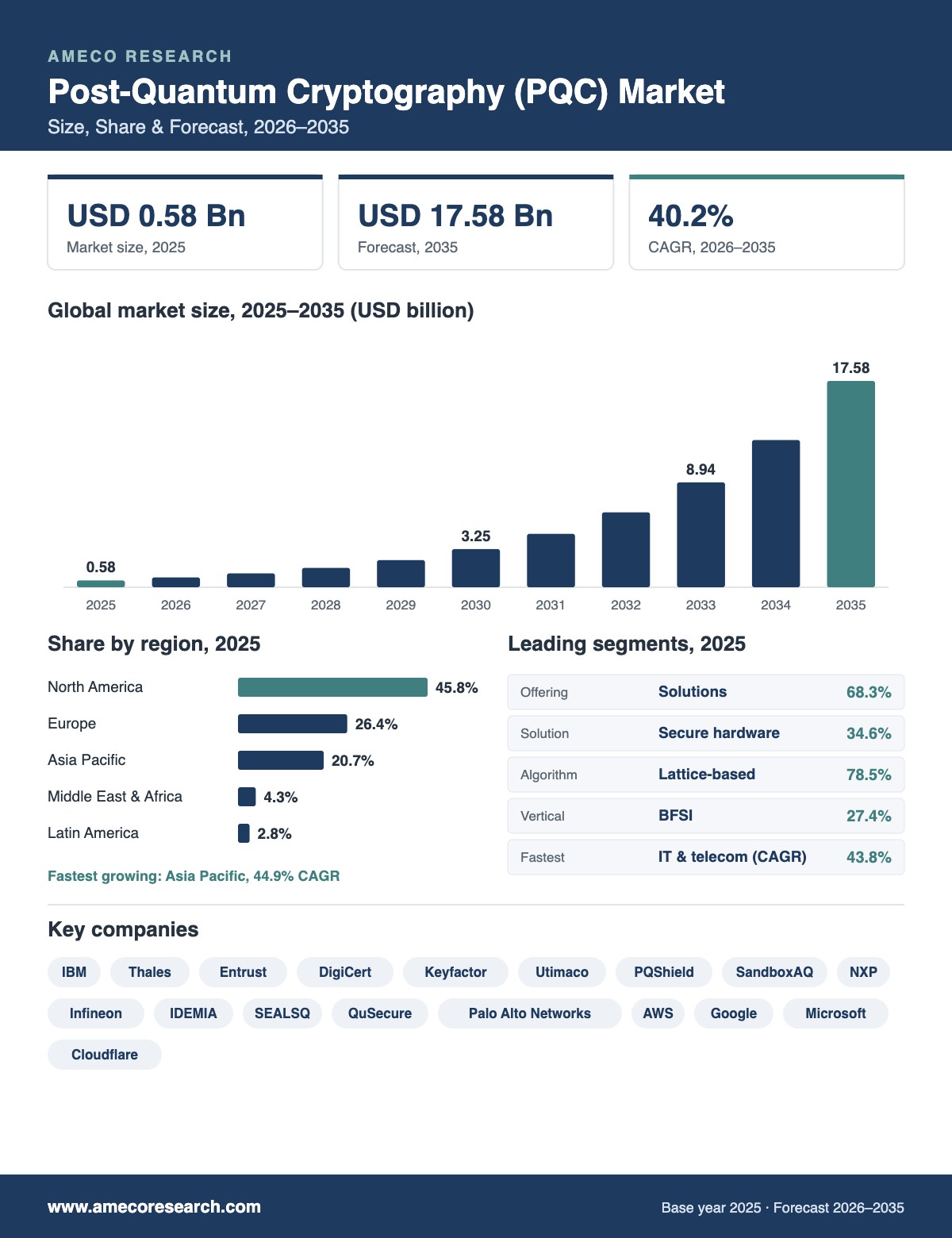 Infographic: Post-Quantum Cryptography (PQC) Market Size, Share, Trends & Growth Opportunities Forecast to 2026 - 2035 | Ameco Research
PQC Market Report Scope
| Report Attribute | Details |
| PQC Market Size in 2025 | USD 0.58 Billion |
| PQC Market Size in 2026 | USD 0.84 Billion |
| PQC Market Forecast by 2035 | USD 17.58 Billion |
| PQC Market CAGR (2026–2035) | 40.2% |
| Historical Data | 2021–2024 |
| Base Year | 2025 |
| Forecast Period | 2026–2035 |
| Largest Region | North America (45.8% share in 2025) |
| Fastest-Growing Region | Asia Pacific (44.9% CAGR) |
| Segments Covered | Offering, Solution Type, Algorithm Type, Deployment Mode, Organization Size, Vertical and Region |
| Regional Scope | North America, Europe, Asia Pacific, Latin America, and Middle East & Africa |
| Key Companies Profiled | IBM, Thales, Entrust, DigiCert, Keyfactor, Utimaco, PQShield, SandboxAQ, NXP Semiconductors, Infineon Technologies, IDEMIA Secure Transactions, SEALSQ, QuSecure, Palo Alto Networks, Amazon Web Services (AWS), Google, Microsoft and Cloudflare |
| Report Coverage | Market size and forecast, NIST standards and regulatory timelines, quantum threat timeline, migration cost analysis, pricing, trends, drivers, restraints, opportunities, segment and regional analysis, competitive landscape, recent developments |
How Big Is the Post-Quantum Cryptography Market in 2026?
Ameco Research estimates the post-quantum cryptography market at USD 0.84 billion in 2026, up about 45% from USD 0.58 billion in 2025. Growth accelerated after the U.S. issued Executive Order 14412 in June 2026 and NIST finalized its transition roadmap, NIST IR 8547, in October 2026, turning PQC from a long-term plan into a budgeted compliance program. The market is expected to pass USD 3 billion by 2030, reaching about USD 3.25 billion, and climb to USD 17.58 billion by 2035, when quantum-vulnerable algorithms are disallowed.
| Year | PQC Market Size (USD Billion) |
| 2025 | 0.58 |
| 2026 | 0.84 |
| 2027 | 1.18 |
| 2028 | 1.65 |
| 2030 | 3.25 |
| 2032 | 6.38 |
| 2035 | 17.58 |
Latest PQC Market Trends 2026
Deadlines become law and procurement rules
U.S. Executive Order 14412, signed on June 22, 2026, requires federal high-value and high-impact systems to use PQC for key establishment by December 31, 2030 and for digital signatures by December 31, 2031, and directs a FAR rule requiring federal contractors to comply. NIST IR 8547, finalized in October 2026, deprecates RSA and elliptic-curve algorithms after 2030 and disallows them after 2035.
Hybrid TLS becomes the default
Browsers, operating systems and libraries now enable hybrid key exchange, which pairs ML-KEM with classical X25519, by default. OpenSSL 3.5 shipped ML-KEM, ML-DSA and SLH-DSA in April 2025, Apple enabled hybrid quantum-secure TLS in iOS 26 and macOS Tahoe 26, and Microsoft made ML-KEM and ML-DSA generally available in Windows in November 2025.
Cryptographic inventory comes first
Most organizations do not know where RSA and ECC are used across their applications, devices, certificates and suppliers. Cryptographic discovery, inventory and cryptographic bill of materials (CBOM) tools are among the fastest-growing PQC products as agencies and enterprises prepare their migration plans.
Crypto-agility and certificate automation
PQC certificates and keys are larger, and certificate lifetimes are shrinking, so organizations are investing in automated PKI and certificate lifecycle management that can swap algorithms without rebuilding systems. Keyfactor’s more than USD 1 billion growth investment, announced in July 2026, reflects this demand.
PQC moves into silicon
Chipmakers and secure element vendors such as NXP, Infineon, IDEMIA and SEALSQ are adding ML-KEM and ML-DSA to microcontrollers, smart cards, TPMs and HSMs, so that cars, payment cards, industrial equipment and IoT devices with long lifetimes stay secure into the 2040s.
Consolidation and quantum-company entry
The market is consolidating as security and quantum computing companies buy PQC capabilities. In October 2026, IonQ agreed to acquire Zero Trust company Elisity to combine post-quantum security with network protection, following earlier deals such as SandboxAQ’s purchase of Cryptosense and Keyfactor’s purchase of Quantum Xchange’s technology.
PQC Market Dynamics
Growth drivers
- Government mandates: U.S. EO 14412, NSA CNSA 2.0, the EU coordinated PQC roadmap and the U.K. NCSC 2035 migration timeline create firm deadlines and budgets.
- “Harvest now, decrypt later” attacks: sensitive data stolen today can be decrypted later, so long-lived financial, health, defense and intellectual property data must be protected now.
- Finalized standards: NIST FIPS 203, 204 and 205 give vendors and buyers stable algorithms to build into products and FIPS 140 validated modules.
- Progress in quantum computing: new research has sharply lowered the estimated number of qubits needed to break RSA-2048, shortening expected “Q-Day” timelines.
- Long-lived devices: vehicles, satellites, smart meters, medical devices and payment cards deployed today must remain secure for 10 to 20 years.
Restraints and challenges
- Migration complexity: cryptography is embedded in thousands of applications, protocols, devices and third-party products, making full migration a multi-year effort.
- Performance and size: PQC keys and signatures are larger than RSA and ECC, which can affect constrained devices, network packets and certificate chains.
- Skills shortage: few security teams have hands-on PQC experience, raising reliance on consultants.
- Budget competition: without a visible near-term attack, some organizations delay spending in favor of other security priorities.
- Evolving standards: FN-DSA (FIPS 206) and HQC are still being finalized, and some protocols await updated specifications.
Opportunities
- Cryptographic discovery and CBOM tools to map quantum-vulnerable assets across large enterprises.
- PQC migration services for governments, federal contractors, banks and critical infrastructure operators.
- Quantum-safe hardware including HSMs, secure elements, TPMs and PQC-ready microcontrollers.
- Telecom and 5G/6G security as operators upgrade VPNs, SIM cards and core networks.
- PQC as a service through cloud key management, managed PKI and quantum-safe VPN offerings.
PQC Market Segment Analysis
By offering: Why are PQC services growing fastest?
Solutions accounted for 68.3% of revenue in 2025, about USD 0.40 billion, covering quantum-safe hardware, software libraries, PKI platforms and network security products. Services, including cryptographic risk assessment, inventory, migration planning, integration and managed services, held 31.7% and are the fastest-growing offering at about a 42.6% CAGR, as federal agencies, contractors and banks prepare compliance-driven migration plans.
| Offering | Share (2025) | Key Highlights |
| Solutions | 68.3% | Largest; hardware, software, PKI and network security products |
| Services | 31.7% | Fastest-growing at 42.6% CAGR; assessment, migration and managed services |
By solution type
Quantum-safe hardware, including HSMs, secure elements, TPMs and PQC-enabled chips, led solution revenue with 34.6% in 2025. PQC software libraries and toolkits held 27.2%, cryptographic discovery, PKI and crypto-agility platforms 21.4%, and quantum-safe network security, such as VPNs, TLS gateways and secure messaging, 16.8%. Discovery and crypto-agility platforms are growing fastest.
| Solution Type | Share (2025) | Key Highlights |
| Quantum-Safe Hardware (HSMs, Secure Elements, Chips) | 34.6% | Largest; payments, government and device security |
| PQC Software Libraries & Toolkits | 27.2% | Embedded in applications, OS and cloud services |
| Crypto Discovery, PKI & Crypto-Agility Platforms | 21.4% | Fastest-growing; inventory, CBOM and certificate automation |
| Quantum-Safe Network Security (VPN, TLS, Messaging) | 16.8% | Hybrid TLS, quantum-safe VPN and secure communications |
By algorithm type
Lattice-based algorithms, including ML-KEM, ML-DSA and FN-DSA, accounted for 78.5% of the market in 2025 because they offer the best balance of speed and key size and form the core of NIST’s standards. Hash-based signatures such as SLH-DSA, LMS and XMSS held 13.2%, mainly for firmware and code signing. Code-based schemes such as HQC and Classic McEliece held 5.1%, and multivariate and other algorithms 3.2%.
| Algorithm Type | Share (2025) | Key Highlights |
| Lattice-Based (ML-KEM, ML-DSA, FN-DSA) | 78.5% | Largest; default for key exchange and signatures |
| Hash-Based (SLH-DSA, LMS, XMSS) | 13.2% | Firmware, secure boot and code signing |
| Code-Based (HQC, Classic McEliece) | 5.1% | Backup key establishment; HQC selected by NIST in 2025 |
| Multivariate & Others | 3.2% | Specialized and research use |
By deployment mode and organization size
On-premises deployments held 56.4% of revenue in 2025, reflecting the use of HSMs and private PKI in banks, governments and defense. Cloud deployments, at 43.6%, are growing faster as AWS, Google Cloud, Microsoft Azure and Cloudflare add PQC to key management, load balancers and TLS endpoints. Large enterprises accounted for 74.8% of spending, while small and medium-sized enterprises (25.2%) mainly adopt PQC through cloud and managed services.
| Deployment / Organization | Share (2025) | Key Highlights |
| On-Premises | 56.4% | Largest; HSMs and private PKI |
| Cloud | 43.6% | Fastest-growing; cloud KMS and PQC TLS |
| Large Enterprises | 74.8% | Banks, governments, telecom and tech |
| SMEs | 25.2% | Adoption through cloud and managed services |
By vertical: Which industry leads PQC adoption?
BFSI was the largest vertical with 27.4% of revenue in 2025, as banks protect long-lived customer data, payment networks and interbank messaging. Government and defense followed with 24.9%, driven by national mandates and classified systems. IT and telecom, with 18.6%, is the fastest-growing vertical at about a 43.8% CAGR. Healthcare held 8.1%, energy and utilities 6.3%, automotive 5.2% and other verticals 9.5%.
| Vertical | Share (2025) | Key Highlights |
| BFSI | 27.4% | Largest; payments, trading and customer data |
| Government & Defense | 24.9% | Federal mandates, CNSA 2.0 and classified systems |
| IT & Telecom | 18.6% | Fastest-growing at 43.8% CAGR; cloud, TLS and 5G |
| Healthcare | 8.1% | Patient records and connected medical devices |
| Energy & Utilities | 6.3% | Smart grids and critical infrastructure |
| Automotive | 5.2% | Connected vehicles and over-the-air updates |
| Others | 9.5% | Retail, manufacturing and education |
PQC Market Regional Analysis
| Region | Share (2025) | Outlook |
| North America | 45.8% | Largest; federal mandates and leading PQC vendors |
| Europe | 26.4% | EU PQC roadmap and U.K. 2035 migration timeline |
| Asia Pacific | 20.7% | Fastest-growing at 44.9% CAGR; China, Japan, South Korea, India |
| Middle East & Africa | 4.3% | Government and banking modernization in the Gulf |
| Latin America | 2.8% | Early adoption in banking and telecom |
Why does North America lead the PQC market?
North America accounted for about 45.8% of revenue in 2025. The U.S. has the most detailed migration requirements, from the Quantum Computing Cybersecurity Preparedness Act and NSA CNSA 2.0 to Executive Order 14412 and NIST IR 8547, and its federal contractor rules extend these deadlines to suppliers. The region is also home to many leading PQC, PKI, cloud and quantum companies, including IBM, DigiCert, Keyfactor, SandboxAQ, QuSecure, AWS, Google, Microsoft and Cloudflare.
What makes Asia Pacific the fastest-growing region?
Asia Pacific held about 20.7% of the market in 2025 and is forecast to grow at a 44.9% CAGR. China is developing its own national post-quantum algorithms, South Korea has selected domestic PQC standards, Japan and Singapore have issued financial-sector migration guidance, and India’s National Quantum Mission is funding quantum-safe communications. Large banking, telecom and electronics manufacturing industries add further demand.
How is Europe developing?
Europe represented about 26.4% of revenue in 2025. The EU’s coordinated implementation roadmap calls on member states to begin the transition by the end of 2026 and to protect critical infrastructure by 2030, while the U.K. NCSC targets full migration by 2035. Germany’s BSI and France’s ANSSI also recommend hybrid PQC, and European vendors such as Thales, Utimaco, Infineon, IDEMIA and PQShield play a major role.
PQC Market Segmentation
PQC Market Leading Companies
The post-quantum cryptography market combines established security vendors, specialist PQC companies, chipmakers and cloud platforms. Thales, Entrust and Utimaco lead in quantum-safe HSMs; DigiCert, Keyfactor and Entrust in PQC-ready PKI and certificate management; PQShield and SandboxAQ in PQC IP, discovery and migration tools; NXP, Infineon, IDEMIA and SEALSQ in PQC-enabled chips and secure elements; and IBM, AWS, Google, Microsoft and Cloudflare in large-scale deployment of quantum-safe cloud and network services.
IBM · Thales · Entrust · DigiCert · Keyfactor · Utimaco · PQShield · SandboxAQ · NXP Semiconductors · Infineon Technologies · IDEMIA Secure Transactions · SEALSQ · QuSecure · Palo Alto Networks · Amazon Web Services (AWS) · Google · Microsoft · Cloudflare
Recent developments
- October 2026: NIST finalized IR 8547, its PQC transition roadmap, which deprecates quantum-vulnerable RSA and elliptic-curve algorithms after 2030 and disallows them after 2035.
- October 2026: IonQ agreed to acquire Zero Trust security company Elisity for up to USD 1.3 billion to combine post-quantum and network security.
- July 2026: Keyfactor announced more than USD 1 billion in growth investment led by Summit Partners to expand its post-quantum PKI and certificate platform.
- June 2026: The U.S. President signed Executive Order 14412, setting 2030 and 2031 deadlines for PQC key establishment and digital signatures in high-value federal systems.
- November 2025: Microsoft made ML-KEM and ML-DSA generally available in Windows 11, Windows Server 2025 and .NET 10.
- April 2025: OpenSSL 3.5 added native support for ML-KEM, ML-DSA and SLH-DSA, with hybrid post-quantum key exchange as a default TLS option.
- March 2025: NIST selected HQC as a fifth post-quantum algorithm and backup to ML-KEM for key establishment.
PQC Market: Frequently Asked Questions
How big is the post-quantum cryptography market?
The global post-quantum cryptography (PQC) market was valued at USD 0.58 billion in 2025 and is estimated at USD 0.84 billion in 2026. Ameco Research projects it to reach USD 17.58 billion by 2035, growing at a CAGR of 40.2% from 2026 to 2035.
What is post-quantum cryptography?
Post-quantum cryptography (PQC) is a family of public-key encryption and digital signature algorithms designed to resist attacks from future large-scale quantum computers. Unlike quantum key distribution, PQC runs on today’s computers, chips and networks, so it can replace RSA and elliptic-curve cryptography through software, firmware and hardware updates.
What are the NIST post-quantum cryptography standards?
NIST published its first three PQC standards in August 2024: FIPS 203 (ML-KEM) for key establishment, FIPS 204 (ML-DSA) for digital signatures and FIPS 205 (SLH-DSA), a hash-based signature scheme. FN-DSA (FALCON) is being standardized as FIPS 206, and NIST selected HQC in March 2025 as a backup key-establishment algorithm.
What is the deadline to migrate to post-quantum cryptography?
Under U.S. Executive Order 14412 of June 2026, high-value and high-impact federal systems must use PQC for key establishment by December 31, 2030 and for digital signatures by December 31, 2031. NIST IR 8547, finalized in October 2026, deprecates quantum-vulnerable RSA and elliptic-curve algorithms after 2030 and disallows them after 2035. The EU and U.K. have set similar 2030–2035 targets.
Why are organizations adopting PQC now if quantum computers are not ready?
The main reason is the “harvest now, decrypt later” threat: attackers can collect encrypted data today and decrypt it once a powerful quantum computer exists. Data that must stay confidential for 10 years or more is already at risk. Migration across certificates, devices, applications and supply chains also takes many years, so organizations are starting now.
Which segment leads the PQC market?
Solutions accounted for about 68.3% of revenue in 2025, led by quantum-safe hardware such as HSMs, secure elements and PQC-ready chips. Lattice-based algorithms, including ML-KEM and ML-DSA, account for about 78.5% of deployments by value. Services are the fastest-growing offering as organizations seek help with cryptographic inventory and migration.
Which industry spends the most on post-quantum cryptography?
Banking, financial services and insurance (BFSI) held about 27.4% of PQC revenue in 2025, followed by government and defense at 24.9%. IT and telecom is the fastest-growing vertical as cloud providers, browsers and telecom operators roll out quantum-safe TLS, VPN and 5G security.
Who are the key companies in the post-quantum cryptography market?
Key companies include IBM, Thales, Entrust, DigiCert, Keyfactor, Utimaco, PQShield, SandboxAQ, NXP Semiconductors, Infineon Technologies, IDEMIA Secure Transactions, SEALSQ, QuSecure and Palo Alto Networks, along with cloud and platform providers such as AWS, Google, Microsoft and Cloudflare.
Related ICT and Media Market Reports
- GPU-as-a-Service Market Size, Share, Trends & Growth Opportunities Forecast to 2026 - 2035
- Agentic AI Market Size, Share, Trends & Growth Opportunities Forecast to 2026 - 2035
- Enterprise AI Market Size, Share, Trends & Growth Opportunities Forecast to 2026 - 2035
- Data Center Cooling Market Size, Share, Trends & Growth Opportunities Forecast to 2026 - 2035
- AI Data Center Market Size, Share, Trends & Growth Opportunities Forecast to 2026 - 2035