AI-Powered Revenue Recovery Market Size, Share, Trends & Growth Opportunities Forecast to 2026 - 2035
AI-Powered Revenue Recovery Market Size, Share & Trends Report, 2026–2035
LAST UPDATED: NOVEMBER 2026
The global AI-powered revenue recovery market size was valued at USD 7.12 billion in 2025 and is projected to reach USD 53.22 billion by 2035, growing at a CAGR of 22.4% from 2026 to 2035. The market is estimated at USD 8.63 billion in 2026, as hospitals, subscription businesses, lenders, merchants and telecom operators use machine learning, generative AI and AI agents to win back revenue lost to failed payments, claim denials, payer take-backs, unpaid invoices, chargebacks and billing leakage. North America holds the largest share, while Asia Pacific is the fastest-growing region.
AI-powered revenue recovery refers to software, platforms and managed services that use artificial intelligence to identify, prioritise and collect revenue a business has already earned but failed to receive. Typical use cases include smart retries and dunning for failed card and subscription payments, healthcare claim denial prevention and appeals, underpayment and payer recoupment recovery, AI-driven collections for consumer and B2B receivables, chargeback and dispute recovery, and revenue leakage detection in billing and contracts.
The revenue at stake is large. Recurly estimates that subscription businesses could lose about USD 129 billion to involuntary churn from failed payments in 2025, Waystar finds that payers take back more than USD 40 billion of provider revenue every year, and Premier estimates that U.S. providers spent USD 19.7 billion in a single year fighting claim denials. AI agents that can retry, appeal, negotiate and dispute at scale make the AI-powered revenue recovery market one of the fastest-growing applications of enterprise AI.
AI-Powered Revenue Recovery Market Key Takeaways
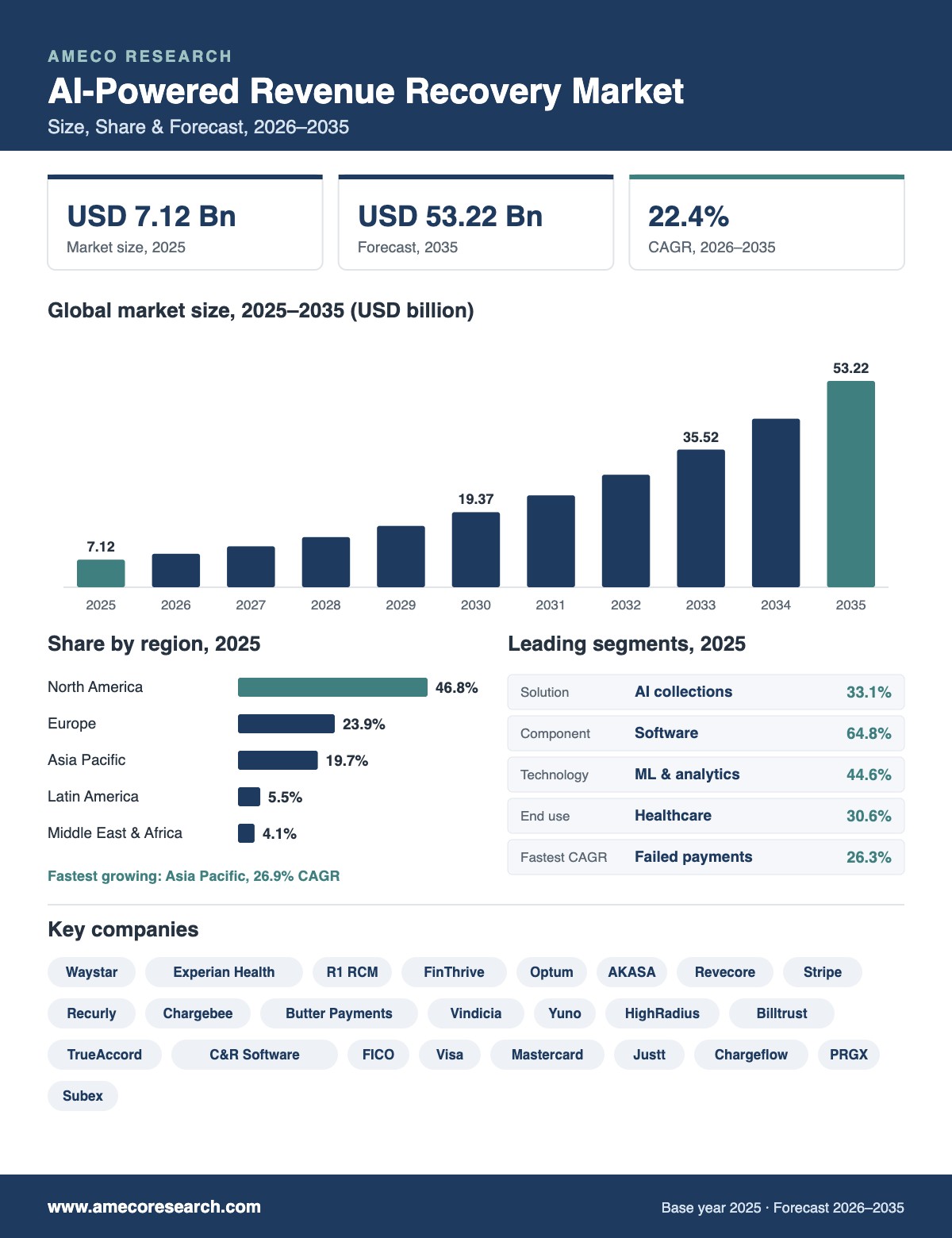 Infographic: AI-Powered Revenue Recovery Market Size, Share, Trends & Growth Opportunities Forecast to 2026 - 2035 | Ameco Research
AI-Powered Revenue Recovery Market Report Scope
| Report Attribute | Details |
| Market Size in 2025 | USD 7.12 Billion |
| Market Size in 2026 | USD 8.63 Billion |
| Market Forecast by 2035 | USD 53.22 Billion |
| CAGR (2026–2035) | 22.4% |
| Historical Data | 2021–2024 |
| Base Year | 2025 |
| Forecast Period | 2026–2035 |
| Largest Region | North America (46.8% share in 2025) |
| Fastest-Growing Region | Asia Pacific (26.9% CAGR) |
| Segments Covered | Solution Type, Component, Deployment Mode, Technology, End-Use Industry and Region |
| Regional Scope | North America, Europe, Asia Pacific, Latin America, and Middle East & Africa |
| Key Companies Profiled | Waystar, Experian Health, R1 RCM, FinThrive, Optum, AKASA, Revecore, Stripe, Recurly, Chargebee, Butter Payments, Vindicia (Amdocs), Yuno, HighRadius, Billtrust, TrueAccord, C&R Software, FICO, Visa (Verifi), Mastercard (Ethoca), Justt, Chargeflow, PRGX and Subex |
| Report Coverage | Market size and forecast, estimation methodology, revenue leakage pool analysis, recovery rate benchmarks, pricing models (SaaS and contingency fee), agentic AI adoption, regulatory analysis, trends, drivers, restraints, opportunities, segment and regional analysis, competitive landscape, recent developments |
How Big Is the AI-Powered Revenue Recovery Market in 2026?
Ameco Research estimates the AI-powered revenue recovery market at USD 8.63 billion in 2026, up about 21% from USD 7.12 billion in 2025, as payment providers, revenue cycle vendors and card networks roll out AI agents for retries, appeals and disputes. The market is expected to reach about USD 19.37 billion by 2030 and USD 53.22 billion by 2035. Growth runs ahead of overall enterprise AI because recovery tools are often priced on results, so buyers see a direct return on spend.
| Year | Market Size (USD Billion) |
| 2025 | 7.12 |
| 2026 | 8.63 |
| 2027 | 10.56 |
| 2028 | 12.93 |
| 2030 | 19.37 |
| 2032 | 29.02 |
| 2035 | 53.22 |
How We Estimated the AI-Powered Revenue Recovery Market
There is no official statistic for AI revenue recovery spending, so Ameco Research sized each recovery pool from published industry data and applied clearly stated adoption and pricing assumptions:
| Data Point | Value | How It Is Used |
| U.S. provider spending to overturn claim denials (Premier, 2022) | USD 19.7 billion a year; about 15% of private-payer claims initially denied | About 10% of denial-management spend assumed to flow to AI tools and AI-enabled services: healthcare segment about USD 2.06 billion in 2025 |
| Annual payer recoupments (Waystar, April 2026) | More than USD 40 billion of provider revenue taken back each year | Supports fast growth in underpayment and recoupment recovery |
| Subscription revenue at risk from failed payments (Recurly) | About USD 129 billion in 2025, on a USD 1.5 trillion subscription economy | Assumes about half is addressed by AI tools, about 45% is recovered and fees average about 4.75% of recovered revenue: about USD 1.38 billion |
| Chargebacks (Mastercard) | About 286 million in 2026, rising to 359 million by 2029; about USD 46 in third-party fees per chargeback | About 5% of chargebacks handled by AI dispute tools: about USD 0.62 billion |
| AI collections, receivables and revenue assurance | Ameco assumption | AI collections about USD 2.36 billion; revenue leakage and recovery audit about USD 0.70 billion |
| Ameco Enterprise AI forecast | USD 105.83 billion in 2025, 20.1% CAGR | Recovery is about 6.7% of enterprise AI; growth set slightly higher at 22.4% due to results-based pricing and agentic AI |
For context, Ameco Research values the enterprise AI market at USD 105.83 billion in 2025 and the agentic AI market at USD 9.87 billion in 2026. AI-powered revenue recovery is one of the clearest return-on-investment use cases for both, because every recovered dollar can be measured.
Latest AI-Powered Revenue Recovery Market Trends 2026
AI agents take over payment recovery
Butter Payments reported in January 2026 that it recovered 56% more subscription revenue year over year after adding 50 new AI recovery models and launching agentic outreach, while Yuno’s NOVA voice and WhatsApp agents recovered up to 75% of failed payments on answered calls in early testing.
Card networks bring AI to disputes
Visa processed 106 million disputes in 2025, up 35% from 2019, and on April 1, 2026 introduced six AI dispute tools, including a generative AI Dispute Recovery Manager that scores each dispute’s chance of winning and drafts responses.
Payer take-backs become a new recovery target
In April 2026, Waystar added AI that finds payer recoupments, which it says exceed USD 40 billion a year and have grown twice as fast as claim volume; one health system surfaced USD 32 million in previously missed take-backs.
AI-native underpayment and appeals platforms
Revecore launched ReClaim in June 2026, an AI-native platform trained on more than 750 million claims that has doubled appeal-drafting speed and cut appeal cycle times by 15 to 20 days for clients.
Denials keep rising, AI budgets follow
Experian Health’s 2026 State of Claims report found 40% of providers see at least one in ten claims denied and 75% say denials are increasing; 64% plan to invest in AI for claims and denial management.
Results-based pricing
Many recovery vendors charge a share of revenue recovered, which lowers the barrier for mid-sized hospitals, SaaS companies and merchants and ties vendor revenue to recovery volumes.
AI-Powered Revenue Recovery Market Dynamics
Growth drivers
- Large and growing revenue leakage: failed payments, claim denials, payer take-backs and chargebacks drain hundreds of billions of dollars a year.
- Subscription economy: recurring billing makes involuntary churn from expired or declined cards a major growth problem.
- Rising claim denials: providers face higher denial rates and more complex payer rules, increasing the value of AI appeals.
- Generative and agentic AI: AI can now draft appeals, dispute evidence and customer outreach at scale.
- Clear return on investment: recovered revenue is easy to measure, and contingency pricing removes upfront risk.
Restraints and challenges
- Data integration: recovery tools need clean data from billing, EHR, payment and ERP systems.
- Regulation: collections and customer outreach must follow consumer protection, debt collection and privacy rules.
- Payer and issuer AI: insurers and banks are deploying their own AI, creating an automation contest over denials and disputes.
- Customer experience risk: aggressive automated outreach can damage relationships and brand trust.
- Explainability: regulated sectors need auditable decisions for appeals, collections and disputes.
Opportunities
- Underpayment and recoupment recovery for hospitals and physician groups.
- Embedded recovery inside payment gateways, billing platforms and orchestration layers.
- Voice and messaging AI agents for collections and payment updates in local languages.
- B2B receivables automation for finance teams managing large invoice volumes.
- Emerging markets with fast-growing digital payments and consumer lending in Asia Pacific and Latin America.
AI-Powered Revenue Recovery Market Segment Analysis
By solution type
AI-driven collections and receivables recovery accounted for 33.1% of revenue in 2025, about USD 2.36 billion, as lenders, collection agencies and B2B finance teams adopted AI for account prioritisation and digital outreach. Healthcare claim denial, underpayment and recoupment recovery held 28.9%, failed payment and involuntary churn recovery 19.4%, revenue leakage and recovery audit 9.9%, and chargeback and dispute recovery 8.7%. Failed payment recovery is the fastest-growing solution at about a 26.3% CAGR.
| Solution Type | Share (2025) | Key Highlights |
| AI Collections & Receivables Recovery | 33.1% | Largest; consumer debt and B2B accounts receivable |
| Healthcare Claim Denial, Underpayment & Recoupment Recovery | 28.9% | AI appeals, underpayment detection and take-back tracking |
| Failed Payment & Involuntary Churn Recovery | 19.4% | Fastest-growing at 26.3% CAGR; smart retries and AI dunning |
| Revenue Leakage & Recovery Audit | 9.9% | Billing, contract, telecom and supplier overpayment recovery |
| Chargeback & Dispute Recovery | 8.7% | AI dispute evidence and win-likelihood scoring |
By component
Software and platforms held 64.8% of revenue in 2025, delivered mainly as cloud subscriptions or embedded in billing and payment platforms. Services, including managed recovery and contingency-fee recovery programs run with AI, accounted for 35.2%.
| Component | Share (2025) | Key Highlights |
| Software & Platforms | 64.8% | Largest; SaaS and embedded recovery tools |
| Services | 35.2% | Managed and contingency-fee recovery programs |
By technology: Are AI agents taking over?
Machine learning and predictive analytics, used to score accounts, time retries and predict denials, accounted for 44.6% of the market in 2025. Generative AI and conversational AI agents, which draft appeals and dispute responses and contact customers by voice and chat, held 23.8% and are the fastest-growing technology at about a 29.7% CAGR. NLP and document intelligence held 17.9%, and intelligent automation and RPA 13.7%.
| Technology | Share (2025) | Key Highlights |
| Machine Learning & Predictive Analytics | 44.6% | Largest; scoring, retry timing and denial prediction |
| Generative AI & Conversational AI Agents | 23.8% | Fastest-growing at 29.7% CAGR; appeals and outreach |
| NLP & Document Intelligence | 17.9% | Remittance, contract and claim document analysis |
| Intelligent Automation & RPA | 13.7% | Portal work, status checks and posting |
By deployment mode
Cloud deployment accounted for 79.3% of revenue in 2025 and is growing faster, as recovery tools connect to cloud payment gateways, billing systems and clearinghouses. On-premises deployments, held mainly by large banks and health systems, represented 20.7%.
By end-use industry
Healthcare was the largest end-use industry with 30.6% of revenue in 2025. Banking, financial services and insurance held 26.4%, subscription, SaaS and digital media 14.2%, retail and e-commerce 12.1%, telecom and utilities 9.3%, and other industries 7.4%.
| End-Use Industry | Share (2025) | Key Highlights |
| Healthcare | 30.6% | Largest; providers, physician groups and RCM firms |
| BFSI | 26.4% | Lenders, card issuers, insurers and collection agencies |
| Subscription, SaaS & Digital Media | 14.2% | Fastest-growing; involuntary churn recovery |
| Retail & E-commerce | 12.1% | Chargebacks, failed payments and refunds abuse |
| Telecom & Utilities | 9.3% | Revenue assurance and bill collection |
| Others | 7.4% | Travel, education, public sector and B2B services |
AI-Powered Revenue Recovery Market Regional Analysis
| Region | Share (2025) | Outlook |
| North America | 46.8% | Largest; U.S. healthcare revenue cycle and subscriptions |
| Europe | 23.9% | Subscriptions, PSD2 payments and collections |
| Asia Pacific | 19.7% | Fastest-growing at 26.9% CAGR; India, Japan, Australia |
| Latin America | 5.5% | Digital payments and lending in Brazil and Mexico |
| Middle East & Africa | 4.1% | Telecom revenue assurance and digital banking |
Why does North America lead the AI-powered revenue recovery market?
North America accounted for about 46.8% of revenue in 2025. The U.S. has the world’s most complex healthcare billing system, with nearly 15% of private-payer claims initially denied, the largest subscription economy and a mature collections industry. Revenue cycle vendors, payment providers and card networks headquartered in the U.S. are launching AI recovery products first.
What makes Asia Pacific the fastest-growing region?
Asia Pacific held about 19.7% of the market in 2025 and is forecast to grow at a 26.9% CAGR. Rapid growth in digital payments, buy-now-pay-later and consumer lending in India and Southeast Asia, subscription services in Japan, South Korea and Australia, and AI voice agents that work in local languages are driving adoption.
How is Europe developing?
Europe represented about 23.9% of revenue in 2025. Strong customer authentication rules, a large subscription and streaming base and digital collections in the U.K., Germany, France and the Nordics support demand, while GDPR and consumer credit rules shape how AI outreach is designed.
AI-Powered Revenue Recovery Market Segmentation
AI-Powered Revenue Recovery Market Leading Companies
Waystar, Experian Health, R1 RCM, FinThrive, Optum, AKASA and Revecore lead AI denial, underpayment and recoupment recovery in healthcare. Stripe, Recurly, Chargebee, Butter Payments, Vindicia and Yuno provide AI payment retry and involuntary churn recovery; HighRadius, Billtrust, TrueAccord, C&R Software and FICO serve receivables and collections; Visa (Verifi), Mastercard (Ethoca), Justt and Chargeflow address chargebacks and disputes; and PRGX and Subex focus on recovery audit and revenue assurance.
Waystar · Experian Health · R1 RCM · FinThrive · Optum · AKASA · Revecore · Stripe · Recurly · Chargebee · Butter Payments · Vindicia (Amdocs) · Yuno · HighRadius · Billtrust · TrueAccord · C&R Software · FICO · Visa (Verifi) · Mastercard (Ethoca) · Justt · Chargeflow · PRGX · Subex
Recent developments
- October 2026: Experian Health published its 2026 State of Claims report, finding that 64% of providers plan to invest in AI for claims and denial management.
- June 2026: Revecore launched ReClaim, an AI-native platform for underpayment recovery and clinical appeals built on more than 750 million claims.
- April 2026: Waystar introduced AI to identify payer recoupments, which it estimates exceed USD 40 billion a year.
- April 2026: Visa announced six AI-powered dispute resolution tools, including the generative AI Dispute Recovery Manager.
- January 2026: Butter Payments reported 56% year-over-year growth in recovered subscription revenue and launched agentic AI outreach.
- September 2025: Yuno launched NOVA AI agents that contact customers by phone and WhatsApp to recover failed payments.
AI-Powered Revenue Recovery Market: Frequently Asked Questions
How big is the AI-powered revenue recovery market?
The global AI-powered revenue recovery market was valued at USD 7.12 billion in 2025 and is estimated at USD 8.63 billion in 2026. Ameco Research projects it to reach USD 53.22 billion by 2035, growing at a CAGR of 22.4% from 2026 to 2035.
What is AI-powered revenue recovery?
AI-powered revenue recovery is the use of machine learning, generative AI and AI agents to find and win back revenue that a business has earned but not collected. It covers failed card and subscription payments, denied or underpaid healthcare claims, payer take-backs, overdue invoices and consumer debts, chargebacks and disputes, and billing or contract leakage. AI decides which accounts to pursue, when and how to retry or contact customers, and drafts appeals and dispute evidence.
How does AI recover failed payments?
AI payment recovery tools analyse decline codes, card issuer behaviour, customer history and timing to pick the best moment and route to retry a failed charge, update expired cards automatically, and send personalised dunning messages. Newer AI agents also contact customers by email, SMS, WhatsApp or voice to fix the payment method, recovering revenue that would otherwise be lost to involuntary churn.
How is AI used in healthcare claim denial and underpayment recovery?
Health systems use AI to predict which claims are likely to be denied before submission, sort denials by recovery value, draft appeal letters with generative AI, detect payer underpayments against contracts, and track payer recoupments. Nearly 15% of claims to private payers are initially denied and more than half of denials are eventually overturned, so automation directly recovers cash and cuts appeal costs.
How did Ameco Research estimate the AI-powered revenue recovery market?
The estimate combines published loss pools with stated assumptions: about USD 19.7 billion spent by U.S. providers fighting claim denials (Premier), more than USD 40 billion in annual payer recoupments (Waystar), about USD 129 billion of subscription revenue at risk from failed payments (Recurly) and Mastercard’s chargeback volume and fee data. Ameco Research applied AI adoption and pricing assumptions to each pool, added AI collections and revenue assurance spending, and cross-checked the total against its enterprise AI and agentic AI forecasts.
Which segment leads the AI-powered revenue recovery market?
AI-driven collections and receivables recovery was the largest solution segment with about 33.1% of revenue in 2025, followed by healthcare claim denial, underpayment and recoupment recovery at 28.9%. Failed payment and involuntary churn recovery is the fastest-growing segment at about a 26.3% CAGR.
Which region leads the AI-powered revenue recovery market?
North America led with about 46.8% of revenue in 2025 because of the size of the U.S. healthcare revenue cycle, subscription economy and collections industry. Europe held 23.9%, and Asia Pacific is the fastest-growing region at about a 26.9% CAGR, driven by digital payments and lending in India, Southeast Asia, Japan and Australia.
Who are the key companies in the AI-powered revenue recovery market?
Key companies include Waystar, Experian Health, R1 RCM, FinThrive, Optum, AKASA, Revecore, Stripe, Recurly, Chargebee, Butter Payments, Vindicia (Amdocs), Yuno, HighRadius, Billtrust, TrueAccord, C&R Software, FICO, Visa (Verifi), Mastercard (Ethoca), Justt, Chargeflow, PRGX and Subex.
Related ICT and Media Market Reports
- Sovereign AI Infrastructure Market Size, Share, Trends & Growth Opportunities Forecast to 2026 - 2035
- AI Inference Infrastructure Market Size, Share, Trends & Growth Opportunities Forecast to 2026 - 2035
- Post-Quantum Cryptography (PQC) Market Size, Share, Trends & Growth Opportunities Forecast to 2026 - 2035
- GPU-as-a-Service Market Size, Share, Trends & Growth Opportunities Forecast to 2026 - 2035
- Agentic AI Market Size, Share, Trends & Growth Opportunities Forecast to 2026 - 2035