Construction Equipment Aftermarket Size and Growth Opportunities and Forecast till 2026 - 2035
Construction Equipment Aftermarket Size, Share & Trends Report, 2026–2035
LAST UPDATED: OCTOBER 2026
The global Construction Equipment Aftermarket size was valued at USD 26.80 billion in 2025 and is projected to reach USD 44.12 billion by 2035, growing at a CAGR of 5% from 2026 to 2035. Growth is driven by a large and aging global fleet of construction machines, infrastructure spending, longer machine life cycles, telematics-based predictive maintenance, rental fleet growth and online parts sales.
The construction equipment aftermarket covers replacement parts, components, attachments, repair and maintenance services, remanufacturing and upgrades for construction machinery after the original sale. It includes parts such as engines and engine components, hydraulics, undercarriage, filters, tires and tracks, electrical parts and wear parts for earthmoving and road building equipment, material handling equipment and cranes, and concrete equipment. Parts are sold through OEM dealers, independent distributors and online channels to contractors, rental companies and equipment owners working in residential, commercial and infrastructure construction.
Construction Equipment Aftermarket Key Takeaways
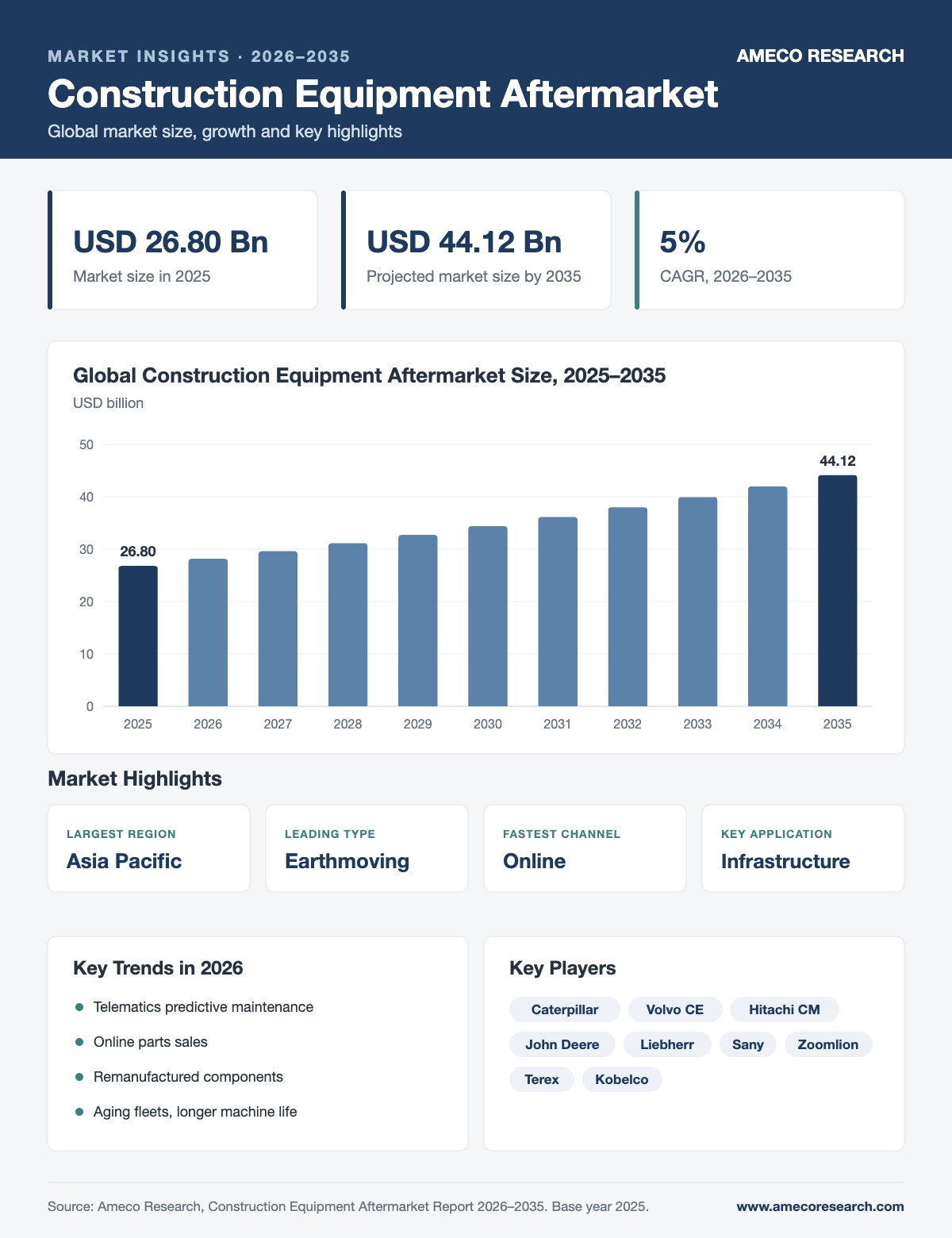 Infographic: Construction Equipment Aftermarket Size and Growth Opportunities and Forecast till 2026 - 2035 | Ameco Research
Construction Equipment Aftermarket Report Scope
| Report Attribute | Details |
| Construction Equipment Aftermarket Size in 2025 | USD 26.80 Billion |
| Construction Equipment Aftermarket Forecast by 2035 | USD 44.12 Billion |
| Construction Equipment Aftermarket CAGR (2026–2035) | 5% |
| Analysis Period | 2023–2035 |
| Base Year | 2025 |
| Forecast Period | 2026–2035 |
| Segments Covered | by Equipment Type, by Sales Channel, by Application, and By Region |
| Regional Scope | North America, Europe, Asia Pacific, Latin America, and Middle East & Africa |
| Key Companies Profiled | Caterpillar, Kobelco Construction Machinery, Hitachi Construction Machinery, John Deere, Palfinger, Tadano, Liebherr Group, Terex, Sany Global, Volvo Construction Equipment, The Manitowoc Company, and Zoomlion Heavy Industry |
| Report Coverage | Market Trends, Drivers, Restraints, Opportunities, Competitive Analysis, Player Profiling, Regulation Analysis |
Construction Equipment Aftermarket Size Forecast, 2023–2035
The table below shows the year-by-year size of the global construction equipment aftermarket. Revenue is expected to grow about 1.6 times between 2025 and 2035, reaching roughly USD 34.39 billion by 2030.
| Year | Market Size (USD Billion) |
| 2023 (historical) | 24.26 |
| 2024 (historical) | 25.50 |
| 2025 (base year) | 26.80 |
| 2026 (forecast) | 28.17 |
| 2027 (forecast) | 29.61 |
| 2028 (forecast) | 31.12 |
| 2029 (forecast) | 32.71 |
| 2030 (forecast) | 34.39 |
| 2031 (forecast) | 36.14 |
| 2032 (forecast) | 37.99 |
| 2033 (forecast) | 39.93 |
| 2034 (forecast) | 41.97 |
| 2035 (forecast) | 44.12 |
Latest Construction Equipment Aftermarket Trends (2026)
Telematics and predictive maintenance
Connected machines send engine, hydraulic and usage data to dealers and owners, enabling predictive maintenance that schedules parts and service before breakdowns.
Online parts sales
OEMs and distributors are expanding e-commerce portals and apps for parts ordering, availability checks and fast delivery, making online the fastest-growing channel.
Remanufacturing and circularity
Remanufactured engines, transmissions and hydraulic components cost less than new parts and cut waste, and major OEMs are expanding reman programs.
Longer machine life and aging fleets
High prices of new equipment and strong utilization are leading owners to keep machines longer, increasing demand for repair, overhaul and replacement parts.
Infrastructure spending
Government infrastructure programs in the United States, India, the Middle East and other regions keep equipment busy, supporting wear parts and service demand.
Service for electric and hybrid machines
The arrival of electric and hybrid construction equipment creates new aftermarket needs for batteries, power electronics and specialized service skills.
Construction Equipment Aftermarket Dynamics
Growth drivers
- Large and aging installed base of construction machines
- Infrastructure and construction activity
- Longer equipment life cycles
- Telematics and digital service tools
- Rental fleet growth
Restraints and challenges
- Competition from low-cost and counterfeit parts
- Cyclical construction activity
- Supply chain delays for components
- Skilled technician shortages
Opportunities
Key opportunities include predictive maintenance services, e-commerce parts platforms, remanufacturing, service contracts for rental fleets, aftermarket for electric equipment and fast-growing fleets in India, Southeast Asia, the Middle East and Africa.
Construction Equipment Aftermarket Segment Analysis
By equipment type
The market is segmented into earthmoving and road building equipment, material handling and cranes, and concrete equipment. Earthmoving and road building equipment held the largest share thanks to large fleets of excavators, loaders and dozers.
By sales channel
Sales channels include online and offline. Offline dealer and distributor sales dominate, while online sales are expected to grow at the fastest CAGR.
By application
Applications include residential, commercial and infrastructure. Infrastructure is a major source of demand, and the residential segment is likely to achieve substantial growth with urbanization.
Construction Equipment Aftermarket Regional Analysis
The Asia-Pacific region held the biggest market share, driven by large equipment fleets and infrastructure projects such as airports, dams and hydropower in China, India and Southeast Asia.
The Middle East & Africa is expected to be the next developing market, supported by infrastructure investment. North America is expected to grow steadily with infrastructure spending and rental fleets.
Europe is a mature market focused on service, remanufacturing and emission upgrades, and Latin America is growing with mining and infrastructure.
Construction Equipment Aftermarket Segmentation
Construction Equipment Aftermarket Leading Companies
The construction equipment aftermarket includes OEMs and their dealer networks, independent parts manufacturers and distributors, remanufacturers and service providers. Companies compete on parts availability, delivery speed, price, quality, digital tools and service coverage. Key players profiled in this report include Caterpillar, Kobelco Construction Machinery, Hitachi Construction Machinery, John Deere, Palfinger, Tadano, Liebherr Group, Terex, Sany Global, Volvo Construction Equipment, The Manitowoc Company, and Zoomlion Heavy Industry.
CaterpillarKobelco Construction MachineryHitachi Construction MachineryJohn DeerePalfingerTadanoLiebherr GroupTerexSany GlobalVolvo Construction EquipmentThe Manitowoc CompanyZoomlion Heavy Industry
Key Questions Answered in This Report
- What is the size of the construction equipment aftermarket in 2025, and how large will it be by 2030 and 2035?
- What are the main growth drivers, restraints and opportunities through 2035?
- Which by equipment type and by sales channel segments will grow the fastest?
- Which regions and countries offer the largest and fastest-growing opportunities?
- How are telematics, online parts sales and remanufacturing shaping the construction equipment aftermarket in 2026?
- Who are the leading companies, and what strategies are they using to compete?
Research Methodology
Our estimates draw on interviews with equipment manufacturers, dealers, parts distributors, rental companies and contractors, supported by secondary data from annual reports, investor materials, trade and customs data, standards bodies and industry journals. Bottom-up estimates of company revenues and top-down estimates of application demand are reconciled through data triangulation, and the model is updated with 2026 developments to forecast the market through 2035.
Related Reports
- IoT in Construction Market Report
- Electric Excavator Market Report
- Global Aerospace and Defense C-class Parts Market Size - Global Industry Analysis, Market Size, Oppo... Report
- Passenger Car Accessories Aftermarket Report
- Packaging Machinery Market Report
Construction Equipment Aftermarket: Frequently Asked Questions
How big is the construction equipment aftermarket?
The global construction equipment aftermarket was valued at USD 26.80 billion in 2025 and is expected to reach USD 44.12 billion by 2035.
What is the growth rate of the construction equipment aftermarket?
The construction equipment aftermarket is projected to grow at a CAGR of 5% from 2026 to 2035.
What will the construction equipment aftermarket be worth in 2030?
The construction equipment aftermarket is projected to reach about USD 34.39 billion in 2030, growing at a CAGR of 5%.
What is driving growth in the construction equipment aftermarket?
Key drivers are a large and aging machine fleet, infrastructure activity, longer equipment life, telematics and digital service tools, and rental fleet growth.
What is the construction equipment aftermarket?
The construction equipment aftermarket is the market for replacement parts, repairs, maintenance, remanufacturing and upgrades for construction machinery after it is sold.
Which region leads the construction equipment aftermarket?
Asia-Pacific holds the biggest share, with the Middle East and Africa expected to be the next developing market.
Which segment holds the largest share of the construction equipment aftermarket?
Earthmoving and road building equipment holds the largest share, and online sales are expected to grow fastest.
What are the latest trends in the construction equipment aftermarket?
The main 2026 trends are telematics and predictive maintenance, online parts sales, remanufacturing and circularity, longer machine life and aging fleets, infrastructure spending and service for electric and hybrid machines.
What are the main challenges in the construction equipment aftermarket?
The main challenges are low-cost and counterfeit parts, cyclical construction, component supply delays and technician shortages.
What are the most commonly replaced construction equipment parts?
Common replacement parts include filters, undercarriage parts such as tracks and rollers, bucket teeth and cutting edges, hydraulic hoses and pumps, tires and engine components.
Who are the key players in the construction equipment aftermarket?
Leading companies include Caterpillar, Kobelco Construction Machinery, Hitachi Construction Machinery, John Deere, Palfinger, Tadano, Liebherr Group, Terex, Sany Global, Volvo Construction Equipment, The Manitowoc Company, and Zoomlion Heavy Industry.