Gene Amplification Technologies Market Size and Growth Opportunities and Forecast till 2026 - 2035
Gene Amplification Technologies Market Size, Share & Trends Report, 2026–2035
LAST UPDATED: OCTOBER 2026
The global Gene Amplification Technologies Market size was valued at USD 39.86 billion in 2025 and is projected to reach USD 90.75 billion by 2035, growing at a CAGR of 8.5% from 2026 to 2035. Growth is driven by molecular diagnostics and point-of-care PCR testing, next-generation sequencing and single-cell genomics, oncology and liquid biopsy, infectious disease surveillance, and isothermal amplification for rapid, low-cost tests.
Gene amplification technologies make many copies of specific DNA or RNA sequences so they can be detected, measured or sequenced. The main technique is the polymerase chain reaction (PCR), including real-time qPCR and digital PCR, along with isothermal methods such as loop-mediated isothermal amplification (LAMP), nucleic acid sequence-based amplification (NASBA), strand displacement amplification, rolling circle amplification and multiple displacement amplification for whole genome amplification. The market covers instruments, kits and reagents, and services used on samples such as FFPE tissue and single cells for exome sequencing, SNP genotyping, array CGH and hybridization.
Gene Amplification Technologies Market Key Takeaways
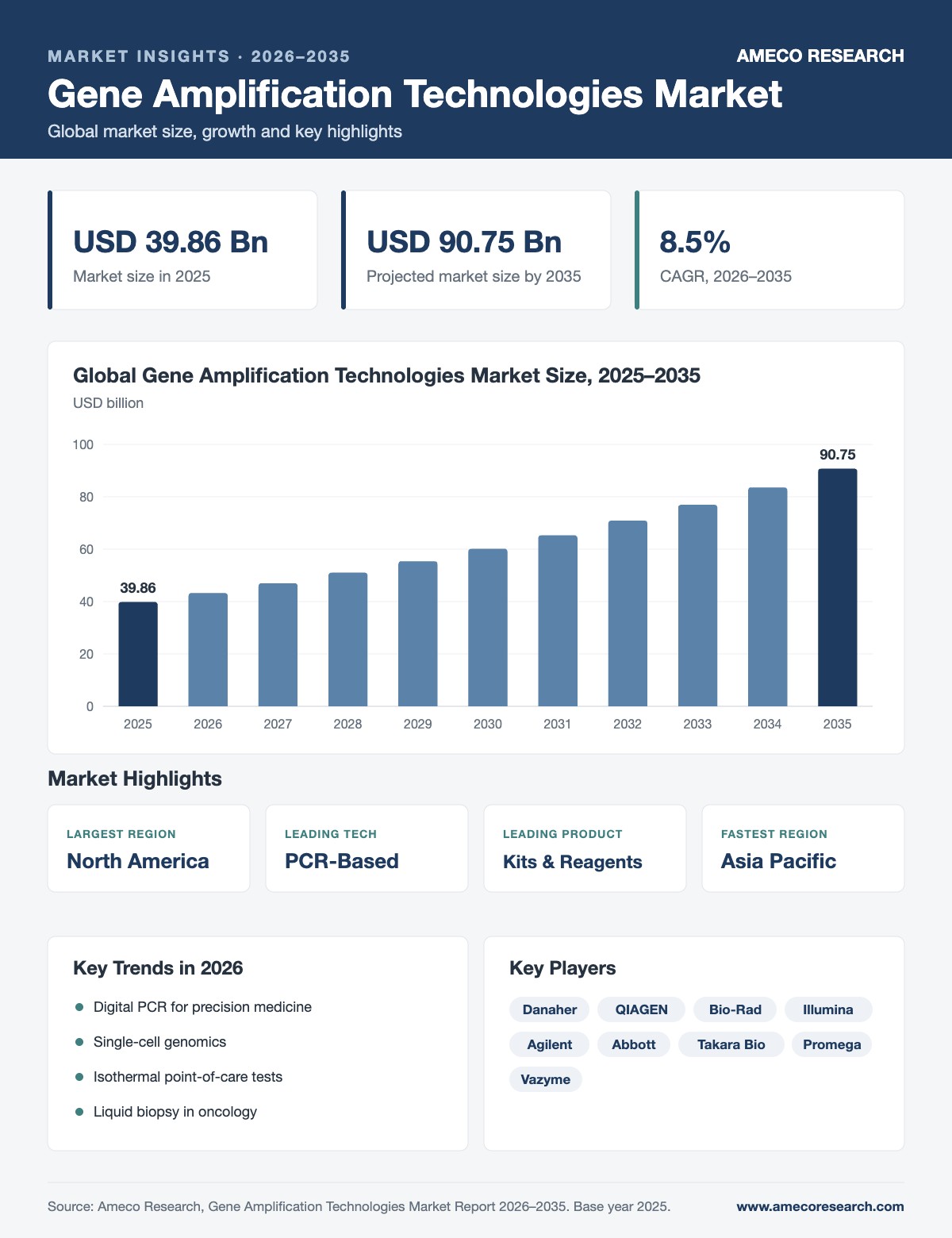 Infographic: Gene Amplification Technologies Market Size and Growth Opportunities and Forecast till 2026 - 2035 | Ameco Research
Gene Amplification Technologies Market Report Scope
| Report Attribute | Details |
| Gene Amplification Technologies Market Size in 2025 | USD 39.86 Billion |
| Gene Amplification Technologies Market Forecast by 2035 | USD 90.75 Billion |
| Gene Amplification Technologies Market CAGR (2026–2035) | 8.5% |
| Analysis Period | 2023–2035 |
| Base Year | 2025 |
| Forecast Period | 2026–2035 |
| Segments Covered | by Product, by Sample Type, by Technology, by Application, by End-Use, and By Region |
| Regional Scope | North America, Europe, Asia Pacific, Latin America, and Middle East & Africa |
| Key Companies Profiled | Abbott Laboratories, Ambion, Inc., Agilent Technologies, Inc., Bio-Rad Laboratories, Danaher Corporation, Illumina Inc., QIAGEN N.V., Merck KGaA, Promega Corporation, Silicon Biosystems, Vazyme Biotech Co. Ltd., and Takara Bio, Inc. |
| Report Coverage | Market Trends, Drivers, Restraints, Opportunities, Competitive Analysis, Player Profiling, Regulation Analysis |
Gene Amplification Technologies Market Size Forecast, 2023–2035
The table below shows the year-by-year size of the global gene amplification technologies market. Revenue is expected to grow about 2.3 times between 2025 and 2035, reaching roughly USD 60.14 billion by 2030.
| Year | Market Size (USD Billion) |
| 2023 (historical) | 33.81 |
| 2024 (historical) | 36.71 |
| 2025 (base year) | 39.86 |
| 2026 (forecast) | 43.28 |
| 2027 (forecast) | 46.99 |
| 2028 (forecast) | 51.02 |
| 2029 (forecast) | 55.39 |
| 2030 (forecast) | 60.14 |
| 2031 (forecast) | 65.30 |
| 2032 (forecast) | 70.90 |
| 2033 (forecast) | 76.98 |
| 2034 (forecast) | 83.58 |
| 2035 (forecast) | 90.75 |
Latest Gene Amplification Technologies Market Trends (2026)
Digital PCR for precision medicine
Digital PCR offers absolute quantification and high sensitivity, making it valuable for liquid biopsy, minimal residual disease monitoring and gene therapy quality control.
Single-cell and low-input genomics
Whole genome and transcriptome amplification methods enable sequencing from single cells and tiny samples, supporting cancer, immunology and developmental biology research.
Isothermal and point-of-care testing
LAMP and other isothermal methods amplify DNA at a single temperature, enabling rapid tests in clinics, pharmacies and homes without complex thermal cyclers.
Oncology and liquid biopsy
Amplification of tumor DNA from blood samples supports cancer screening, therapy selection and monitoring, a major growth area.
Infectious disease surveillance
After COVID-19, public health labs maintain molecular surveillance for respiratory viruses, antimicrobial resistance and outbreaks, sustaining PCR demand.
Automation and sample-to-answer systems
Fully automated systems that combine extraction, amplification and detection reduce hands-on time and errors in clinical labs.
Gene Amplification Technologies Market Dynamics
Growth drivers
- Growth of molecular diagnostics and genetic testing
- Expansion of next-generation sequencing
- Cancer and infectious disease testing
- Research funding in genomics and life sciences
- Government genome programs
Restraints and challenges
- High cost of advanced instruments
- Amplification bias and contamination risks
- Reimbursement and regulatory hurdles for new tests
- Lower testing volumes after the pandemic peak
Opportunities
Key opportunities include digital PCR for oncology and gene therapy, isothermal tests for point-of-care and home use, single-cell and spatial genomics, automation for clinical labs and genomic programs in Asia Pacific and the Middle East.
Gene Amplification Technologies Market Segment Analysis
By product
The market is segmented into instruments, kits and reagents, and services. Kits and reagents hold the largest share because they are consumed in every test.
By sample type
Sample types include FFPE, single cell and others. FFPE tissue is important in oncology, while single-cell samples are growing fastest in research.
By technology
Technologies include PCR-based amplification, multiple displacement amplification, NASBA, strand displacement amplification, LAMP, rolling circle amplification, ramification amplification and others. PCR-based amplification is the most widely used technology.
By application and end use
Applications include exome sequencing, whole genome amplification, SNP genotyping arrays, array CGH, hybridization and others. End users include academic and research institutes, pharmaceutical and biotechnology companies and others.
Gene Amplification Technologies Market Regional Analysis
North America gathered the maximum share, supported by numerous healthcare facilities, growth in genetic testing and large research programs.
The Asia-Pacific region is likely to exhibit the fastest growth rate, driven by disease prevalence, government genomic initiatives and expanding lab facilities in China, Japan, India and South Korea. Europe is a major market with strong research and diagnostics demand.
Latin America and the Middle East & Africa are growing markets, with national genome programs in the Gulf region.
Gene Amplification Technologies Market Segmentation
Gene Amplification Technologies Market Leading Companies
The gene amplification technologies market includes life science tools companies, molecular diagnostics firms, sequencing companies and reagent specialists. Companies compete on assay sensitivity and speed, instrument installed base, menu breadth, automation and price. Key players profiled in this report include Abbott Laboratories, Ambion, Inc., Agilent Technologies, Inc., Bio-Rad Laboratories, Danaher Corporation, Illumina Inc., QIAGEN N.V., Merck KGaA, Promega Corporation, Silicon Biosystems, Vazyme Biotech Co. Ltd., and Takara Bio, Inc..
Abbott LaboratoriesAmbion, Inc.Agilent Technologies, Inc.Bio-Rad LaboratoriesDanaher CorporationIllumina Inc.QIAGEN N.V.Merck KGaAPromega CorporationSilicon BiosystemsVazyme Biotech Co. Ltd.Takara Bio, Inc.
Key Questions Answered in This Report
- What is the size of the gene amplification technologies market in 2025, and how large will it be by 2030 and 2035?
- What are the main growth drivers, restraints and opportunities through 2035?
- Which by product and by sample type segments will grow the fastest?
- Which regions and countries offer the largest and fastest-growing opportunities?
- How are digital PCR, single-cell genomics and point-of-care testing shaping gene amplification in 2026?
- Who are the leading companies, and what strategies are they using to compete?
Research Methodology
This report combines primary and secondary research. Primary research includes interviews with life science tools companies, diagnostic laboratories, research institutes, pharmaceutical companies and distributors. Secondary research covers company annual reports, investor presentations, government and trade association data, patent filings and industry publications. Market size is estimated using both bottom-up (company revenue and production data) and top-down (end-use demand) methods, and results are cross-checked through data triangulation before forecasts are built for 2026–2035.
Related Reports
- Cell Therapy Technologies Market Report
- Sepsis Diagnostics Market Report
- Sleep Apnea Diagnostics Market Report
- Biomarker Technologies Market Report
- Transplant Diagnostics Market Report
Gene Amplification Technologies Market: Frequently Asked Questions
How big is the gene amplification technologies market?
The global gene amplification technologies market was valued at USD 39.86 billion in 2025 and is expected to reach USD 90.75 billion by 2035.
What is the growth rate of the gene amplification technologies market?
The gene amplification technologies market is projected to grow at a CAGR of 8.5% from 2026 to 2035.
What will the gene amplification technologies market be worth in 2030?
The gene amplification technologies market is projected to reach about USD 60.14 billion in 2030, growing at a CAGR of 8.5%.
What is driving growth in the gene amplification technologies market?
Key drivers are growth in molecular diagnostics and genetic testing, sequencing expansion, cancer and infectious disease testing, genomics research funding and government genome programs.
What is gene amplification?
Gene amplification is a laboratory process, such as PCR or LAMP, that makes many copies of a specific DNA or RNA sequence so it can be detected, measured or sequenced.
Which region leads the gene amplification technologies market?
North America holds the largest share, while Asia-Pacific is likely to grow fastest.
Which segment holds the largest share of the gene amplification technologies market?
Kits and reagents are the leading product category, and PCR-based amplification is the most widely used technology.
What are the latest trends in the gene amplification technologies market?
The main 2026 trends are digital PCR for precision medicine, single-cell and low-input genomics, isothermal and point-of-care testing, oncology and liquid biopsy, infectious disease surveillance and automation and sample-to-answer systems.
What are the main challenges in the gene amplification technologies market?
The main challenges are high instrument costs, amplification bias and contamination risks, reimbursement hurdles and lower post-pandemic testing volumes.
What is the difference between PCR and LAMP?
PCR copies DNA by cycling through different temperatures and needs a thermal cycler, while LAMP works at one constant temperature, making it faster and simpler for point-of-care tests.
Who are the key players in the gene amplification technologies market?
Leading companies include Abbott Laboratories, Ambion, Inc., Agilent Technologies, Inc., Bio-Rad Laboratories, Danaher Corporation, Illumina Inc., QIAGEN N.V., Merck KGaA, Promega Corporation, Silicon Biosystems, Vazyme Biotech Co. Ltd., and Takara Bio, Inc..
Related Healthcare Market Reports
- Healthcare Laboratory Information Market Size and Growth Opportunities and Forecast till 2026 - 2035
- Diabetes Associated Ophthalmic Treatment Market Size and Growth Opportunities and Forecast till 2026 - 2035
- Operating Room Integration Market Size and Growth Opportunities and Forecast till 2026 - 2035
- Micropump Market Size and Growth Opportunities and Forecast till 2026 - 2035
- Veterinary Dermatology Drugs Market Size and Growth Opportunities and Forecast till 2026 - 2035