Biodiesel Fuel Market Size and Growth Opportunities and Forecast till 2026 - 2035
Biodiesel Fuel Market Size, Share & Trends Report, 2026–2035
LAST UPDATED: OCTOBER 2026
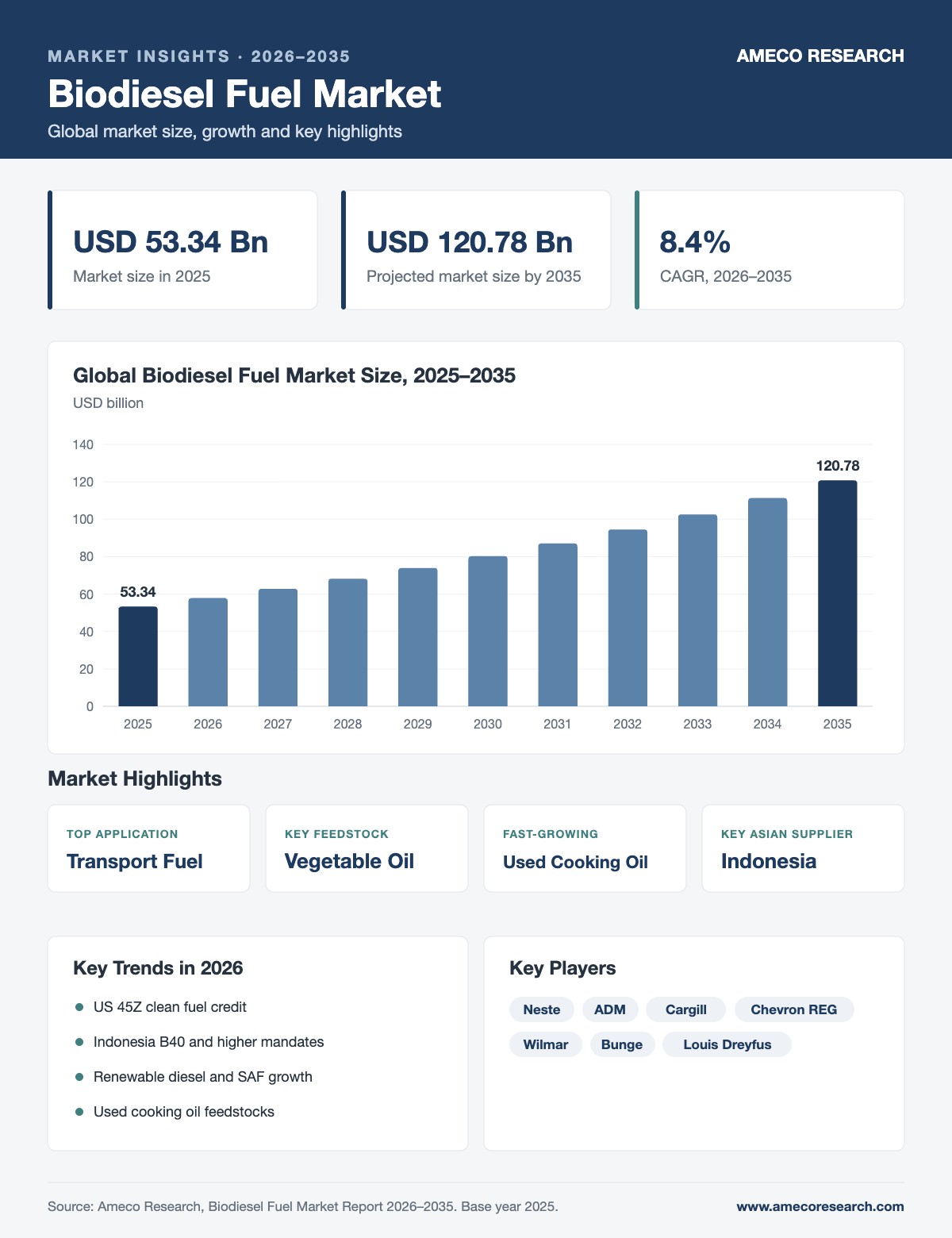
The global Biodiesel Fuel Market size was valued at USD 53.34 billion in 2025 and is projected to reach USD 120.78 billion by 2035, growing at a CAGR of 8.4% from 2026 to 2035. Growth is driven by blending mandates and low-carbon fuel policies, decarbonization of trucking, shipping and off-road equipment, growth of renewable diesel and sustainable aviation fuel from shared feedstocks, and use of waste oils such as used cooking oil.
Biodiesel fuel is a renewable diesel substitute made from vegetable oils, animal fats and used cooking oil. Conventional biodiesel (FAME) is produced by alcohol transesterification, while hydrotreated vegetable oil (HVO), also called renewable diesel, is produced by hydroprocessing and is chemically similar to fossil diesel. Biodiesel is blended with diesel (for example B5, B20 and higher) or used neat in trucks, buses, ships, farm and construction equipment, generators and heating, cutting lifecycle greenhouse gas emissions.
Biodiesel Fuel Market Key Takeaways
Biodiesel Fuel Market Report Scope
| Report Attribute | Details |
| Biodiesel Fuel Market Size in 2025 | USD 53.34 Billion |
| Biodiesel Fuel Market Forecast by 2035 | USD 120.78 Billion |
| Biodiesel Fuel Market CAGR (2026–2035) | 8.4% |
| Analysis Period | 2023–2035 |
| Base Year | 2025 |
| Forecast Period | 2026–2035 |
| Segments Covered | by Process, by Feedstock Type, by Application, and By Region |
| Regional Scope | North America, Europe, Asia Pacific, Latin America, and Middle East & Africa |
| Key Companies Profiled | Archer Daniels Midland Company, Neste Corporation, Cargill, Incorporated, Renewable Energy Group, Inc. (Chevron), Louis Dreyfus Company, Wilmar International Limited, TerraVia Holdings, Inc., REG Life Sciences, LLC, Bunge Limited, and Delta American Fuel, LLC |
| Report Coverage | Market Trends, Drivers, Restraints, Opportunities, Competitive Analysis, Player Profiling, Regulation Analysis |
Biodiesel Fuel Market Size Forecast, 2023–2035
The table below shows the year-by-year size of the global biodiesel fuel market. Revenue is expected to grow about 2.3 times between 2025 and 2035, reaching roughly USD 80.26 billion by 2030.
| Year | Market Size (USD Billion) |
| 2023 (historical) | 45.30 |
| 2024 (historical) | 49.15 |
| 2025 (base year) | 53.34 |
| 2026 (forecast) | 57.88 |
| 2027 (forecast) | 62.81 |
| 2028 (forecast) | 68.16 |
| 2029 (forecast) | 73.97 |
| 2030 (forecast) | 80.26 |
| 2031 (forecast) | 87.10 |
| 2032 (forecast) | 94.52 |
| 2033 (forecast) | 102.57 |
| 2034 (forecast) | 111.30 |
| 2035 (forecast) | 120.78 |
Latest Biodiesel Fuel Market Trends (2026)
New US clean fuel credit
Since January 2025 the US clean fuel production credit (45Z) has replaced the earlier blenders credit, rewarding fuels by their carbon intensity. This favors low-carbon feedstocks and domestic production.
Higher blending mandates in Asia and Latin America
Indonesia moved to a 40% biodiesel blend (B40) in 2025, and countries such as Brazil are raising blend levels, creating large and growing demand for palm and soybean-based biodiesel.
Renewable diesel and SAF growth
Hydrotreated renewable diesel and sustainable aviation fuel plants are expanding quickly and compete with biodiesel for vegetable oils, fats and used cooking oil.
Waste and residue feedstocks
EU and US rules give extra credit to waste-based fuels, increasing demand for used cooking oil, animal fats and other residues, along with tighter fraud and traceability checks.
Decarbonizing heavy transport and shipping
Fleets, ports and shipping companies are using higher biodiesel blends and renewable diesel as drop-in options to cut emissions without new engines.
Industry consolidation
Energy majors have moved into biofuels, such as Chevron's acquisition of Renewable Energy Group, while agribusiness groups expand crushing and biodiesel capacity.
Biodiesel Fuel Market Dynamics
Growth drivers
- Government blending mandates and low-carbon fuel standards
- Decarbonization targets for transport and shipping
- Energy security and agricultural support policies
- Availability of waste oils and fats
- Compatibility with existing diesel engines and infrastructure
Restraints and challenges
- Feedstock price volatility and competition with food and SAF
- Policy and tax credit uncertainty
- Cold-weather performance limits of FAME
- Sustainability concerns about palm and land use
Opportunities
Key opportunities include waste-based and low-carbon-intensity biodiesel, higher blends in marine and off-road fuels, co-processing with renewable diesel and SAF, new crops such as camelina and carinata, and rising mandates in Southeast Asia and Latin America.
Biodiesel Fuel Market Segment Analysis
By process
The market is segmented into alcohol transesterification and hydro-heating (hydrotreating). Transesterification to FAME biodiesel remains the most widely used process, while hydrotreating to renewable diesel is the fastest growing.
By feedstock type
Feedstocks include vegetable oil, animal oil and used cooking oil. Vegetable oils such as soybean, rapeseed and palm oil are the largest feedstocks, while used cooking oil is growing fastest because of extra policy credits.
By application
Applications include fuel, power generation and agriculture. Fuel for road transport is the largest application.
Biodiesel Fuel Market Regional Analysis
In Europe, Germany and France are at the forefront of biodiesel adoption, supported by EU renewable energy targets for transport.
In Asia Pacific, Indonesia and Malaysia are important suppliers based on their palm oil resources, and Indonesia has one of the world's highest blending mandates. In North America, the United States has seen substantial development driven by subsidies and mandates.
Latin America, led by Brazil and Argentina, is a major producer, and the Middle East & Africa is an emerging market.
Biodiesel Fuel Market Segmentation
Biodiesel Fuel Market Leading Companies
The biodiesel fuel market includes agribusiness and oilseed processors, dedicated biofuel producers, energy companies and regional plants. Companies compete on feedstock access and cost, carbon intensity, plant scale, logistics and ability to capture policy credits. Key players profiled in this report include Archer Daniels Midland Company, Neste Corporation, Cargill, Incorporated, Renewable Energy Group, Inc. (Chevron), Louis Dreyfus Company, Wilmar International Limited, TerraVia Holdings, Inc., REG Life Sciences, LLC, Bunge Limited, and Delta American Fuel, LLC.
Archer Daniels Midland CompanyNeste CorporationCargill, IncorporatedRenewable Energy Group, Inc. (Chevron)Louis Dreyfus CompanyWilmar International LimitedTerraVia Holdings, Inc.REG Life Sciences, LLCBunge LimitedDelta American Fuel, LLC
Recent developments
Key Questions Answered in This Report
- What is the size of the biodiesel fuel market in 2025, and how large will it be by 2030 and 2035?
- What are the main growth drivers, restraints and opportunities through 2035?
- Which by process and by feedstock type segments will grow the fastest?
- Which regions and countries offer the largest and fastest-growing opportunities?
- How are the US 45Z credit, Asian blending mandates and renewable diesel growth shaping demand in 2026?
- Who are the leading companies, and what strategies are they using to compete?
Research Methodology
Ameco Research built this forecast from a mix of primary and secondary research. Analysts spoke with biodiesel producers, oilseed processors, fuel distributors, policy agencies and fleet operators to validate pricing, volumes and demand trends, and reviewed company filings, trade statistics, regulatory documents and industry publications. The biodiesel fuel market size was estimated with bottom-up and top-down approaches and validated through data triangulation, with 2025 as the base year and forecasts for 2026–2035.
Related Reports
- Renewable Energy Certificate Market Report
- Plastic to Fuel Market Report
- Hydrogen Energy Storage Market Report
- Energy Storage as a Service Market Report
- Offshore Wind Energy Market Report
Biodiesel Fuel Market: Frequently Asked Questions
How big is the biodiesel fuel market?
The global biodiesel fuel market was valued at USD 53.34 billion in 2025 and is expected to reach USD 120.78 billion by 2035.
What is the growth rate of the biodiesel fuel market?
The biodiesel fuel market is projected to grow at a CAGR of 8.4% from 2026 to 2035.
What will the biodiesel fuel market be worth in 2030?
The biodiesel fuel market is projected to reach about USD 80.26 billion in 2030, growing at a CAGR of 8.4%.
What is driving growth in the biodiesel fuel market?
Key drivers are blending mandates and low-carbon fuel policies, transport decarbonization, energy security and the availability of waste oils and fats.
What is biodiesel fuel?
Biodiesel is a renewable diesel fuel made from vegetable oils, animal fats or used cooking oil, used alone or blended with petroleum diesel.
Which region leads the biodiesel fuel market?
Europe, led by Germany and France, Indonesia and Malaysia in Asia, the United States and Brazil are among the most important biodiesel markets.
Which segment holds the largest share of the biodiesel fuel market?
Vegetable oil is the largest feedstock, transesterification is the most common process and transport fuel is the largest application.
What are the latest trends in the biodiesel fuel market?
The main 2026 trends are new US clean fuel credit, higher blending mandates in Asia and Latin America, renewable diesel and SAF growth, waste and residue feedstocks, decarbonizing heavy transport and shipping and industry consolidation.
What are the main challenges in the biodiesel fuel market?
The main challenges are feedstock price volatility, policy uncertainty, cold-weather limits and sustainability concerns.
What is the difference between biodiesel and renewable diesel?
Biodiesel (FAME) is made by transesterification and is usually blended with diesel, while renewable diesel (HVO) is made by hydrotreating, is chemically similar to fossil diesel and can be used at much higher blends.
Who are the key players in the biodiesel fuel market?
Leading companies include Archer Daniels Midland Company, Neste Corporation, Cargill, Incorporated, Renewable Energy Group, Inc. (Chevron), Louis Dreyfus Company, Wilmar International Limited, TerraVia Holdings, Inc., REG Life Sciences, LLC, Bunge Limited, and Delta American Fuel, LLC.
Related Chemical & Material Market Reports
- Insulating Varnish Market Size and Growth Opportunities and Forecast till 2026 - 2035
- Thick Film Materials Market Size and Growth Opportunities and Forecast till 2026 - 2035
- Color Pigments Market Size and Growth Opportunities and Forecast till 2026 - 2035
- Cinnamon Bark Oil Market Size and Growth Opportunities and Forecast till 2026 - 2035
- Dyclonine Hydrochloride Market Size and Growth Opportunities and Forecast till 2026 - 2035