Organic Antiblock Masterbatch Market Size and Growth Opportunities and Forecast till 2026 - 2035
Organic Antiblock Masterbatch Market Size, Share & Trends Report, 2026–2035
LAST UPDATED: OCTOBER 2026
The global Organic Antiblock Masterbatch Market size was valued at USD 1.37 billion in 2025 and is projected to reach USD 2.75 billion by 2035, growing at a CAGR of 7.1% from 2026 to 2035. Growth is driven by flexible packaging films for food and consumer goods, the shift to recyclable mono-material polyethylene and polypropylene films, higher film line speeds, and demand for additives that keep film optics clear.
Organic antiblock masterbatch is a concentrate of organic antiblocking additives, such as fatty acid amides (for example erucamide, stearamide and bis-amides) and polymeric antiblock agents, dispersed in a carrier resin. Added to plastic films during extrusion, it stops film layers from sticking together (blocking), makes bags easier to open and improves handling on packaging lines, often while keeping films clearer than inorganic antiblocks such as silica or talc. It is used with PE, PP, PA, PS and PET films in packaging and other plastic film applications.
Organic Antiblock Masterbatch Market Key Takeaways
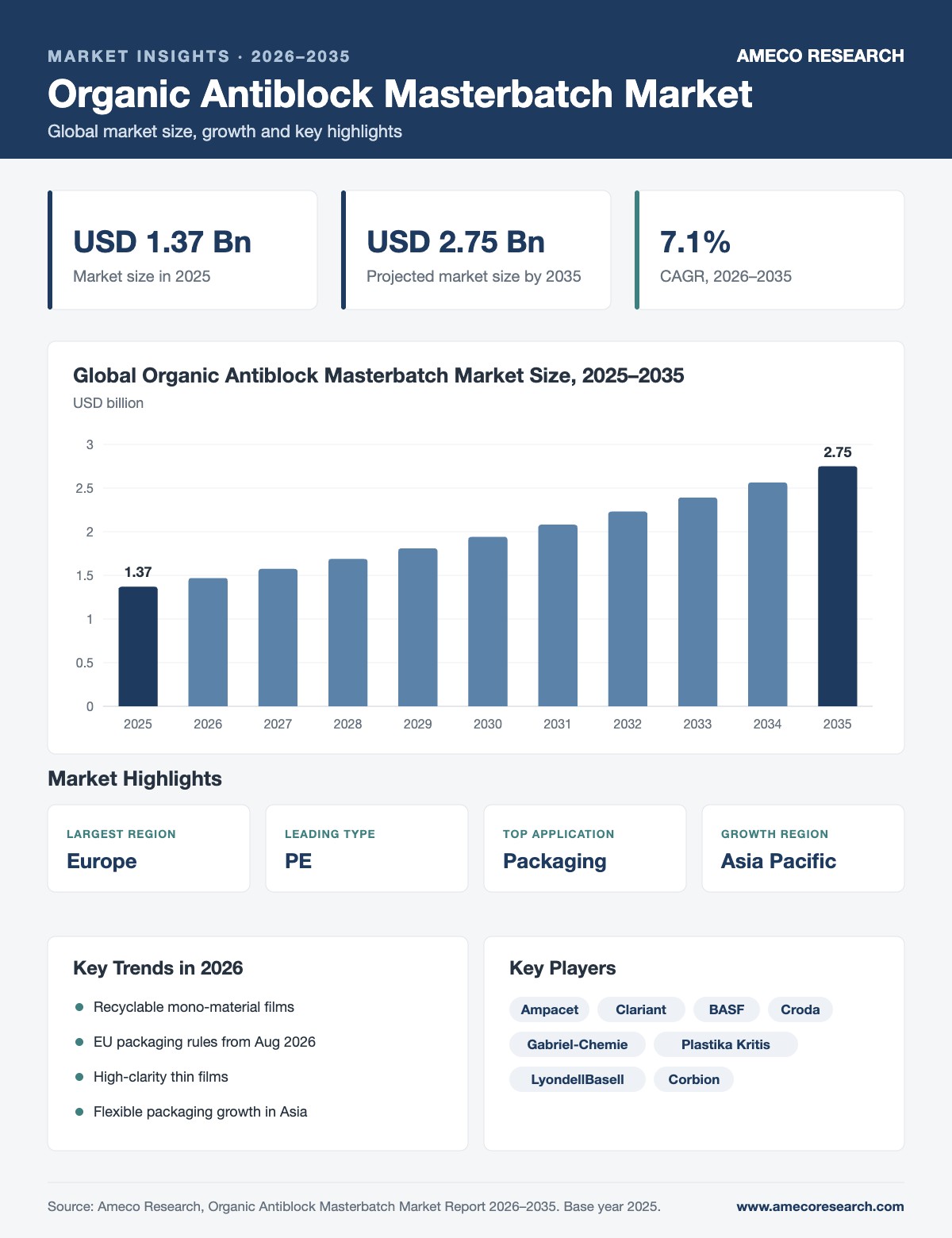 Infographic: Organic Antiblock Masterbatch Market Size and Growth Opportunities and Forecast till 2026 - 2035 | Ameco Research
Organic Antiblock Masterbatch Market Report Scope
| Report Attribute | Details |
| Organic Antiblock Masterbatch Market Size in 2025 | USD 1.37 Billion |
| Organic Antiblock Masterbatch Market Forecast by 2035 | USD 2.75 Billion |
| Organic Antiblock Masterbatch Market CAGR (2026–2035) | 7.1% |
| Analysis Period | 2023–2035 |
| Base Year | 2025 |
| Forecast Period | 2026–2035 |
| Segments Covered | by Type, by Application, and By Region |
| Regional Scope | North America, Europe, Asia Pacific, Latin America, and Middle East & Africa |
| Key Companies Profiled | Ampacet Corporation, BioCeed LLC, BASF SE, PlastikaKritis S.A., A. Schulman, Inc. (LyondellBasell), Cereplast, Inc., Corbion N.V., Clariant International AG, Gabriel-Chemie Group, and Croda International plc |
| Report Coverage | Market Trends, Drivers, Restraints, Opportunities, Competitive Analysis, Player Profiling, Regulation Analysis |
Organic Antiblock Masterbatch Market Size Forecast, 2023–2035
The table below shows the year-by-year size of the global organic antiblock masterbatch market. Revenue is expected to grow about 2.0 times between 2025 and 2035, reaching roughly USD 1.94 billion by 2030.
| Year | Market Size (USD Billion) |
| 2023 (historical) | 1.19 |
| 2024 (historical) | 1.28 |
| 2025 (base year) | 1.37 |
| 2026 (forecast) | 1.47 |
| 2027 (forecast) | 1.57 |
| 2028 (forecast) | 1.69 |
| 2029 (forecast) | 1.81 |
| 2030 (forecast) | 1.94 |
| 2031 (forecast) | 2.08 |
| 2032 (forecast) | 2.23 |
| 2033 (forecast) | 2.39 |
| 2034 (forecast) | 2.56 |
| 2035 (forecast) | 2.75 |
Latest Organic Antiblock Masterbatch Market Trends (2026)
Recyclable mono-material films
Brands are replacing mixed-material laminates with all-PE and all-PP films that can be recycled. These films need carefully balanced slip and antiblock additives to run well on packaging machines.
EU packaging rules
The EU Packaging and Packaging Waste Regulation, applying from August 2026, sets recyclability requirements that favor mono-material films and compliant additive packages.
High-clarity and thin films
Downgauged, high-clarity films for food and retail packaging favor organic antiblocks that cause less haze than mineral antiblocks.
Faster film and packaging lines
Higher extrusion and form-fill-seal speeds require consistent antiblock and slip performance to prevent sticking and roll defects.
Food contact and safety compliance
Converters demand additives with clear food contact approvals in the EU, US and Asia, and with low migration into packaged food.
Growth of flexible packaging in Asia
Rising packaged food, e-commerce and personal care demand in Asia is expanding film capacity and masterbatch use.
Organic Antiblock Masterbatch Market Dynamics
Growth drivers
- Growth of flexible plastic packaging
- Shift to recyclable mono-material films
- Higher-speed film and packaging lines
- Demand for clear, high-quality films
- Expanding packaging production in Asia
Restraints and challenges
- Regulatory pressure on plastic packaging
- Volatile prices of polymers and fatty acid feedstocks
- Competition from inorganic antiblock additives
- Additive migration and printing or sealing issues if poorly balanced
Opportunities
Key opportunities include additive packages for recyclable PE and PP films, high-clarity antiblocks for food packaging, masterbatches for bio-based and compostable films, and fast-growing film markets in India and Southeast Asia.
Organic Antiblock Masterbatch Market Segment Analysis
By type
The market is segmented by carrier polymer into PA, PP, PE, PS and PET. PE masterbatches hold the largest share because polyethylene is the most widely used film polymer, while PP and PET serve BOPP and polyester films.
By application
Applications include the packaging industry, the plastics film industry and others. Packaging is the largest application, led by food, beverage and consumer goods films and bags.
Organic Antiblock Masterbatch Market Regional Analysis
Europe is the largest market for organic antiblock masterbatch, driven by regulations on single-use plastics, recyclable packaging requirements and demand for sustainable films.
The Asia Pacific region is expected to witness significant growth in the coming years, led by flexible packaging growth in China, India and Southeast Asia. North America is a large market for PE films and bags.
Latin America and the Middle East & Africa are growing markets, supported by packaging and film production.
Organic Antiblock Masterbatch Market Segmentation
Organic Antiblock Masterbatch Market Leading Companies
The organic antiblock masterbatch market includes global masterbatch producers, additive manufacturers and regional compounders. Companies compete on additive performance, dispersion quality, film clarity, food contact compliance, technical support and service to film converters. Key players profiled in this report include Ampacet Corporation, BioCeed LLC, BASF SE, PlastikaKritis S.A., A. Schulman, Inc. (LyondellBasell), Cereplast, Inc., Corbion N.V., Clariant International AG, Gabriel-Chemie Group, and Croda International plc.
Ampacet CorporationBioCeed LLCBASF SEPlastikaKritis S.A.A. Schulman, Inc. (LyondellBasell)Cereplast, Inc.Corbion N.V.Clariant International AGGabriel-Chemie GroupCroda International plc
Key Questions Answered in This Report
- What is the size of the organic antiblock masterbatch market in 2025, and how large will it be by 2030 and 2035?
- What are the main growth drivers, restraints and opportunities through 2035?
- Which by type and by application segments will grow the fastest?
- Which regions and countries offer the largest and fastest-growing opportunities?
- How are recyclable mono-material films and EU packaging rules shaping demand in 2026?
- Who are the leading companies, and what strategies are they using to compete?
Research Methodology
This report combines primary and secondary research. Primary research includes interviews with masterbatch producers, additive suppliers, film converters and packaging companies. Secondary research covers company annual reports, investor presentations, government and trade association data, patent filings and industry publications. Market size is estimated using both bottom-up (company revenue and production data) and top-down (end-use demand) methods, and results are cross-checked through data triangulation before forecasts are built for 2026–2035.
Related Reports
- Bioplastics Films Market Report
- Metal Additives Market Report
- Display Packaging Market Report
- Spoon in Lid Packaging Market Report
- Sustainable Plastic Packaging Market Report
Organic Antiblock Masterbatch Market: Frequently Asked Questions
How big is the organic antiblock masterbatch market?
The global organic antiblock masterbatch market was valued at USD 1.37 billion in 2025 and is expected to reach USD 2.75 billion by 2035.
What is the growth rate of the organic antiblock masterbatch market?
The organic antiblock masterbatch market is projected to grow at a CAGR of 7.1% from 2026 to 2035.
What will the organic antiblock masterbatch market be worth in 2030?
The organic antiblock masterbatch market is projected to reach about USD 1.94 billion in 2030, growing at a CAGR of 7.1%.
What is driving growth in the organic antiblock masterbatch market?
Key drivers are flexible packaging growth, recyclable mono-material films, faster film lines, demand for clear films and expanding packaging production in Asia.
What is organic antiblock masterbatch?
Organic antiblock masterbatch is a concentrate of organic additives, such as fatty acid amides, added to plastic films to stop layers from sticking together while keeping films clear.
Which region leads the organic antiblock masterbatch market?
Europe is the largest market, while Asia Pacific is expected to witness significant growth.
Which segment holds the largest share of the organic antiblock masterbatch market?
PE masterbatches hold the largest share by type and packaging is the largest application.
What are the latest trends in the organic antiblock masterbatch market?
The main 2026 trends are recyclable mono-material films, eU packaging rules, high-clarity and thin films, faster film and packaging lines, food contact and safety compliance and growth of flexible packaging in Asia.
What are the main challenges in the organic antiblock masterbatch market?
The main challenges are regulatory pressure on plastics, volatile raw material prices, competition from inorganic antiblocks and potential migration or sealing issues.
What is the difference between organic and inorganic antiblock?
Organic antiblocks such as fatty amides migrate to the film surface to reduce sticking and cause little haze, while inorganic antiblocks such as silica and talc create surface roughness and can reduce clarity.
Who are the key players in the organic antiblock masterbatch market?
Leading companies include Ampacet Corporation, BioCeed LLC, BASF SE, PlastikaKritis S.A., A. Schulman, Inc. (LyondellBasell), Cereplast, Inc., Corbion N.V., Clariant International AG, Gabriel-Chemie Group, and Croda International plc.
Related Chemical & Material Market Reports
- Bioplastics Films Market Size and Growth Opportunities and Forecast till 2026 - 2035
- Lactic Acid and Derivatives Market Size and Growth Opportunities and Forecast till 2026 - 2035
- Pharmaceutical Membrane Technology Market Size and Growth Opportunities and Forecast till 2026 - 2035
- Caustic Soda Flake Market Size and Growth Opportunities and Forecast till 2026 - 2035
- Synthetic Colored Opals Market Size and Growth Opportunities and Forecast till 2026 - 2035