Press Release
AI-Powered Revenue Recovery Market to Reach USD 53.22 Billion by 2035, Growing at 22.4% CAGR | Ameco Research
Date : Nov 28, 2026
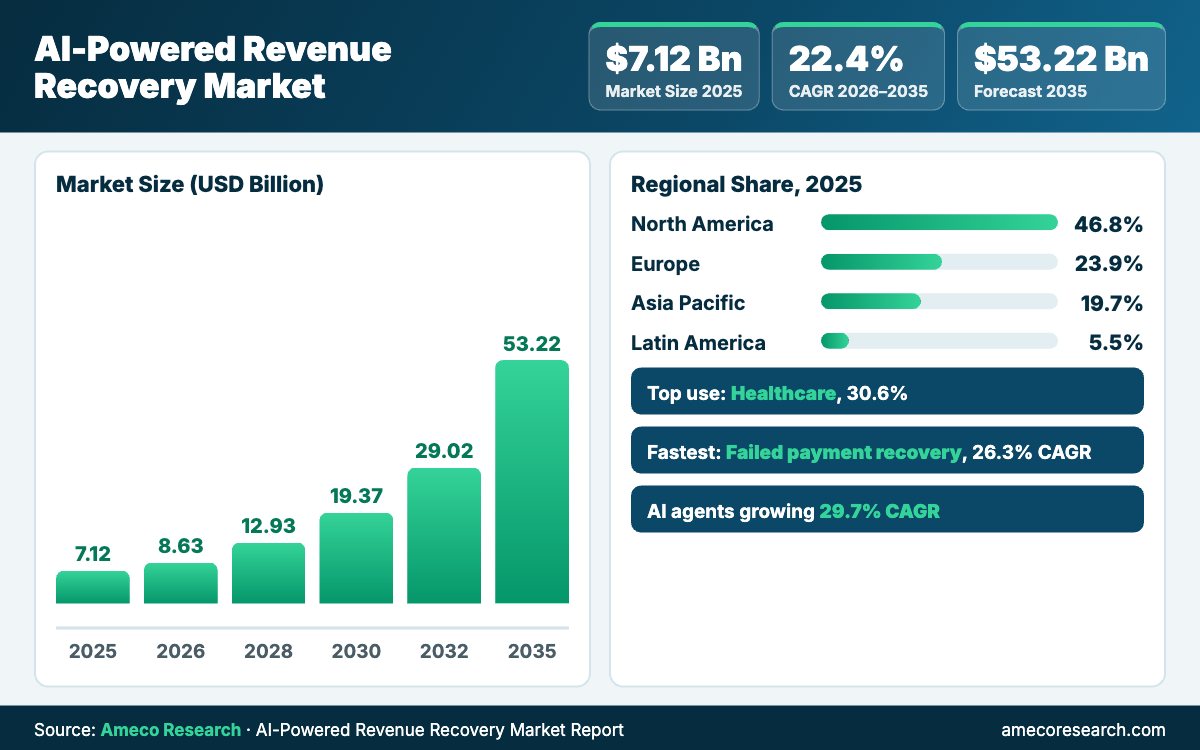
Pune, India, November 28, 2026 — The global AI-powered revenue recovery market is projected to grow from USD 7.12 billion in 2025 to USD 53.22 billion by 2035, at a CAGR of 22.4% from 2026 to 2035, according to the new AI-Powered Revenue Recovery Market report from Ameco Research. The market is estimated at USD 8.63 billion in 2026 as hospitals, subscription businesses, lenders, merchants, and telecom operators use machine learning, generative AI, and AI agents to win back revenue lost to failed payments, claim denials, payer take-backs, unpaid invoices, chargebacks, and billing leakage.
AI-powered revenue recovery refers to software, platforms, and managed services that use artificial intelligence to identify, prioritise, and collect revenue a business has already earned but failed to receive. Typical uses include smart retries and dunning for failed card and subscription payments, healthcare claim denial prevention and appeals, underpayment and payer recoupment recovery, AI-driven collections, chargeback and dispute recovery, and revenue leakage detection in billing and contracts. The revenue at stake is large: Recurly estimates subscription businesses could lose about USD 129 billion to failed payments in 2025, Waystar finds payers take back more than USD 40 billion of provider revenue every year, and Premier estimates U.S. providers spent USD 19.7 billion in a single year fighting claim denials.
AI-Powered Revenue Recovery Market Size and Forecast
Ameco Research estimates the market at USD 8.63 billion in 2026, up about 21% from 2025, as payment providers, revenue cycle vendors, and card networks roll out AI agents for retries, appeals, and disputes. The market is expected to reach about USD 19.37 billion by 2030 and USD 53.22 billion by 2035. Growth runs ahead of overall enterprise AI because recovery tools are often priced on results, giving buyers a direct, measurable return.
| Year | Market Size (USD Billion) |
|---|---|
| 2025 | 7.12 |
| 2026 | 8.63 |
| 2027 | 10.56 |
| 2028 | 12.93 |
| 2030 | 19.37 |
| 2032 | 29.02 |
| 2035 | 53.22 |
Key Takeaways
- Market size: USD 7.12 billion in 2025, about USD 8.63 billion in 2026, and USD 53.22 billion by 2035.
- Growth rate: 22.4% CAGR from 2026 to 2035.
- Leading region: North America, with about 46.8% of 2025 revenue.
- Fastest-growing region: Asia Pacific, at a 26.9% CAGR.
- Leading solution: AI collections and receivables recovery, at 33.1%.
- Fastest-growing solution: Failed payment and involuntary churn recovery, at 26.3% CAGR.
- Leading end use: Healthcare, at 30.6%.
- Fastest technology: Generative AI and conversational AI agents, at 29.7% CAGR.
How Ameco Research Sized the Market
There is no official statistic for AI revenue recovery spending, so Ameco Research sized each recovery pool from published industry data and stated assumptions. In healthcare, about 10% of the USD 19.7 billion U.S. providers spend on denials is assumed to flow to AI tools and AI-enabled services, giving about USD 2.06 billion in 2025. In subscriptions, about half of the USD 129 billion at risk is assumed to be addressed by AI tools, with about 45% recovered and fees averaging about 4.75% of recovered revenue, giving about USD 1.38 billion. Chargeback recovery, AI collections, and revenue leakage audits were sized the same way, and the total was cross-checked against Ameco’s enterprise AI forecast.
What Is Driving the AI-Powered Revenue Recovery Market?
Large and growing revenue leakage
Failed payments, claim denials, payer take-backs, and chargebacks drain hundreds of billions of dollars a year from businesses and health systems.
The subscription economy and rising denials
Recurring billing makes involuntary churn from expired or declined cards a major growth problem, while providers face higher denial rates and more complex payer rules. Experian Health’s 2026 State of Claims report found that 75% of providers say denials are increasing and 64% plan to invest in AI for claims and denial management.
Generative and agentic AI
AI can now draft appeals, assemble dispute evidence, and contact customers by voice and chat at scale — work that previously required large teams.
Clear return on investment
Recovered revenue is easy to measure, and contingency pricing — where vendors take a share of what they recover — removes upfront risk for buyers.
Key Revenue Recovery Trends in 2026
- AI agents take over payment recovery: Butter Payments reported in January 2026 that it recovered 56% more subscription revenue year over year after launching agentic outreach, while Yuno’s NOVA voice and WhatsApp agents recovered up to 75% of failed payments on answered calls in early testing.
- Card networks bring AI to disputes: Visa processed 106 million disputes in 2025 and on April 1, 2026 introduced six AI dispute tools, including a generative AI Dispute Recovery Manager that scores each dispute’s chance of winning and drafts responses.
- Payer take-backs become a target: In April 2026, Waystar added AI that finds payer recoupments; one health system surfaced USD 32 million in previously missed take-backs.
- AI-native appeals platforms: Revecore launched ReClaim in June 2026, trained on more than 750 million claims, doubling appeal-drafting speed and cutting appeal cycle times by 15 to 20 days.
- Results-based pricing: Contingency-fee models are lowering the barrier for mid-sized hospitals, SaaS companies, and merchants.
Challenges
Recovery tools need clean data from billing, EHR, payment, and ERP systems, and integration can be slow. Collections and customer outreach must follow consumer protection, debt collection, and privacy rules, and regulated sectors need auditable, explainable decisions. Insurers and banks are deploying their own AI, creating an automation contest over denials and disputes. Aggressive automated outreach can also damage customer relationships and brand trust.
Segment Analysis
| Solution Type | Share, 2025 | Key Highlights |
|---|---|---|
| AI collections & receivables recovery | 33.1% | Largest; about USD 2.36 billion |
| Healthcare denial, underpayment & recoupment recovery | 28.9% | AI appeals and take-back tracking |
| Failed payment & involuntary churn recovery | 19.4% | Fastest growing at 26.3% CAGR |
| Revenue leakage & recovery audit | 9.9% | Billing, contract, telecom, supplier overpayments |
| Chargeback & dispute recovery | 8.7% | AI dispute evidence and win scoring |
| Technology | Share, 2025 | Key Highlights |
|---|---|---|
| Machine learning & predictive analytics | 44.6% | Scoring, retry timing, denial prediction |
| Generative AI & conversational agents | 23.8% | Fastest growing at 29.7% CAGR |
| NLP & document intelligence | 17.9% | Remittance, contract, claim documents |
| Intelligent automation & RPA | 13.7% | Portal work, status checks, posting |
By component, software and platforms held 64.8% and services, including contingency-fee recovery programmes, 35.2%. Cloud deployment accounted for 79.3%. By end use, healthcare led with 30.6%, followed by BFSI (26.4%), subscription, SaaS, and digital media (14.2%, the fastest growing), retail and e-commerce (12.1%), telecom and utilities (9.3%), and others (7.4%).
Regional Outlook
| Region | Share, 2025 | Outlook |
|---|---|---|
| North America | 46.8% | Largest; U.S. healthcare revenue cycle and subscriptions |
| Europe | 23.9% | Subscriptions, PSD2 payments, collections |
| Asia Pacific | 19.7% | Fastest growing at 26.9% CAGR |
| Latin America | 5.5% | Digital payments and lending in Brazil and Mexico |
| Middle East & Africa | 4.1% | Telecom revenue assurance, digital banking |
The U.S. has the world’s most complex healthcare billing system, with nearly 15% of private-payer claims initially denied, plus the largest subscription economy and a mature collections industry. Asia Pacific is growing fastest on the back of digital payments, buy-now-pay-later, and consumer lending in India and Southeast Asia, and AI voice agents that work in local languages.
Competitive Landscape
Waystar, Experian Health, R1 RCM, FinThrive, Optum, AKASA, and Revecore lead AI denial, underpayment, and recoupment recovery in healthcare. Stripe, Recurly, Chargebee, Butter Payments, Vindicia (Amdocs), and Yuno focus on failed payment recovery; HighRadius, Billtrust, TrueAccord, C&R Software, and FICO serve collections and receivables; Visa (Verifi), Mastercard (Ethoca), Justt, and Chargeflow address disputes; and PRGX and Subex specialise in recovery audit and revenue assurance. For company benchmarking, make an inquiry with Ameco Research.
Opportunities Ahead
- Underpayment and recoupment recovery for hospitals and physician groups.
- Embedded recovery inside payment gateways, billing platforms, and orchestration layers.
- Voice and messaging AI agents for collections and payment updates in local languages.
- B2B receivables automation and fast-growing digital payment markets in Asia Pacific and Latin America.
For related coverage, see Ameco Research’s Healthcare Revenue Cycle Management Market, Agentic AI Market, Enterprise AI Market, and Payment Processing Solutions Market reports.
Report Scope
| Attribute | Details |
|---|---|
| Market size (2025 / 2026) | USD 7.12 billion / USD 8.63 billion |
| Market size (2035) | USD 53.22 billion |
| CAGR (2026–2035) | 22.4% |
| Historical data / base year | 2021–2024 / 2025 |
| Segments covered | Solution type, component, deployment mode, technology, end-use industry, region |
| Regions covered | North America, Europe, Asia Pacific, Latin America, Middle East & Africa |
Who Should Read This Report
- Hospital and health system revenue cycle leaders.
- Subscription, SaaS, and e-commerce finance and payments teams.
- Lenders, collection agencies, and B2B finance teams.
- Recovery software vendors and investors in fintech and health tech.
The full report covers revenue leakage pools, recovery rate benchmarks, SaaS and contingency pricing models, agentic AI adoption, regulation, and company profiles. To access it, buy the report.
Frequently Asked Questions
How big is the AI-powered revenue recovery market?
The market was USD 7.12 billion in 2025, is estimated at USD 8.63 billion in 2026, and is projected to reach USD 53.22 billion by 2035, according to Ameco Research.
What is the growth rate of the AI-powered revenue recovery market?
The market is forecast to grow at a CAGR of 22.4% from 2026 to 2035.
What is AI-powered revenue recovery?
It is the use of AI software and services to identify and collect revenue a business has earned but not received, such as failed payments, denied insurance claims, payer take-backs, unpaid invoices, and chargebacks.
Which industry uses AI revenue recovery the most?
Healthcare is the largest end use at 30.6%, driven by claim denials and payer take-backs, followed by banking, financial services, and insurance at 26.4%.
Who are the leading AI revenue recovery companies?
Key players include Waystar, Experian Health, R1 RCM, AKASA, Stripe, Recurly, Butter Payments, HighRadius, FICO, and Visa (Verifi).
Conclusion
AI-powered revenue recovery is one of the clearest return-on-investment uses of enterprise AI, because every recovered dollar can be measured. With a 22.4% CAGR and a forecast value of USD 53.22 billion by 2035, the market will be shaped by AI agents, results-based pricing, rising claim denials, and the subscription economy’s fight against involuntary churn.
Explore the complete AI-Powered Revenue Recovery Market report for detailed forecasts and competitive analysis.
About Ameco Research
Ameco Research is a market research and consulting firm that provides syndicated reports, custom research, and strategic advisory services across technology, healthcare, energy, automotive, chemicals, and consumer markets. Its analysts combine primary interviews with secondary research to help clients identify growth opportunities and make confident decisions.
Contact Us
Ameco Research
201, Vaidehi-Saaket, Baner - Pashan Link Rd, Pashan, Pune 411021
Phone: +91 898 322 5533
Email: [email protected]
Website: www.amecoresearch.com