Press Release
Solid State Transformer Market to Reach USD 1,603.7 Million by 2035, Growing at 23.4% CAGR | Ameco Research
Date : Nov 17, 2026
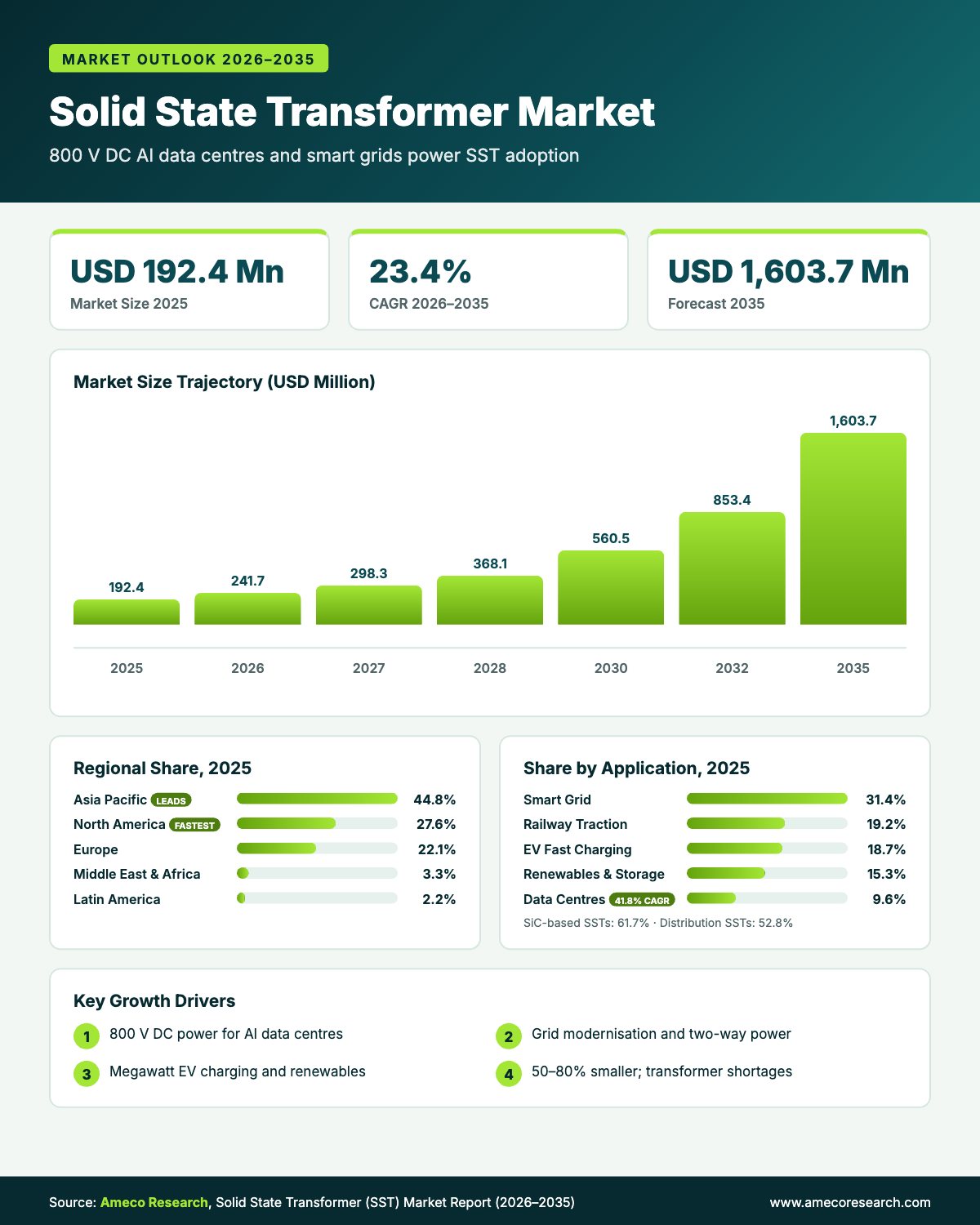
Pune, India, November 17, 2026 — The global solid state transformer (SST) market is projected to grow from USD 192.4 million in 2025 to USD 1,603.7 million by 2035, at a CAGR of 23.4% from 2026 to 2035, according to the new Solid State Transformer (SST) Market report from Ameco Research. The market is estimated at USD 241.7 million in 2026 as AI data centres move to 800 V DC power, utilities modernise distribution grids, and megawatt EV charging and renewable projects need compact, controllable power conversion.
A solid state transformer, also called a power electronic transformer or smart transformer, replaces the heavy copper-and-steel core of a conventional 50/60 Hz transformer with power semiconductors and a compact high-frequency transformer. It typically works in three stages: a rectifier converts medium-voltage AC to DC, an isolated DC/DC converter steps the voltage down at high frequency, and an output stage delivers low-voltage AC or DC. Because every stage is electronically controlled, an SST can regulate voltage, manage power flow in both directions, improve power quality, and provide a native DC connection — capabilities a conventional transformer cannot offer.
Solid State Transformer Market Size and Forecast
Ameco Research estimates the SST market at USD 241.7 million in 2026, up about 26% from 2025. Growth picked up as leading power equipment companies launched or announced medium-voltage SSTs for 800 V DC AI data centres, and the first commercial 800 V DC data centre went live with SSTs. The market is expected to reach about USD 560.5 million by 2030, pass USD 1 billion around 2033, and climb to USD 1,603.7 million by 2035.
| Year | SST Market Size (USD Million) |
|---|---|
| 2025 | 192.4 |
| 2026 | 241.7 |
| 2027 | 298.3 |
| 2028 | 368.1 |
| 2030 | 560.5 |
| 2032 | 853.4 |
| 2035 | 1,603.7 |
Key Takeaways
- Market size: USD 192.4 million in 2025, about USD 241.7 million in 2026, and USD 1,603.7 million by 2035.
- Growth rate: 23.4% CAGR from 2026 to 2035.
- Leading region: Asia Pacific, with about 44.8% of 2025 revenue.
- Fastest-growing region: North America, at a 25.9% CAGR.
- Leading product: Distribution SSTs, at 52.8% of revenue.
- Leading semiconductor: Silicon carbide (SiC), at 61.7%.
- Fastest-growing application: Data centres, at a 41.8% CAGR.
What Is Driving the Solid State Transformer Market?
800 V DC AI data centres
AI rack power densities are rising toward 1 MW, pushing data centre designers toward 800 V DC distribution. NVIDIA’s 800 VDC architecture for next-generation AI factories, announced in May 2025, identified solid state transformers as the way to convert medium-voltage grid power directly to DC. In 2026, Siemens and Reinhausen, Eaton, Enphase, and others announced SSTs for this use, and Envision began running live AI workloads on an 800 V DC system powered by SSTs at its Ulanqab campus in China.
Grid modernisation
Rooftop solar, batteries, and EVs are turning distribution grids into two-way networks. Utilities need voltage control, bidirectional power flow, and real-time monitoring, all of which SSTs provide natively.
Megawatt EV charging and renewable integration
Megawatt charging hubs for electric trucks and buses benefit from compact SSTs that connect chargers directly to medium-voltage lines. Solar, wind, and battery plants gain a direct DC link with fewer conversion steps.
Size, weight, and transformer shortages
SSTs can be 50–80% smaller and lighter than conventional transformers, which matters in data centres, trains, ships, and dense cities. Meanwhile, lead times for conventional distribution and power transformers — often two to four years for large units — are pushing utilities and developers to consider factory-built SSTs that are quicker to install.
Key SST Market Trends in 2026
- Medium-voltage SSTs reach certification: In September 2026, Eaton introduced MVSST 2.0, built with Infineon silicon carbide devices and described as one of the first medium-voltage SST platforms to achieve IEC certification.
- Silicon carbide lowers cost: High-voltage SiC MOSFETs and modules, including 2.3 kV and 3.3 kV devices, allow fewer conversion stages and efficiency of about 98% or more, while falling SiC prices narrow the cost gap with conventional transformers.
- DC microgrids: SSTs are enabling DC microgrids that combine generation, storage, and loads at industrial sites, ports, and campuses.
- New entrants and consolidation: Start-ups such as Amperesand, DG Matrix, and SolidUltra, which raised EUR 3 million in November 2026, are attracting investment, while Eaton agreed in 2025 to acquire SST specialist Resilient Power Systems.
Challenges
SSTs still cost several times more per kVA than conventional transformers. Utilities are used to transformers that last 30 to 40 years, while power electronics still need long-term field data to prove comparable reliability. In pure AC applications, multiple conversion stages can make SST efficiency slightly lower than the best conventional units. Grid codes, protection schemes, and safety standards for SSTs are still developing, and high-voltage SiC devices and high-frequency insulation design remain technically demanding.
SST vs Conventional Transformer: What Changes?
A conventional transformer is a passive device: it changes voltage using magnetic coupling at grid frequency and cannot control what flows through it. An SST is an active power electronic system. Because it converts power to high frequency, its magnetic core can be far smaller, and because every stage is digitally controlled, it can stabilise voltage, correct power quality, limit fault currents, and send power in either direction.
The biggest difference is DC. An SST can supply 800 V DC directly to AI racks, EV chargers, or batteries, removing several separate rectifier and converter stages. For data centres, that means less equipment, less floor space, and fewer conversion losses. The trade-off today is higher upfront cost and less field history, which is why early adoption is concentrated where space, control, and DC power matter most.
Segment Analysis
| Product Type | Share, 2025 | Key Highlights |
|---|---|---|
| Distribution SST | 52.8% | Largest and fastest growing; grid edge, data centres, EV charging |
| Power SST | 28.4% | Substations, HVDC links, utility-scale renewables |
| Traction SST | 18.8% | Lighter onboard transformers for trains and metros |
By component, power electronic converters accounted for 44.1% of SST value, high-frequency transformers 23.7%, control, protection, and monitoring systems 17.4%, and switches, cooling, and enclosures 14.8%. By semiconductor material, SiC held 61.7%, silicon IGBT-based designs 24.6%, and GaN and hybrid designs 13.7%, the fastest-growing material at about 27.3% CAGR. By voltage, medium-voltage SSTs (1–36 kV) accounted for 56.2%, high voltage 26.9%, and low voltage 16.9%.
| Application | Share, 2025 | Key Highlights |
|---|---|---|
| Smart grid & distribution | 31.4% | Largest; voltage control and bidirectional power flow |
| Railway traction | 19.2% | Lighter, more efficient onboard power |
| EV fast charging | 18.7% | Megawatt charging hubs on medium-voltage lines |
| Renewable & storage integration | 15.3% | Solar, wind, and battery DC links |
| Data centres | 9.6% | Fastest growing at 41.8% CAGR; 800 V DC AI power |
| Industrial & others | 5.8% | Microgrids, marine, industrial drives |
Regional Outlook
| Region | Share, 2025 | Outlook |
|---|---|---|
| Asia Pacific | 44.8% | Largest; China grid, rail, EV charging, data centres |
| North America | 27.6% | Fastest growing at 25.9% CAGR |
| Europe | 22.1% | Rail, renewables, data centre pilots |
| Middle East & Africa | 3.3% | Gulf data centre and smart city projects |
| Latin America | 2.2% | Early grid and renewable projects |
China leads SST pilots across distribution grids, high-speed rail, EV charging, and now 800 V DC data centres, while Japan, South Korea, and Taiwan contribute strong power electronics industries. North America is growing fastest on the back of hyperscale AI data centre construction, transformer shortages, Department of Energy grid programmes, and EV charging networks, with Enphase building SST power modules in Texas. Europe builds on its long history of SST research for rail traction.
Competitive Landscape
The market combines large grid equipment makers, data centre power companies, and specialist start-ups. Hitachi Energy, ABB, Siemens, Siemens Energy, and GE Vernova lead in grid and traction applications; Eaton, Delta Electronics, Schneider Electric, Envision, and Sungrow focus on data centre and renewable power; and Enphase, Amperesand, DG Matrix, and SolarEdge are bringing new SST designs to market. Other companies profiled include Mitsubishi Electric and Maschinenfabrik Reinhausen, while silicon carbide suppliers Infineon and Wolfspeed are critical technology partners. For company benchmarking, make an inquiry with Ameco Research.
Opportunities Ahead
- Hyperscale and AI campuses adopting 800 V DC power from 2027 onward.
- Megawatt charging hubs for electric trucks, buses, and fleets.
- DC microgrids for industrial sites, ports, and campuses.
- Lightweight traction transformers and offshore wind, marine, and aerospace uses.
For related coverage, see Ameco Research’s AI Data Center Market, Insulated Gate Bipolar Transistor (IGBT) Market, Substation Market, and Electric Vehicle Charging Station Market reports.
Report Scope
| Attribute | Details |
|---|---|
| Market size (2025 / 2026) | USD 192.4 million / USD 241.7 million |
| Market size (2035) | USD 1,603.7 million |
| CAGR (2026–2035) | 23.4% |
| Historical data / base year | 2021–2024 / 2025 |
| Segments covered | Product type, component, semiconductor material, voltage level, application, region |
| Regions covered | North America, Europe, Asia Pacific, Latin America, Middle East & Africa |
Who Should Read This Report
- Data centre developers and power architects planning 800 V DC designs.
- Utilities, grid operators, and transformer manufacturers.
- EV charging, renewable, and storage developers.
- SiC and power electronics suppliers and investors.
The full report covers SST technology and topologies, SiC and GaN device analysis, cost and pricing, 800 V DC data centre architecture, standards, and company profiles. To access it, buy the report.
Frequently Asked Questions
How big is the solid state transformer market?
The SST market was USD 192.4 million in 2025, is estimated at USD 241.7 million in 2026, and is projected to reach USD 1,603.7 million by 2035, according to Ameco Research.
What is the growth rate of the SST market?
The market is forecast to grow at a CAGR of 23.4% from 2026 to 2035.
What is a solid state transformer used for?
SSTs are used in smart grids, railway traction, EV fast charging, renewable and battery integration, and increasingly in AI data centres that use 800 V DC power.
Why do AI data centres need solid state transformers?
SSTs can convert medium-voltage grid power directly to 800 V DC for high-density AI racks, reducing conversion stages, equipment, and floor space.
Who are the leading SST companies?
Key players include Hitachi Energy, ABB, Siemens, GE Vernova, Eaton, Delta Electronics, Schneider Electric, Envision, and Enphase Energy.
Conclusion
The solid state transformer is moving from pilots and rail niches toward volume deployment. With a 23.4% CAGR and a forecast value of USD 1,603.7 million by 2035, the market will be shaped by 800 V DC AI data centres, falling SiC costs, certification milestones, and grid operators’ need for flexible, controllable power conversion.
Explore the complete Solid State Transformer (SST) Market report for detailed forecasts and competitive analysis.
About Ameco Research
Ameco Research is a market research and consulting firm that provides syndicated reports, custom research, and strategic advisory services across technology, healthcare, energy, automotive, chemicals, and consumer markets. Its analysts combine primary interviews with secondary research to help clients identify growth opportunities and make confident decisions.
Contact Us
Ameco Research
201, Vaidehi-Saaket, Baner - Pashan Link Rd, Pashan, Pune 411021
Phone: +91 898 322 5533
Email: [email protected]
Website: www.amecoresearch.com