Press Release
Sovereign AI Infrastructure Market to Reach USD 441.5 Billion by 2035, Growing at 20.7% CAGR | Ameco Research
Date : Nov 28, 2026
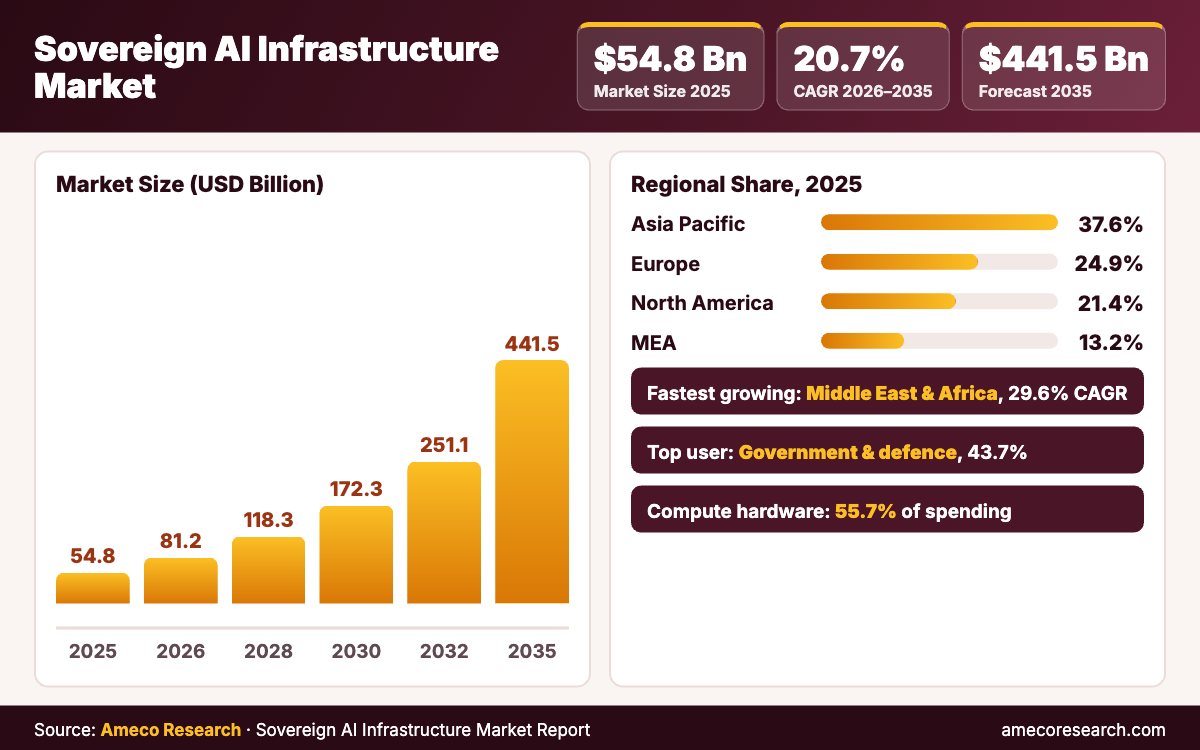
Pune, India, November 28, 2026 — The global sovereign AI infrastructure market is projected to grow from USD 54.8 billion in 2025 to USD 441.5 billion by 2035, at a CAGR of 20.7% from 2026 to 2035, according to the new Sovereign AI Infrastructure Market report from Ameco Research. The market is estimated at USD 81.2 billion in 2026 as governments, national champions, and telecom operators build domestic AI factories, national supercomputers, and sovereign clouds to keep data, models, and compute under national control.
Sovereign AI infrastructure is the computing capacity a nation owns or controls to develop and run artificial intelligence under its own laws and priorities. It includes national AI supercomputers, government and public-private AI data centres (often called AI factories), sovereign cloud platforms run by local providers, GPU and accelerator clusters, high-speed networking and storage, power and cooling, and the software used to train and serve national language models. Sovereign AI has moved from policy debate to large-scale spending: NVIDIA reported that its sovereign AI business more than tripled to over USD 30 billion in fiscal 2026, and countries from Saudi Arabia and the UAE to India, Japan, South Korea, Canada, and the EU are funding national compute.
Sovereign AI Infrastructure Market Size and Forecast
Ameco Research estimates the market at USD 81.2 billion in 2026, up about 48% from 2025, as national AI factories in Europe, the Gulf, and Asia move from announcement to construction and first GPU clusters go live. The market is expected to reach about USD 172.3 billion by 2030 and USD 441.5 billion by 2035. Growth is slightly slower than for AI infrastructure overall because sovereign programmes depend on public budgets and multi-year procurement cycles.
| Year | Market Size (USD Billion) |
|---|---|
| 2025 | 54.8 |
| 2026 | 81.2 |
| 2027 | 98.0 |
| 2028 | 118.3 |
| 2030 | 172.3 |
| 2032 | 251.1 |
| 2035 | 441.5 |
Key Takeaways
- Market size: USD 54.8 billion in 2025, about USD 81.2 billion in 2026, and USD 441.5 billion by 2035.
- Growth rate: 20.7% CAGR from 2026 to 2035.
- Leading region: Asia Pacific, with about 37.6% of 2025 revenue.
- Fastest-growing region: Middle East & Africa, at a 29.6% CAGR.
- Leading component: Compute hardware, at 55.7%; software and platforms are growing fastest at 25.4% CAGR.
- Leading deployment: Sovereign clouds and national-champion AI factories, at 41.3%.
- Leading end user: Government and defence, at 43.7%.
How Ameco Research Sized the Market
There is no official statistic for total sovereign AI spending, so Ameco Research built its estimate from verifiable disclosures and stated assumptions. NVIDIA’s sovereign AI revenue of over USD 30 billion in fiscal 2026 anchors accelerated computing spend. Assuming accelerated computing accounts for about 56% of a sovereign AI build-out, total spending including networking, storage, facilities, power, software, and services comes to about USD 54.8 billion in 2025. National programme pipelines — EU AI gigafactories, the IndiaAI Mission, HUMAIN, Stargate UAE, and programmes in Canada, Japan, and South Korea — were used to check regional shares and the 2026–2028 ramp-up.
What Is Driving the Sovereign AI Infrastructure Market?
Data sovereignty and security
Governments need sensitive citizen, health, and defence data to be processed within national jurisdiction, under national law.
Strategic autonomy
Countries want to reduce reliance on a few foreign cloud providers and secure access to scarce AI chips, treating compute as critical national infrastructure.
Economic competitiveness and language
National compute supports domestic AI start-ups, research, and industry, while national language models need local data and dedicated training capacity to serve citizens in their own languages.
Large public funding programmes
EU, Gulf, Asian, and Canadian programmes are committing tens of billions of dollars to AI compute, often alongside private investment.
Key Sovereign AI Infrastructure Trends in 2026
- Europe moves to AI gigafactories: On July 30, 2026, the EuroHPC Joint Undertaking launched its call for up to seven AI gigafactories, backed by up to EUR 10 billion in public funding and at least EUR 20 billion in private investment. The call closed on November 12, 2026, and Germany raised federal support for a national gigafactory to EUR 1 billion.
- Gulf states build at gigawatt scale: Saudi Arabia’s HUMAIN brought AMD Instinct MI355X systems online in August 2026 and targets 1.9 GW of capacity by 2030, while the UAE’s Stargate UAE campus is planned at 1 GW, with the first 200 MW due in 2026.
- National compute for national models: India’s IndiaAI Mission made more than 45,000 GPUs available to researchers and start-ups by June 2026, and Singapore launched its ASPIRE 2B supercomputer.
- Telecom operators become sovereign AI providers: Deutsche Telekom opened its Industrial AI Cloud in Munich with about 10,000 NVIDIA Blackwell GPUs in February 2026, and SoftBank, Swisscom, Orange, and Telenor offer sovereign compute.
- Hyperscaler sovereign regions: Microsoft, AWS, Google Cloud, and Oracle offer sovereign and dedicated regions that keep data and operations in-country, often with local partners.
- Energy shapes site selection: Campuses are planned around power availability, from Nordic hydropower to Gulf solar and gas.
Challenges
Gigawatt-scale AI campuses cost tens of billions of dollars, straining public budgets, and limited grid capacity and long connection times delay projects. U.S. export controls affect which countries can buy leading accelerators and in what volume. Operating large AI clusters requires scarce engineering talent, and some national clusters risk being underused if local demand and software ecosystems lag behind the hardware.
Segment Analysis
| Component | Share, 2025 | Key Highlights |
|---|---|---|
| Compute hardware (GPU & accelerator systems) | 55.7% | Largest; about USD 30.5 billion |
| Facilities, power & cooling | 16.2% | AI factory buildings, liquid cooling, grid links |
| Networking & storage | 14.6% | InfiniBand, Ethernet, high-performance storage |
| Software & platforms | 7.3% | Fastest growing at 25.4% CAGR |
| Services | 6.2% | Design, integration, managed AI |
| Deployment Model | Share, 2025 | Key Highlights |
|---|---|---|
| Sovereign cloud & national-champion AI factories | 41.3% | Largest and fastest growing |
| Government-owned supercomputers & data centres | 33.6% | National labs, EuroHPC, defence |
| Hyperscaler sovereign & dedicated regions | 18.9% | In-country regions with local control |
| On-premises & hybrid sovereign | 6.2% | Regulated enterprises and agencies |
By workload, training of foundation and national language models accounted for 57.4% of spending in 2025, while inference and AI services held 42.6% and are growing faster at about 24.8% CAGR; Ameco Research expects inference to become the larger workload by 2029. By end user, government and defence led with 43.7%, followed by research and academia (18.2%), telecom and cloud providers (16.9%), BFSI (7.8%), healthcare and life sciences (6.4%), and industrial, energy, and others (7.0%).
Regional Outlook
| Region | Share, 2025 | Outlook |
|---|---|---|
| Asia Pacific | 37.6% | Largest; China, Japan, South Korea, India, Singapore |
| Europe | 24.9% | EU AI factories, gigafactories, telco AI clouds |
| North America | 21.4% | U.S. national labs, Canada’s compute strategy |
| Middle East & Africa | 13.2% | Fastest growing at 29.6% CAGR |
| Latin America | 2.9% | Brazil’s national AI plan |
China is building national computing networks with domestic accelerators, Japan is funding ABCI and private AI infrastructure through SoftBank and Sakura Internet, South Korea is expanding national GPU capacity, and India provides shared GPU access through the IndiaAI Mission. The Gulf is growing fastest, as HUMAIN, G42, and Stargate UAE build gigawatt-scale campuses with low-cost energy and sovereign wealth funding.
Competitive Landscape
NVIDIA is the leading technology supplier to sovereign AI programmes, with AMD and Intel also supplying accelerators. Hewlett Packard Enterprise, Dell, Supermicro, Lenovo, Fujitsu, and Eviden build national supercomputers and AI factories; Oracle, Microsoft, AWS, and Google Cloud offer sovereign and dedicated cloud regions; and national champions such as Deutsche Telekom, SoftBank, G42 (Core42), HUMAIN, Mistral AI, Nscale, Yotta Data Services, NAVER Cloud, and Huawei operate sovereign AI capacity. For company benchmarking or a national programme tracker, make an inquiry with Ameco Research.
Opportunities Ahead
- Public-private AI factories combining government anchor demand with private operators.
- Sovereign inference services for public services, healthcare, finance, and defence.
- Turnkey AI factory solutions from server makers, chip vendors, and integrators.
- Emerging-market programmes and energy-integrated campuses co-located with renewable and nuclear power.
For related coverage, see Ameco Research’s AI Inference Infrastructure Market, AI Data Center Market, GPU as a Service Market, and Enterprise AI Market reports.
Report Scope
| Attribute | Details |
|---|---|
| Market size (2025 / 2026) | USD 54.8 billion / USD 81.2 billion |
| Market size (2035) | USD 441.5 billion |
| CAGR (2026–2035) | 20.7% |
| Historical data / base year | 2021–2024 / 2025 |
| Segments covered | Component, deployment model, workload, end user, region |
| Regions covered | North America, Europe, Asia Pacific, Latin America, Middle East & Africa |
Who Should Read This Report
- Government digital, defence, and research agencies planning national compute.
- Telecom operators, cloud providers, and national AI champions.
- Chipmakers, server vendors, and data centre developers.
- Investors and sovereign funds tracking AI infrastructure.
The full report includes a national AI programme tracker, the AI factory and gigafactory pipeline in MW and GPUs, sovereign cloud and export-control analysis, and company profiles. To access it, buy the report.
Frequently Asked Questions
How big is the sovereign AI infrastructure market?
The market was USD 54.8 billion in 2025, is estimated at USD 81.2 billion in 2026, and is projected to reach USD 441.5 billion by 2035, according to Ameco Research.
What is the growth rate of the sovereign AI infrastructure market?
The market is forecast to grow at a CAGR of 20.7% from 2026 to 2035.
What is sovereign AI infrastructure?
It is the AI computing capacity a nation owns or controls — national supercomputers, AI factories, sovereign clouds, and supporting networking, storage, power, and software — used to develop and run AI under its own laws.
Which region is growing fastest?
The Middle East & Africa is the fastest-growing region at a 29.6% CAGR, led by Saudi Arabia and the UAE, while Asia Pacific is the largest market.
Who are the leading sovereign AI infrastructure companies?
Key players include NVIDIA, AMD, HPE, Dell, Oracle, Microsoft, AWS, Google Cloud, Deutsche Telekom, SoftBank, G42, HUMAIN, and Mistral AI.
Conclusion
Compute has become a matter of national strategy. With a 20.7% CAGR and a forecast value of USD 441.5 billion by 2035, the sovereign AI infrastructure market will be shaped by Europe’s gigafactories, Gulf gigawatt campuses, Asian national compute programmes, and the shift from training national models to serving them to citizens and industry.
Explore the complete Sovereign AI Infrastructure Market report for detailed forecasts and competitive analysis.
About Ameco Research
Ameco Research is a market research and consulting firm that provides syndicated reports, custom research, and strategic advisory services across technology, healthcare, energy, automotive, chemicals, and consumer markets. Its analysts combine primary interviews with secondary research to help clients identify growth opportunities and make confident decisions.
Contact Us
Ameco Research
201, Vaidehi-Saaket, Baner - Pashan Link Rd, Pashan, Pune 411021
Phone: +91 898 322 5533
Email: [email protected]
Website: www.amecoresearch.com