Press Release
Data Center Battery Market to Reach USD 6,012.6 Million by 2035 at 5.3% CAGR as Lithium-Ion Replaces Lead-Acid
Date : Nov 04, 2026
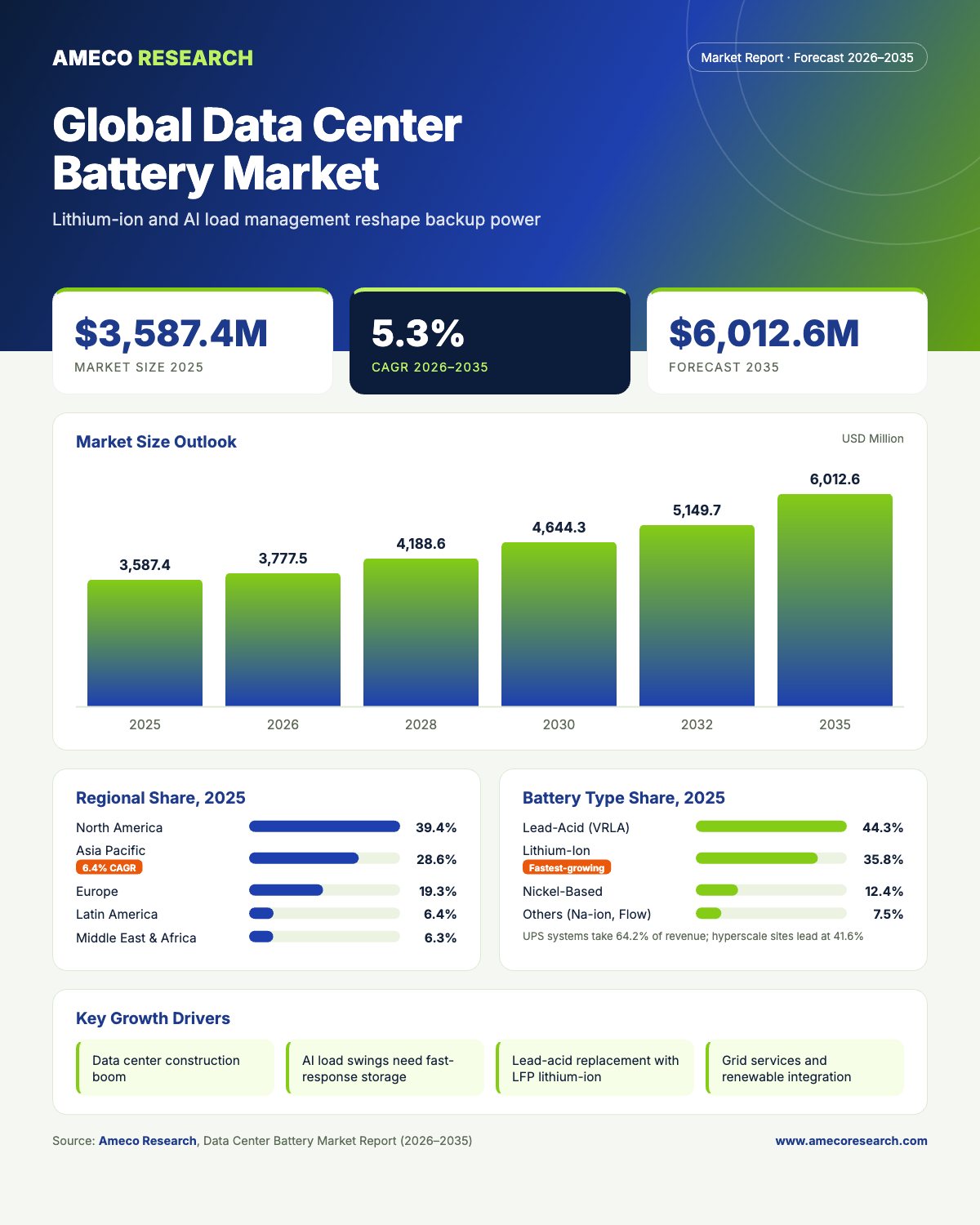
Pune, India, November 8, 2026 — The global Data Center Battery Market was valued at USD 3,587.4 million in 2025 and is projected to reach USD 6,012.6 million by 2035, growing at a CAGR of 5.3% from 2026 to 2035, according to the latest Data Center Battery Market report by Ameco Research. The market is estimated at USD 3,777.5 million in 2026. Battery volumes are rising much faster than revenue, because lithium-ion cell prices have fallen sharply and each lithium-ion system replaces several generations of shorter-lived lead-acid batteries.
Data center batteries keep servers, storage, and network equipment running when grid power fails or fluctuates. They sit mainly inside uninterruptible power supply (UPS) systems, bridging the minutes until backup generators start, and are increasingly used in battery energy storage systems (BESS) for peak shaving, load balancing, and grid services. The 180-page study covers battery chemistries, capacity classes, data center types, applications, regional demand, and the suppliers competing for this shift.
Data Center Battery Market Size and Growth Outlook
The market is going through a major technology change. Valve-regulated lead-acid (VRLA) batteries still make up the largest installed base, but operators are moving to lithium-ion, mostly lithium iron phosphate (LFP), for longer life, a smaller footprint, and lower total cost of ownership. At the same time, AI training clusters with sharp, fast-changing power demand are turning batteries from passive backup into active power management assets.
| Year | Market Size (USD Million) |
|---|---|
| 2025 (Base Year) | 3,587.4 |
| 2026 | 3,777.5 |
| 2028 | 4,188.6 |
| 2030 | 4,644.3 |
| 2032 | 5,149.7 |
| 2035 | 6,012.6 |
Key Takeaways
- Market size 2025: USD 3,587.4 million, rising to USD 6,012.6 million by 2035
- Growth rate: 5.3% CAGR from 2026 to 2035
- Leading region: North America, with about 39.4% of 2025 revenue
- Fastest-growing region: Asia Pacific, at a 6.4% CAGR
- Battery type: Lead-acid leads with 44.3%; lithium-ion (35.8%) is the fastest-growing chemistry
- Data center type: Hyperscale facilities account for 41.6% of demand, followed by colocation at 26.5%
- Application: UPS systems take 64.2% of revenue, ahead of backup power at 20.6%
What Is Driving Demand for Data Center Batteries?
A Data Center Construction Boom
Cloud computing, AI, streaming, and digital services are driving record hyperscale and colocation capacity additions, and every new hall needs battery backup. Outages can cost operators hundreds of thousands of dollars per hour, so reliable UPS batteries are essential for Tier III and Tier IV facilities.
AI and High-Density Computing
GPU racks need stable, clean power and a fast response to grid disturbances. AI training clusters can swing power demand by tens of megawatts in seconds, and batteries now smooth those swings, protect hardware, and stabilize the grid connection. Industry estimates suggest energy storage linked to AI data centers could reach about 300 GWh of demand by 2030.
Lead-Acid Replacement and Grid Services
Short VRLA lifespans create a steady replacement cycle, and much of it is shifting to lithium-ion. Batteries also help data centers use more solar and wind power, shave peak demand, and earn revenue from grid support programs.
Data Center Battery Market Trends in 2026
- Lithium-ion takes over new builds: Most new hyperscale and colocation halls specify LFP UPS batteries, which offer 10–15 year lifespans, 50–70% smaller footprints, and lower cooling needs than VRLA.
- Medium-voltage UPS and grid ride-through: New medium-voltage UPS systems use batteries to ride through grid faults instead of disconnecting, and around 3 GW of such projects are operating or under construction in the U.S.
- Batteries as a bridge to grid power: Long waits for grid connections are pushing operators to install large on-site BESS. In August 2026, Cummins won its largest BESS contract, a 5 MWh LFP system for a U.S. data center that manages AI load swings.
- Falling LFP cell prices: Large-format 314Ah LFP cells were trading around USD 0.05 per Wh in mid-2026, making lithium-ion cost-competitive with lead-acid over its lifetime.
- Second-life and new chemistries: Repurposed EV batteries and sodium-ion cells are emerging as lower-cost options. In May 2026, Cleantech Energy Company raised USD 40 million to scale storage systems built from second-life EV batteries for data centers.
Challenges
Lithium-ion systems, battery management, and monitoring still cost more upfront, which can deter small and mid-sized operators. Installations must meet fire safety standards such as UL 9540A and NFPA 855, adding design, testing, and insurance requirements. Switching existing halls from lead-acid can require changes to UPS, cooling, and safety systems, while dependence on lithium, graphite, and cell manufacturing in a few countries exposes buyers to price swings and trade restrictions. Growing battery volumes also need recycling and end-of-life solutions.
Segment Analysis
By Battery Type
| Battery Type | Share (2025) | Key Highlights |
|---|---|---|
| Lead-Acid (VRLA) | 44.3% | Lowest upfront cost; large installed base; 3–6 year life |
| Lithium-Ion | 35.8% | Fastest-growing; 10–15 year life; smaller footprint |
| Nickel-Based (NiZn, NiCd) | 12.4% | High power density and wide temperature tolerance |
| Others (Sodium-Ion, Flow) | 7.5% | Emerging low-cost and long-duration options |
Lithium-ion is expected to become the largest chemistry within the forecast period as new hyperscale and colocation sites standardize on LFP.
By Battery Capacity
Medium-scale batteries held 46.5% in 2025, serving typical enterprise and colocation UPS systems. Small-scale batteries accounted for 42.6%, used in server rooms, edge sites, and rack-level UPS. Large-scale systems held 10.9% but are growing fastest as hyperscale and AI campuses add megawatt-scale storage.
By Data Center Type and Application
Hyperscale data centers accounted for 41.6% of demand, colocation 26.5%, enterprise 21.4%, and edge 10.5%. UPS systems took 64.2% of revenue and backup power systems 20.6%, while energy storage, peak shaving, and load balancing (15.2%) is the fastest-growing application.
Regional Outlook
| Region | Share (2025) | Outlook |
|---|---|---|
| North America | 39.4% | Largest market; U.S. hyperscale and AI campus construction |
| Asia Pacific | 28.6% | Fastest-growing at a 6.4% CAGR; China, India, Japan, Singapore |
| Europe | 19.3% | Germany, U.K., Ireland, Netherlands, and the Nordics; sustainability rules |
| Latin America | 6.4% | New capacity in Brazil, Mexico, and Chile |
| Middle East & Africa | 6.3% | Gulf AI campuses and South African data center hubs |
The U.S. hosts the largest concentration of hyperscale and AI data centers, in markets such as Northern Virginia, Texas, Arizona, Ohio, and California, and federal energy storage tax credits and grid connection delays support large battery deployments. China is Asia Pacific's largest market and home to CATL, BYD, and Narada, while EU sustainability rules and high electricity prices encourage European operators to deploy lithium-ion batteries that can also balance the grid.
Leading Companies
The market includes UPS and power infrastructure suppliers, established lead-acid manufacturers, and large lithium-ion cell makers. Competition centers on battery life, energy density, safety certification, total cost of ownership, monitoring software, and the ability to supply complete battery cabinets and storage systems for large campuses. Companies profiled include Vertiv, Eaton, Schneider Electric, EnerSys, East Penn Manufacturing, C&D Technologies, Exide Technologies, GS Yuasa, Samsung SDI, LG Energy Solution, Panasonic, CATL, BYD, Narada Power, Huawei Digital Power, and Saft (TotalEnergies).
Want details on supplier profiles, pricing, or methodology? Make an Inquiry with an Ameco Research analyst.
Opportunities Through 2035
- Grid-interactive UPS: Data centers can sell frequency regulation and demand response services to utilities.
- Large-scale BESS for AI campuses: Batteries can bridge delayed grid connections and replace part of diesel generator capacity.
- Renewable integration: Operators pursuing 24/7 carbon-free energy need storage to firm solar and wind supply.
- Sodium-ion and second-life batteries: These offer lower-cost, safer storage for backup applications.
- Edge data centers: Remote and urban sites need compact, maintenance-free lithium-ion backup.
For related infrastructure coverage, see Ameco Research's Data Center Cooling Market report, the AI Data Center Market analysis, the Battery Technology Market report, and the Energy Storage as a Service Market study.
Report Scope
| Report Attribute | Details |
|---|---|
| Market Size in 2025 | USD 3,587.4 Million |
| Market Forecast in 2035 | USD 6,012.6 Million |
| CAGR (2026–2035) | 5.3% |
| Base Year | 2025 |
| Historical Data | 2021–2024 |
| Forecast Period | 2026–2035 |
| Segments Covered | Battery Type, Battery Capacity, Data Center Type, Application, Region |
| Regions Covered | North America, Europe, Asia Pacific, Latin America, Middle East & Africa |
| Report Coverage | Market size and forecast, trends, drivers, restraints, opportunities, segment and regional analysis, competitive landscape, recent developments |
| Pages | 180 |
Who Should Read This Report?
- Data center operators and colocation providers planning UPS upgrades and lithium-ion migration.
- UPS, battery, and energy storage suppliers sizing demand by chemistry, capacity, and region.
- Investors and infrastructure funds assessing battery makers and data center power assets.
- Utilities and grid operators exploring data center flexibility and grid services.
- Consultants and engineering firms advising on resilience, fire safety, and energy strategy.
The study supports investment planning with ten-year forecasts, business strategy with segment shares and growth rates, market entry with regional and country analysis, and competitive intelligence with supplier profiles and recent deals. Buy the Data Center Battery Market Report for immediate access.
Conclusion
The Data Center Battery Market is shifting from lead-acid backup to lithium-ion power management. With revenue forecast to rise from USD 3,587.4 million in 2025 to USD 6,012.6 million by 2035 at a 5.3% CAGR, suppliers that combine long-life LFP chemistry, strong safety certification, and grid-interactive capability will be best placed to serve the AI era. Ameco Research's report gives operators, suppliers, and investors the data to plan that transition.
Explore the Data Center Battery Market Report
Preview the data and methodology, ask about pricing and coverage, get the complete 180-page study, or request extra segments, country-level data, and research beyond the report’s scope.
About Ameco Research
Ameco Research is a market research and consulting firm that provides syndicated reports, customized research, and data-driven insight across industries including energy and power, ICT, automotive, healthcare, and chemicals. Its analysts help businesses, investors, and institutions find growth opportunities and make informed strategic decisions.
Contact Us
Ameco Research
201, Vaidehi-Saaket, Baner - Pashan Link Rd, Pashan, Pune, Maharashtra 411021, India
Phone: +91 898 322 5533
E-mail: [email protected]
Website: www.amecoresearch.com