Press Release
GPU as a Service Market to Reach USD 111.97 Billion by 2035, Growing at 30.1% CAGR | Ameco Research
Date : Nov 12, 2026
Pune, India, November 12, 2026 — The global GPU-as-a-Service (GPUaaS) market is forecast to grow from USD 8.06 billion in 2025 to USD 111.97 billion by 2035, advancing at a CAGR of 30.1% from 2026 to 2035, according to the new GPU as a Service Market report from Ameco Research. Demand for AI model training and inference is outpacing what most organisations can build on their own, making on-demand access to accelerated computing one of the fastest-growing areas of cloud infrastructure.
GPU-as-a-Service gives businesses remote access to graphics processing units through the cloud, billed by the hour, by reservation, or by subscription. Instead of buying and housing expensive accelerators, AI developers, research teams, studios, and enterprises rent capacity from hyperscalers and specialist “neocloud” providers. The report finds that long-term capacity contracts worth billions of dollars, along with the rise of sovereign AI clouds, are reshaping how GPU computing is bought and sold.
GPU as a Service Market Size and Forecast
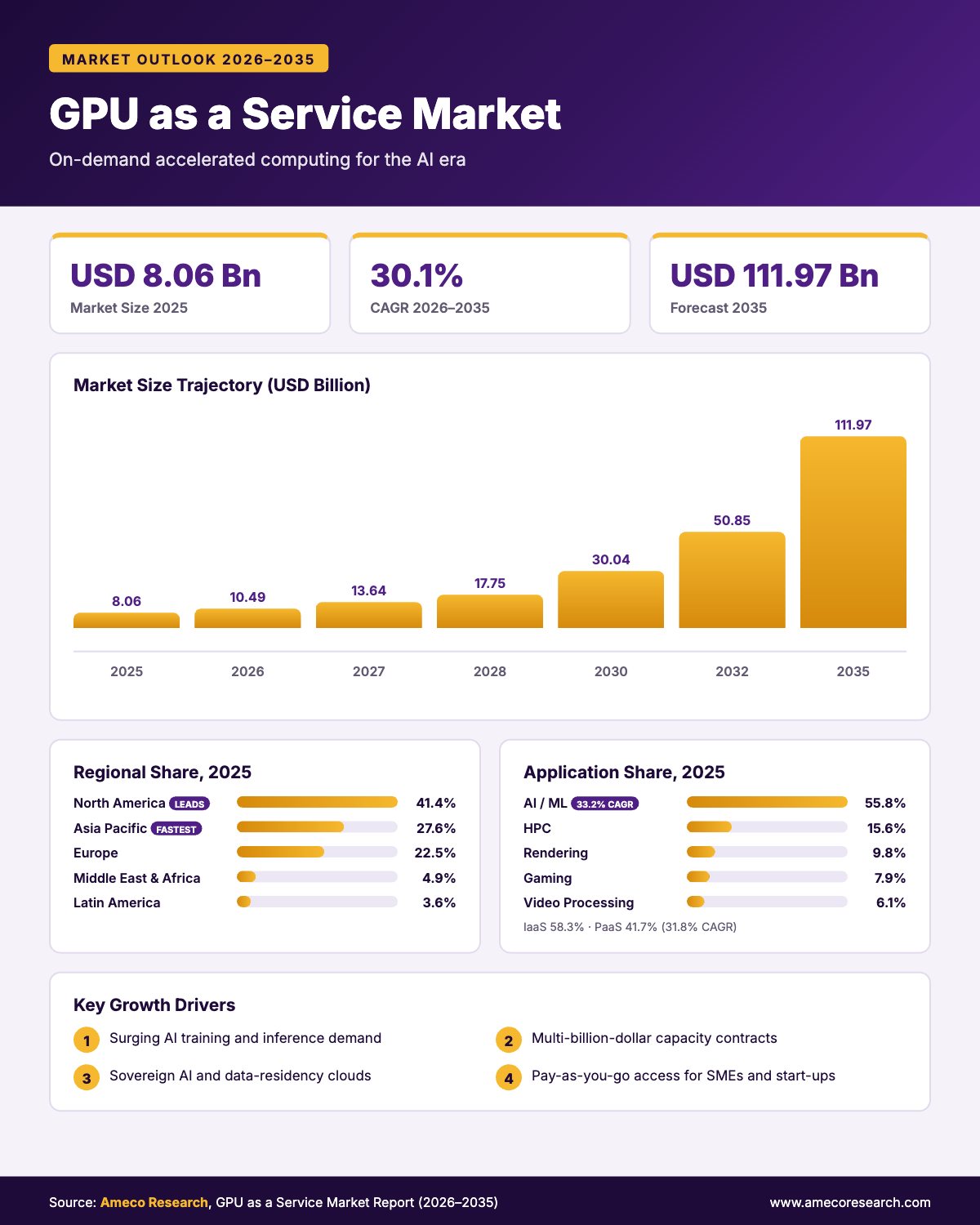
Ameco Research sizes the market at USD 8.06 billion in 2025, rising to USD 10.49 billion in 2026 and USD 30.04 billion by 2030. Expanding inference workloads, broader enterprise adoption, and new data centre capacity are expected to lift the market to USD 111.97 billion by 2035.
| Year | Market Size (USD Billion) |
|---|---|
| 2025 | 8.06 |
| 2026 | 10.49 |
| 2027 | 13.64 |
| 2028 | 17.75 |
| 2030 | 30.04 |
| 2032 | 50.85 |
| 2035 | 111.97 |
Key Takeaways
- Market size: USD 8.06 billion in 2025, forecast to reach USD 111.97 billion by 2035.
- Growth rate: 30.1% CAGR from 2026 to 2035.
- Leading region: North America, with a 41.4% share (about USD 3.34 billion) in 2025.
- Fastest-growing region: Asia Pacific, at a 34.2% CAGR.
- Top application: AI and machine learning, at 55.8% of revenue and a 33.2% CAGR.
- Fastest-growing deployment: Hybrid and multi-cloud, at a 36.1% CAGR.
What Is Driving the GPU as a Service Market?
AI training and inference need far more compute
Frontier model developers need tens of thousands of GPUs for training runs, and every product built on those models needs inference capacity to serve users. Few organisations can buy, power, and cool that hardware fast enough, so renting has become the default. As AI agents and reasoning models increase compute per query, inference is becoming a growing share of GPU cloud demand.
Multi-billion-dollar capacity contracts
The report tracks a series of large, multi-year agreements. CoreWeave signed an expanded deal with Meta worth about USD 21 billion running to December 2032, announced in April 2026. Nebius agreed a USD 17.4 billion capacity contract with Microsoft in September 2025. Lambda reportedly signed an agreement with Anthropic worth around USD 35 billion for roughly 350 MW of capacity in Texas in August 2026, and Perplexity contracted CoreWeave for Grace Blackwell-based inference in March 2026. Such contracts give providers the revenue visibility needed to finance new data centres.
Sovereign AI and data residency
Governments and regulated industries increasingly want AI computing that stays within national borders. Providers such as OVHcloud, Scaleway, and IONOS in Europe, Yotta in India, and Sakura Internet in Japan are building sovereign GPU clouds, often with public support. This trend spreads demand beyond the major U.S. hyperscalers.
Lower barriers for SMEs and start-ups
Pay-as-you-go access and developer-friendly platforms let smaller companies fine-tune models, run simulations, or render content without capital spending. SMEs are the fastest-growing customer group at a 33.4% CAGR.
Key Market Trends
- Rise of neoclouds: GPU-focused providers such as CoreWeave, Nebius, Lambda, and Crusoe are winning large contracts by offering faster access to the latest NVIDIA systems.
- Power as the bottleneck: Access to grid capacity, not chips alone, now determines how fast providers can grow, pushing investment into new sites and on-site generation.
- Reserved-capacity pricing: Buyers are locking in multi-year reservations to secure supply, while spot markets serve flexible workloads.
- Liquid-cooled racks: High-density GPU systems are accelerating adoption of direct-to-chip liquid cooling.
- Managed AI platforms: Providers are bundling orchestration, model serving, and storage on top of raw GPU capacity to move up the value chain.
Challenges
Supply of the most advanced GPUs, high-bandwidth memory, and power remains tight, which can delay customer projects. Neocloud providers rely heavily on debt financing and a small number of large customers, creating concentration risk. Rapid hardware cycles can shorten the useful life of installed fleets, and price competition is intensifying for older GPU generations. Export controls and data-sovereignty rules also complicate cross-border offerings. The report notes that providers with secured power, strong balance sheets, and diversified customers are best positioned.
Build or Rent? Why Buyers Are Choosing GPU as a Service
For most organisations, the decision to rent rather than own GPUs comes down to speed, risk, and utilisation. Building an in-house cluster means securing scarce hardware, finding data centre space with enough power and cooling, and hiring specialists to run it, a process that can take a year or more. Renting capacity can be arranged in days or weeks.
Hardware cycles are another factor. New GPU generations arrive roughly every one to two years, each with large gains in performance per watt. Owners risk being left with older systems that are less competitive, while cloud customers can move to newer instances as they launch. Utilisation also matters: many teams need large bursts of compute for training, followed by quieter periods. Pay-as-you-go and spot pricing match spending to actual use.
The report notes that the largest AI developers often combine both models, owning some capacity while signing long-term reservations with cloud providers for the rest. Enterprises are following a similar hybrid path, which explains the 36.1% CAGR for hybrid and multi-cloud deployment.
Segment Analysis
By service model, infrastructure-as-a-service led with 58.3% in 2025, while platform-as-a-service (41.7%) is growing faster at a 31.8% CAGR as buyers seek managed tooling. By GPU type, high-end GPUs held 67.2%, followed by mid-range (25.6%) and low-end (7.2%). Public cloud represented 62.4% of deployment, hybrid and multi-cloud 20.6%, and private cloud 17.0%. Large enterprises accounted for 71.3% of spending, with SMEs at 28.7%.
| Pricing Model | Share, 2025 |
|---|---|
| Pay-as-you-go | 41.6% |
| Reserved instances | 28.7% |
| Subscription | 17.8% |
| Spot instances | 11.9% |
| Application | Share, 2025 | Note |
|---|---|---|
| AI / machine learning | 55.8% | Largest and fastest growing, 33.2% CAGR |
| High-performance computing | 15.6% | Scientific simulation, engineering |
| Rendering & visualisation | 9.8% | VFX, design, digital twins |
| Gaming | 7.9% | Cloud gaming and game development |
| Video processing | 6.1% | Encoding and streaming |
| Data analytics & others | 4.8% | — |
By end user, IT and telecom led with 23.6%, followed by BFSI (12.8%), healthcare and life sciences (11.3%), automotive (9.1%), manufacturing (8.4%), media and entertainment (8.1%), gaming (7.2%), retail (6.0%), government (5.1%), energy (4.4%), and others (4.0%).
Regional Outlook
| Region | Share, 2025 | Highlights |
|---|---|---|
| North America | 41.4% | About USD 3.34 billion; hyperscalers and neoclouds |
| Asia Pacific | 27.6% | Fastest growing at 34.2% CAGR; sovereign AI programmes |
| Europe | 22.5% | Data-sovereign GPU clouds |
| Middle East & Africa | 4.9% | National AI data centre projects |
| Latin America | 3.6% | Emerging cloud regions |
North America’s lead reflects the concentration of AI labs and the largest cloud providers. Asia Pacific is expanding fastest as India, Japan, South Korea, and Southeast Asian governments invest in national GPU capacity and as Alibaba Cloud and Tencent Cloud expand AI infrastructure.
Competitive Landscape
The market combines hyperscalers with specialist GPU clouds. Key companies profiled include NVIDIA (DGX Cloud), Amazon Web Services, Microsoft Azure, Google Cloud, Oracle Cloud Infrastructure, CoreWeave, Nebius, Lambda, Crusoe, Vultr, Alibaba Cloud, Tencent Cloud, OVHcloud, Fluidstack, RunPod, and Yotta Data Services. Providers compete on access to the newest GPUs, secured power, network performance, price, and software tooling. Readers who need provider benchmarking or pricing analysis can make an inquiry with the Ameco Research team.
Opportunities Ahead
- Inference-optimised GPU clouds for agentic and reasoning workloads.
- Sovereign and industry-specific GPU clouds for regulated sectors.
- GPU marketplaces and fractional GPU offerings for SMEs and researchers.
- Energy-efficient, liquid-cooled facilities in power-rich regions.
Related insights are available in Ameco Research’s AI Data Center Market, Data Center Cooling Market, Server Market, and Agentic AI Market reports.
Report Scope
| Attribute | Details |
|---|---|
| Market size (2025) | USD 8.06 billion |
| Market size (2035) | USD 111.97 billion |
| CAGR (2026–2035) | 30.1% |
| Segments covered | Service model, GPU type, deployment, pricing model, enterprise size, application, end user, region |
| Regions covered | North America, Europe, Asia Pacific, Latin America, Middle East & Africa |
Who Should Read This Report
- Cloud and data centre operators planning GPU capacity.
- AI developers and enterprises comparing build-versus-rent strategies.
- Investors and lenders assessing neocloud and AI infrastructure opportunities.
- Semiconductor, power, and cooling suppliers to the AI compute supply chain.
The complete study includes detailed segment forecasts, country-level data, and provider profiles. To access the full analysis, buy the report.
Frequently Asked Questions
How big is the GPU as a Service market?
The global GPU-as-a-Service market was valued at USD 8.06 billion in 2025 and is projected to reach USD 111.97 billion by 2035, according to Ameco Research.
What is the growth rate of the GPU as a Service market?
The market is forecast to grow at a CAGR of 30.1% from 2026 to 2035.
Which application drives GPUaaS demand?
AI and machine learning account for 55.8% of revenue and are growing at a 33.2% CAGR, driven by model training and inference.
Which region leads the GPU as a Service market?
North America held the largest share at 41.4% in 2025, while Asia Pacific is the fastest-growing region at a 34.2% CAGR.
Who are the leading GPU cloud providers?
Key providers include NVIDIA DGX Cloud, AWS, Microsoft Azure, Google Cloud, Oracle Cloud Infrastructure, CoreWeave, Nebius, Lambda, and Crusoe.
Conclusion
GPU-as-a-Service has become the main way the world accesses AI computing. With a 30.1% CAGR and a forecast value of USD 111.97 billion by 2035, the market will be shaped by long-term capacity contracts, the race for power, sovereign AI programmes, and the shift from training to inference.
Explore the complete GPU as a Service Market report for full forecasts and competitive analysis.
About Ameco Research
Ameco Research is a market research and consulting firm that provides syndicated reports, custom research, and strategic advisory services across technology, healthcare, energy, automotive, chemicals, and consumer markets. Its analysts combine primary interviews with secondary research to help clients identify growth opportunities and make confident decisions.
Contact Us
Ameco Research
201, Vaidehi-Saaket, Baner - Pashan Link Rd, Pashan, Pune 411021
Phone: +91 898 322 5533
Email: [email protected]
Website: www.amecoresearch.com